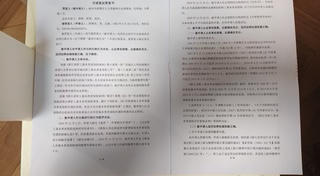
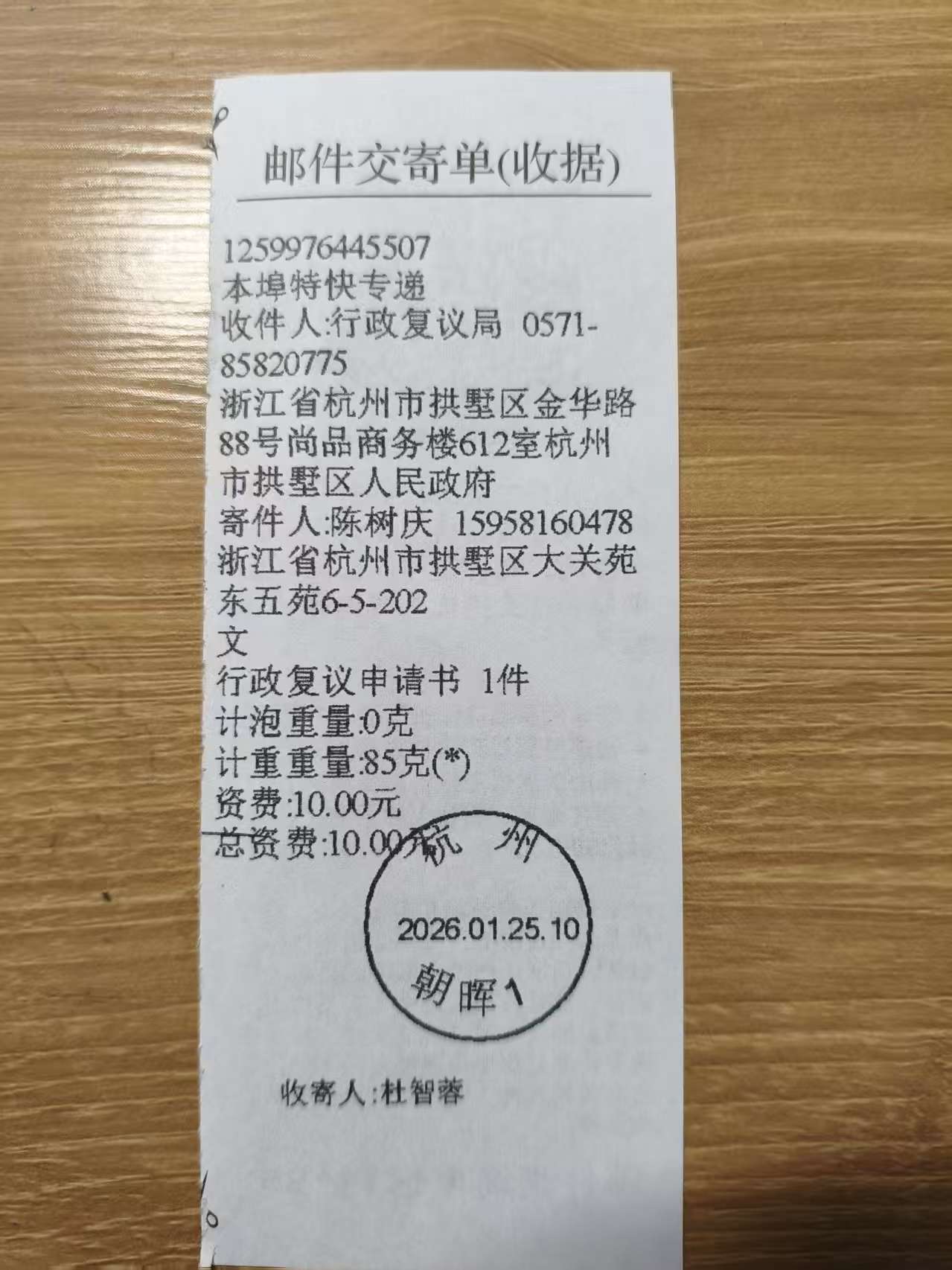
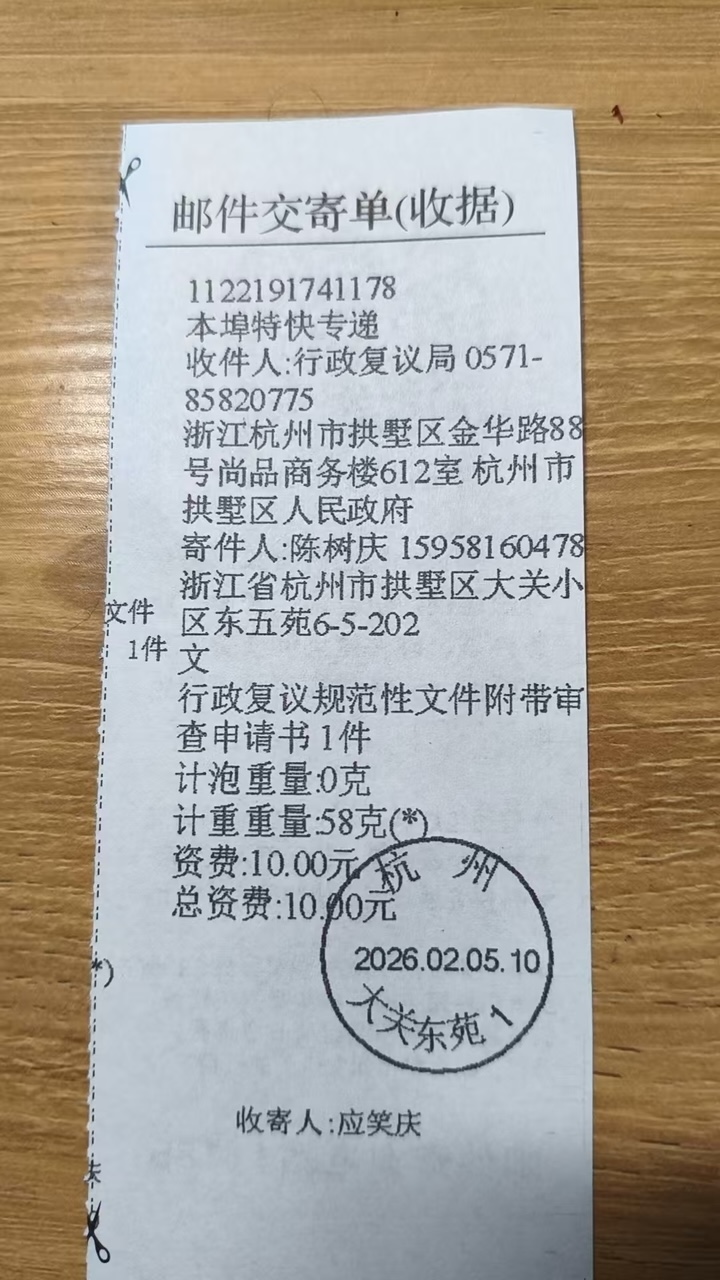
杭州市拱墅区行人民政府(政复议局):
申述人陈树庆,杭拱政复[2006]67号的行政复议申请人(以下称申请人)。
2006年3月2日下午,根据《中华人民共和国行政复议法》第四十七条的规定,申请人到杭州市拱墅区行政复议局查阅并复制本行政复议案被申请人杭州市拱墅区人力资源和社会保障局的《行政复议答复书》和其他有关材料。
在收到上述《答复书》等有关材料之前,申请人在与被申请人交涉中从未收到如此详细的被申请人关于其履职的书面理由和依据,同时发现对本案《行政复议申请书》中提出的被申请复议的行政行为不合理、不合法主张,《答复书》既无认可也没有反驳与否定,现申请人对《答复书》进行必要的事实补充说明及针对性申述。
一、关于申请人的除名、视同缴费年限问题,《行政复议答复书》写有“1995年7月申请人被做除名处理,故被申请人对其视同缴费年限认定为0年0个月,申请人的连续工龄应从其参加养老保险之日1992年4月起计算。”
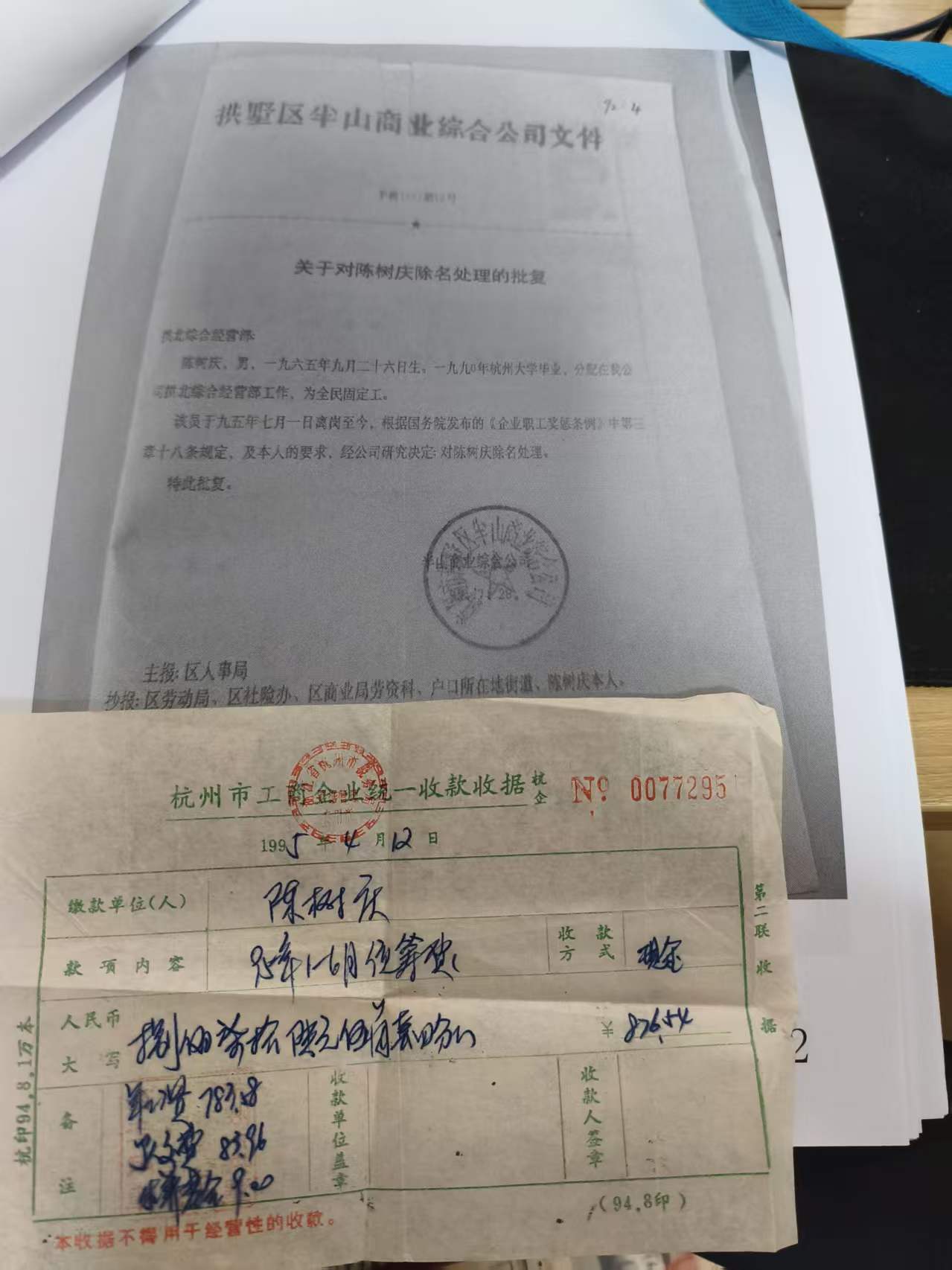
首先,拱墅区半山商业综合公司《关于对陈树庆除名处理的批复》里对申请人除名的理由“1995年7月1日离岗至今”还是当月匆匆忙忙做出的除名决定,如果扣除的视同缴费期间为1995年7月1日所谓“离岗”至做出决定期间,当然名正言顺,但扣除的是我在单位1991年12月至1992年3月无任何过错的4个月上班期间,是否适当?
1995年7月拱墅区半山商业综合公司《关于对陈树庆除名处理的批复》,里面所描述“该员于95年7月1日离岗至今”是虚构的、不符合我与该公司约定。 实际情况是单位本身经营长期不善(老国有商业单位受大量专业市场、综合市场个体商贩的冲击),早在一年多以前已停发工资,随后我提出承包业务,但因没有提供我为单位创收所需要的条件(看中的营业场地被别人租走),只好约定允许申请人陈树庆自谋生计,人事关系继续挂靠在单位并代为缴纳社保,当然实际费用都由陈树庆自己提供(见申请人前些天家中翻箱倒柜才找出的,在本《申述》的附件:陈树庆向单位支付的代缴社保费用《杭州市工商企业统一收款收据》0077295号为证),这种情况下,当然就不存在所谓的“离岗”还是“在岗”问题了。在通知我“除名”前我没有告知将要除名的理由及维权途径,我当时也只是把它当作单位的单方面解约行为,将“除名”与辞退、辞职之间的实际意思与后果没有去认真了解与分辨。
虽然这种“除名”从一定程度也反映了社会法治不健全情况下,公民个体法治意识尤其是维权意识欠缺情况下的弱势。总之,由于申请人对于自己职工权利的无知及所谓“除名”后疏于维权,也由于扣除的视同缴费年限实际只有4个月,所以在本案提出的复议请求按24年4个月的缴费年限办理养老金审定中,并没有包含这4个月的视同缴费期间。既然被申请人在《行政复议答复书》把这个问题提出来了,申请人也不妨做出补充说明并提供足以推翻“除名”事实的证据,在复议程序中如果能够对此问题做出公正解决当然最好,如果不予理会或在形式上继续认同被申请人关于本案“除名”及4个月视同缴费清零的认定,因无关本案大局,申请人愿意采取“对方不再提,我方不再究”的行为立场。
二、《答复书》对于被申请人“约而不守”损害政府行为信赖利益保护原则问题避而不谈。
当初缴费的时候,被申请人没有告知包括申请人在内的缴费人所谓“服刑期间违规参加基本养老保险”问题,假装不知“违规收费”,作为政府行为对社保缴费来者不拒;现在要其支付法定社会保险责任的时候,突然变卦,找理由说“违规”了,是因为缴费人的“违规缴费”。时到今日,被申请人作为专业的(也是应知的)涉嫌故意或明显过失的“知规不告”并“违规收费”不用承担“违规”的责任,反而让外行的、积极履约缴费的社保受益人即本案申请人陈树庆来承担以“违规”为名的毁约损失。更何况所谓的“违规”绝不能等同于“违法”,中华人民共和国没有任何一条法律明确规定“服刑期间不得参与社会保险”或规定社会保险机构“对服刑期间参与社会保险的可以取消并拒绝承担届时保险责任”,被申请人的行为,放到任何一个讲道理、行法治的文明时代,放在任何一个讲道理、行法治的文明地方,都会因其显失公平,看作权力强势的任意和荒唐,严重损害了政府的社会公信力!
三、在本案申请人到被申请人的窗口办理退休手续时,一再(口头)提请被申请人考虑我国已经签署、有的已经批准的人权公约,里面有关于禁止强迫无偿劳动及人人普适的社会保险规定,当时有其科长级的工作人员笑答我“扯远了!”,我权当其不知或开玩笑而已。现在,申请人在《行政复议申请书》中正式详列了《经济、社会及文化权利国际公约》、《世界人权宣言》、《公民权利及政治权利国际公约》有关条款及内容,但《答复书》继续无视行政行为(包括具体行政行为与抽象行政行为)不得与法律相抵触原则、无视国家已经签署和批准生效的国际公约。
国家签署尤其是已经批准的国际公约,是向包括中国人民在内的全世界公开承诺,任何在具体案件适用法律时对这些公约的漠视,不仅有损于国内的法治实现,也势必严重损害国家的国际信誉和国际形象。社会的文明进程到了二十一世纪都已经过了二十多年,无论国家工作人员还是国家机关在行使权力时,如果还继续忽视本国已经签署及批准的国际公约的作用与效力,其知识面、其能力、其格局,能说是合格的吗?
四、《答复书》无视机关事业单位大量违法使用劳务派遣工的虚假务工(实际务工与包括登记社保在内挂名务工不一致)并严重违反“同工同酬”的法律规定,只对于本案申请人服刑期间的社保缴费作“违规”认定。实质上是同样的“社保代缴”,这种双重标准不仅有违于法治社会“政府行为法无授权不可为,公民行为法无禁止即自由”的基本原则,与古代封建专制主义社会权力恣意的“只许州官放火,不许百姓点灯”有何区别?
五、毋庸置疑,违反联合国宪章及联合国两个人权公约、违反普世文明价值的监狱强迫无偿劳动,在我们国家要保持改革开放或进一步扩大开放的过程中,是必须做出根本性的改观甚至废除的。这也正是国家司法部、外交部等的发言人在接受相关采访或主动播报时一再(掩饰性地)强调“新疆没有强迫劳动”、“中国没有强迫劳动”的原因。申请人在坐牢期间与同室服刑人员晚上按规定收看中央电视台新闻联播,每每看到听到这种“没有强迫劳动”的发言或宣称,都会群起而笑之,“中国没有强迫劳动?只要有监狱的地方就有强迫劳动,至少我们所在的乔司监狱一直以来都在强迫劳动”,当然除了我自己看到、听到不少关于强迫劳动的一些“手段”,接下来如果有必要,还不妨让“大家都来讲故事”说说他们坐牢的亲身感受(包括强迫无偿劳动),让有关经济问题学者来谈谈“监狱强迫无偿劳动”对市场公平竞争、对社会就业形势及劳工权益的冲击、劳改产品对中国商品出口的作用与影响等等,在这里怕太“离题”也限于篇幅点到为止,先不再展开更加具体、充分的讨论。
如果从本行政复议案申请人人陈树庆的个案开始,希望逐步推广到普遍承认过去服刑期间的社保缴费有效,甚至允许广大服刑人员出狱后补缴服刑期间的社保缴费不足年限让刑满释放人员真正向其他公民一样都能公平地老有所养,不仅有利于服刑人员在监狱的安心改造,也有利于刑满获释人员的安置及回归社会正常生活,避免部分人员走投无路下可能的铤而走险。在现行刑罚制度及执行状态与将来废除监狱强迫无偿劳动之间,建立一个合理的缓冲与过渡期。
综上,申请人恳请杭州市拱墅区人民政府(行政复议局)在审定本行政复议案时,对于申请人在《行政复议申请书》中提出的问题与理由,就被申请人在《行政复议答复书》中既不认可也不反驳的行为,予以必要的注意。这种对于法律适用争议焦点的拒绝回答:如果是因为不能,说明其行政行为的合法性与合理性经不起推敲;如果是不屑,那是权力的傲慢,更应该予以防止。
盼望本案最终能做出合法、公正、周全的行政复议决定。
此致
敬礼!
申请人 陈 树 庆
2026年 3 月 3 日
附:
1、本对《行政复议答复书》的申述副本1分
2、《杭州市工商企业统一收款收据》0077295号复印件2分
Statement in Response to the Reply on Administrative Reconsideration
To: People’s Government of Gongshu District, Hangzhou (Administrative Reconsideration Bureau)
Applicant: Chen Shuqing, applicant in the administrative reconsideration case Hang Gong Zheng Fu [2006] No. 67 (hereinafter referred to as “the Applicant”).
On the afternoon of 2 March 2006, in accordance with Article 47 of the Administrative Reconsideration Law of the People’s Republic of China, the Applicant went to the Administrative Reconsideration Bureau of Gongshu District, Hangzhou, to inspect and obtain copies of the “Reply on Administrative Reconsideration” issued by the respondent, the Gongshu District Human Resources and Social Security Bureau, Hangzhou, as well as other relevant materials in this reconsideration case.
Before receiving the above Reply and related materials, the Applicant had never, in any dealings with the Respondent, received such a detailed written explanation of the Respondent’s performance of its duties and the basis for this. The Applicant also noted that, with regard to the claims in the “Application for Administrative Reconsideration” concerning the irrationality and illegality of the administrative acts being challenged, the Reply neither acknowledged nor refuted or rejected them. The Applicant therefore now submits the following necessary supplementary factual explanations and targeted representations in respect of the Reply.
I. On the issues of the Applicant’s removal from the staff register and his deemed contribution years
The “Reply on Administrative Reconsideration” states:
“In July 1995 the Applicant was removed from the staff register. The Respondent therefore determined his deemed contribution years as 0 years and 0 months, and the Applicant’s continuous length of service should be calculated from the date he joined the pension insurance scheme, namely April 1992.”
Firstly, the “Approval on the Removal of Chen Shuqing from the Staff Register” issued by Gongshu District Banshan Commercial Comprehensive Company gives as the reason for removal that “he has been absent from his post since 1 July 1995”. The decision to remove him was rushed through in that same month. If the period to be deducted as deemed contribution years were the time from the so-called “leaving his post” on 1 July 1995 to the date the decision was made, this would at least be logically consistent. However, what has been deducted are the four months between December 1991 and March 1992, during which I was working normally for the company with no fault on my part. Is such a deduction appropriate?
The description in the July 1995 “Approval on the Removal of Chen Shuqing from the Staff Register” – “this employee has been absent from his post since 1 July 1995” – is fabricated and does not accord with what was agreed between myself and the company.
In reality, the company’s operations had been poor for a long period (as an old state-owned commercial unit it was heavily impacted by the rise of various specialist markets and large integrated private markets). More than a year earlier, it had already stopped paying wages. I then proposed to take on operations on a contract basis, but, as the company failed to provide the conditions I needed to generate revenue for it (the premises I had my eye on were rented out to someone else), we instead agreed that I would be allowed to seek my own means of livelihood, whilst my personnel relationship would remain attached to the company and it would pay my social insurance contributions on my behalf. In practice, of course, the contributions were funded by me personally (see the “Hangzhou Industrial and Commercial Enterprises Unified Receipt No. 0077295” for social insurance contributions paid by me to the company on my behalf, which I only managed to find recently by turning the house upside down – this is attached to this Statement).
Under such circumstances, the distinction between being “on post” or “off post” simply did not exist. I was not informed in advance of the reasons for my removal or of any channels through which I could defend my rights. At the time, I treated it merely as a unilateral termination of the employment relationship by the company and did not carefully consider or distinguish the real meaning and consequences of “removal” as opposed to dismissal or resignation.
To some extent, this kind of “removal” reflects both the shortcomings of the rule of law in society, and the weakness of individual citizens’ legal awareness and, in particular, their awareness of how to safeguard their rights.
In short, because I was ignorant of my rights as an employee and failed to defend them after this so-called “removal”, and also because the period of deemed contributions actually deducted came to only four months, in this reconsideration case my request that my pension entitlement be assessed on the basis of 24 years and 4 months of contributions does not include these four months of deemed contribution.
Since the Respondent has raised this issue in the Reply on Administrative Reconsideration, the Applicant may as well provide a supplementary explanation and evidence sufficient to overturn the “removal” as fact. If this matter can be fairly resolved within the reconsideration procedure, so much the better. If it is ignored or if, at least formally, the Respondent’s determination regarding “removal” and the clearing of the four months of deemed contributions is upheld, then, as it does not affect the overall substance of the case, the Applicant is willing to adopt the stance that “if the other party does not raise it further, I will not pursue it further”.
II. The Reply avoids addressing the issue of the Respondent’s breach of promise and the principle of protecting legitimate expectations in relation to government conduct
At the time of paying contributions, the Respondent never informed contributors, including the Applicant, of any issue of “unlawful participation in basic pension insurance while serving a sentence”. It feigned ignorance of “irregular charges” and, in its capacity as a government body, accepted social insurance contributions from all who came.
Now that it is required to fulfil its statutory social insurance responsibilities, it suddenly goes back on its word and looks for reasons to claim “irregularity”, blaming it on the contributor’s “irregular payment of contributions”.
To this day, the Respondent, as the specialist body (and one that should certainly know better), does not bear any responsibility for the “irregularities” stemming from its deliberate or grossly negligent failure to inform contributors of the relevant rules and from charging contributions that it now labels “irregular”. Instead, it is the layperson, the Applicant – who has made active and good-faith payments – who is made to bear the losses of this breach under the guise of “irregularity”.
Moreover, so-called “irregularity” absolutely cannot be equated with “illegality”. Nowhere in the law of the People’s Republic of China is there any clear provision that “persons serving sentences may not participate in social insurance”; nor is there any law stating that social insurance bodies may “cancel participation and refuse to bear insurance responsibilities when they fall due” in respect of those who have contributed whilst serving sentences.
Placed in any civilised era that values reason and the rule of law, and in any civilised place that values reason and the rule of law, the Respondent’s conduct – obviously and seriously unfair – would be regarded as arbitrary and absurd behaviour by a powerful authority, causing serious harm to the social credibility of government.
III. The Reply ignores the applicability of human rights treaties already signed and, in some cases, ratified by China
When the Applicant went to the Respondent’s service counter to handle retirement procedures, he repeatedly (verbally) urged the Respondent to take into account the international human rights conventions that China has signed and, in some cases, ratified – in particular the provisions on the prohibition of forced unpaid labour and on the universal right of everyone to social security. A section-level member of staff replied with a laugh: “You’re going too far!” I took that to mean either ignorance or a joke.
Now, in the “Application for Administrative Reconsideration”, the Applicant has formally and in detail listed the relevant provisions and contents of the International Covenant on Economic, Social and Cultural Rights, the Universal Declaration of Human Rights and the International Covenant on Civil and Political Rights. Yet the Reply continues to ignore the principle that administrative acts (including both specific and abstract administrative acts) must not conflict with the law, and it ignores the international treaties that the State has signed and ratified and which are in force.
When a State signs, and especially when it ratifies, an international convention, it is making a public commitment to the whole world, including to the Chinese people. To ignore these conventions in the application of law to specific cases not only undermines the realisation of the rule of law domestically, but also inevitably does serious damage to the country’s international reputation and image.
We are now more than twenty years into the twenty-first century. If, when exercising their powers, State officials and organs continue to disregard the role and effect of the international conventions their country has signed and ratified, can we really say they are competent – in terms of their knowledge, their capability and their vision?
IV. The Reply ignores the widespread unlawful use of agency workers by public bodies and institutions
The Reply ignores the widespread unlawful use of agency workers by public bodies and institutions, in which the reality of the work performed and the nominal employment records (including registration for social insurance) do not match, and which severely breaches the legal requirement of “equal pay for equal work”. Yet it only identifies the Applicant’s social insurance contributions during his time in prison as “irregular”.
In essence, both are the same kind of “social insurance paid on behalf of others”. Such double standards not only contravene the basic rule-of-law principle that “what is not authorised for government action by law must not be done, and what is not prohibited by law for citizens is permitted”, but are hardly distinguishable from the arbitrary exercise of power in a feudal autocracy – the old rule that “officials may set fires, but commoners may not even light lamps”.
V. On forced unpaid labour and the need for reform
There is no doubt that forced unpaid labour in prisons – in breach of the UN Charter, the two UN human rights covenants and universally recognised civilised values – must undergo fundamental reform, and even abolition, if our country is to maintain or further expand its policy of reform and opening up.
This is precisely why spokespersons for the Ministry of Justice, the Ministry of Foreign Affairs and other bodies have repeatedly (and defensively) insisted in interviews or official briefings that “there is no forced labour in Xinjiang” and “there is no forced labour in China”.
During my imprisonment, my fellow inmates and I were required to watch the CCTV Evening News every night. Whenever we heard these claims that “there is no forced labour in China”, there would be peals of laughter in the cell: “No forced labour in China? Wherever there is a prison, there is forced labour. At the very least, here in Qiaosi Prison, we have always been subjected to forced labour.”
Besides the many “methods” of forced labour that I have seen and heard in person, it would, if necessary, be entirely possible to let “everyone tell their stories” about their own experience of imprisonment (including forced unpaid labour). One could also invite economists and other scholars to discuss the impact of “forced unpaid prison labour” on fair market competition, the employment situation and workers’ rights, as well as the role and influence of prison-labour products on China’s exports.
To go into detail on all of this here would risk straying too far from the subject and would also exceed the limits of this document, so I shall leave it at that for now.
Starting from this individual administrative reconsideration case regarding myself, the Applicant, I would hope that we can gradually move towards universal recognition of the validity of social insurance contributions made during periods of imprisonment, and even to allowing former inmates, after release, to make up any insufficient contributions for the period they were in prison, so that those who have served their sentences can, like all other citizens, enjoy a fair and secure old age.
This would not only help those in prison to focus on rehabilitation, but would also facilitate the resettlement and social reintegration of those released, reducing the risk that some, finding themselves with no way out, might be driven to desperate acts. It would, in other words, create a reasonable buffer and transition between the current system and practice of punishment and the eventual abolition of forced unpaid labour in prisons.
In summary, the Applicant respectfully requests that, when reviewing this administrative reconsideration case, the People’s Government of Gongshu District, Hangzhou (Administrative Reconsideration Bureau), give due attention to the issues and arguments raised in the “Application for Administrative Reconsideration”, and to the Respondent’s failure, in the Reply, either to acknowledge or to refute them.
If this refusal to respond to the key points of contention regarding the application of law is due to an inability to do so, it shows that the legality and rationality of the administrative act cannot withstand scrutiny. If it is due to disdain, it is an expression of the arrogance of power and should all the more be guarded against.
The Applicant looks forward to a lawful, fair and thorough administrative reconsideration decision in this case.
Yours faithfully,
Applicant: Chen Shuqing
3 March 2026
Attachments:
- One copy of this Statement in Response to the Reply on Administrative Reconsideration
- Two copies of the photocopy of “Hangzhou Industrial and Commercial Enterprises Unified Receipt No. 0077295”