
作者:中国民主党记者俞滨 2025年1月20日
中国,作为全球最大且最为封闭的国家之一,其国内的言论和信息管制向来严密。国内民众无法自由访问全球社交平台,只有通过VPN等技术手段才能绕过这一封锁,而使用这些工具本身在中国也被视为违法行为。封锁限制了国内对外界的接触,讽刺的是,中国的跨国迫害影响力已经远远超出了国界,渗透到全球各地。
跨国迫害的背后,是一个精密且系统化的国家机器运作,它不依赖于单一形式的威胁,而是通过多样的手段和渠道,构成了一个在全球范围内不断扩张的恐惧体系。
我的朋友Lyndon Li之前为美国之音调查了一起前皇家海军陆战队员被指控为香港情报机构工作间谍的离奇死亡案件。死者与中国政府的间谍网络有关联。这一事件不仅暴露了中国跨国行动的深度,也突显了中国对外部世界进行渗透与干扰的恐怖。
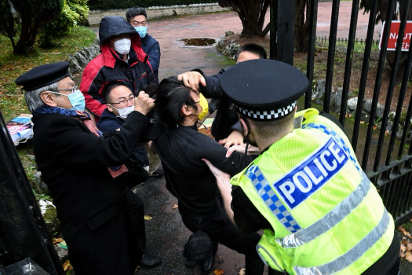
类似的暴力事件并非个别。中国驻曼彻斯特总领事馆内的工作人员曾在2019年对香港抗议者实施暴力行为。一位在领馆外进行抗议的香港人遭到殴打,并被强行拖入领馆内。动用暴力来维护所谓的“国家尊严”。这种行径不仅直接威胁到受害者的人身安全,也挑战了人权的的基本保护。
在同一地点,中国领馆工作人员还曾威胁自由亚洲的记者,试图阻止其进行新闻报道。当记者在领馆门口拍摄时,工作人员声称该行为违反了《维也纳公约》中的外交特权,并扬言报警。虽然记者强调其拍摄的是公共区域,属于言论自由的范畴,但这些工作人员依然对记者进行了干扰和恐吓。
除了暴力和恐吓外,中国还通过国际刑警发布“红通”,将跨国追捕作为常规手段。许多被中国政府视为“威胁”的民主人士,甚至无辜的香港青年,均成为中国政府跨国打压的目标。一位19岁的香港女孩張晞晴因涉嫌“分裂国家”而被悬赏100万港币通缉。
我自己也曾遭遇过类似的跨国迫害。作为长期关注中国政治和人权的活动人士,我也曾被不明身份的人士袭击,伦敦警察局逮捕了袭击者,已经做出了起诉决定。
中国的跨国迫害系统是精密且具有全球扩张性的。无论是通过暴力、恐吓、间谍活动,还是利用外交手段限制言论自由,中国的跨国行动都在无形中侵蚀了全球的民主与人权空间。更重要的是,这一系统并非单纯的局部事件,而是一整套由国家机器驱动的全球性压制机制。
跨国迫害的力量,并非仅在于肉体上的伤害,而在于它让人们在无形中丧失了自我表达的权利,逐渐让恐惧成为无法摆脱的阴影。
而最危险的压迫,是在表达之前的恐惧。
China’s Transnational Persecution
By— Bin Yu, Journalist of China Democracy Party(UK) 20th, Jan, 2025
China, as one of the largest and most closed-off countries globally, has always maintained strict control over speech and information within its borders. Domestic citizens are unable to freely access global social platforms and can only bypass these blocks through technologies like VPNs, which are considered illegal in China. This censorship limits the domestic population’s interaction with the outside world, yet ironically, China’s transnational persecution influence stretches far beyond its borders, infiltrating nations across the globe.
Behind this transnational persecution lies a sophisticated and systematic state apparatus. It does not rely on a single form of threat but instead employs a variety of methods and channels, creating a growing system of fear that expands worldwide.
My friend Lyndon previously investigated the bizarre death of a former Royal Marine who was accused of working as a spy for Hong Kong intelligence agencies. The deceased had connections to China’s spy network. This case exposed not only the depth of China’s transnational operations but also highlighted China’s terrifying efforts to infiltrate and disrupt the external world.
Such violent incidents are not isolated. Staff at the Chinese Consulate in Manchester were involved in violent acts against Hong Kong protesters in 2019. A Hong Kong protester outside the consulate was beaten and forcibly dragged inside the consulate. This use of violence was purportedly to protect the so-called “national dignity.” Such actions not only directly endanger the safety of victims but also challenge fundamental human rights protections.
At the same location, consulate staff also threatened a journalist from Radio Free Asia in an attempt to prevent reporting. When the journalist was filming outside the consulate, staff claimed the action violated the diplomatic privileges outlined in the Vienna Convention and threatened to call the police. Despite the journalist’s clarification that the filming was in a public space, within the scope of free speech, the staff continued to harass and intimidate the reporter.
In addition to violence and intimidation, China also utilizes Interpol’s “Red Notice” to pursue transnational arrests as a routine method. Many individuals the Chinese government deems as “threats,” including innocent Hong Kong youth, have become targets of China’s global crackdown. A 19-year-old Hong Kong girl, Cheung Hei Ching. was even offered a reward of 1 million Hong Kong dollars for her capture on charges of “separatism.”
I myself have encountered similar transnational persecution. As a long-time advocate for Chinese politics and human rights, I have been attacked by individuals of unknown identity. The London Metropolitan Police arrested the assailant, and prosecution has already been decided.
China’s transnational persecution system is sophisticated and expansively global. Whether through violence, intimidation, espionage, or diplomatic means to restrict freedom of speech, China’s transnational actions subtly erode the global space for democracy and human rights. More importantly, this system is not merely a series of localized incidents but a comprehensive global suppression mechanism driven by the state apparatus.
The power of transnational persecution lies not only in the physical harm it causes but in its ability to gradually strip individuals of their right to self-expression, making fear an inescapable shadow.
And the deepest oppression, is the fear before expression.
