
杭州市拱墅区人民政府:
申请人:陈树庆,男,浙江省杭州市人,现住杭州市拱墅区大关苑东五苑6幢5单元202室,身份证号330106196509260073,联系电话15958160478.
申请审查的文件:《浙江省人力资源和社会保障厅文件-浙人社函[2010]358号-关于被判处有期徒刑人员基本养老保险有关问题的复函(此件依申请公开)》。
申请审查的事实和理由:
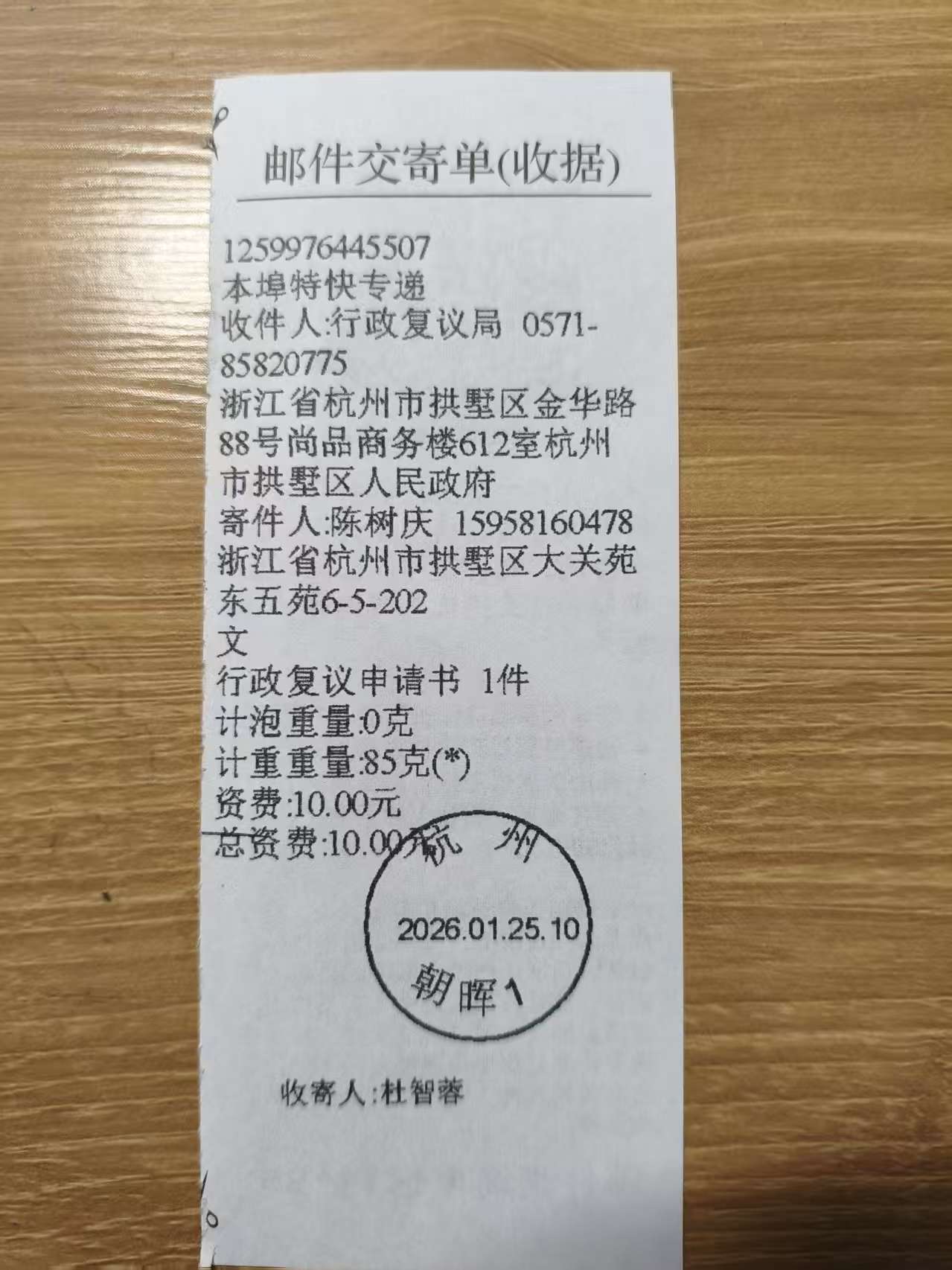
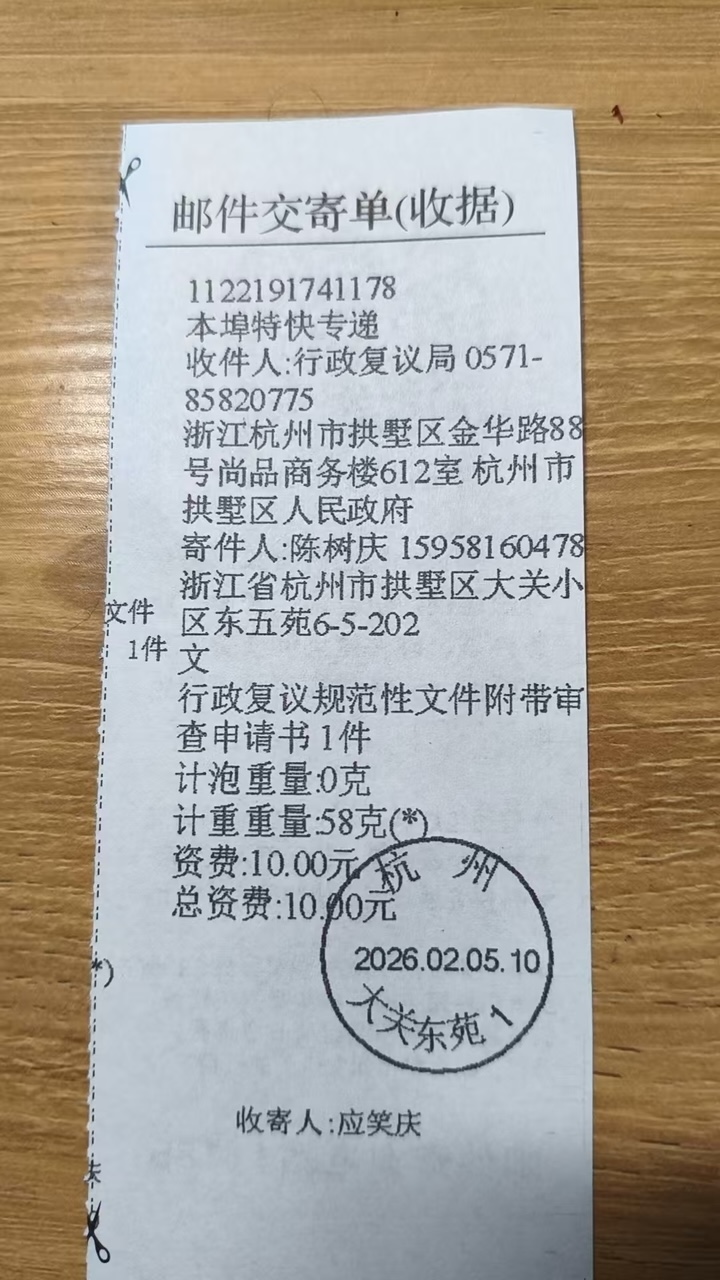
2026年1月25日,申请人陈树庆向杭州市拱墅区人民政府邮寄递交了《行政复议申请书》,请求被申请人杭州市拱墅区社会保险管理服务中心履行法定社会保险责任,按照申请人的《浙江省职工基本养老保险历年参保证明》所表明的累计缴费24年4个月的年限,为申请人办好退休资格确认、核定退休金额并发放退休金。2026年2月3日经拱墅区行政复议局同意,申请人将本行政复议的被申请人变更为杭州市拱墅区人力资源和社会保障局。2026年2月4日,申请人陈树庆收到《行政复议受理通知书》杭拱政复[2026]67号。
根据《中华人民共和国行政复议法》第十三条“公民、法人或者其他组织认为行政机关的行政行为所依据的下列规范性文件不合法,在对行政行为申请行政复议时,可以一并向行政复议机关提出对该规范性文件的附带审查申请:……(二)县级以上地方各级人民政府及其工作部门的规范性文件;……”,本复议案申请人陈树庆,对制作日期是二〇一〇年九月三十日的《浙江省人力资源和社会保障厅文件-浙人社函[2010]358号-关于被判处有期徒刑人员基本养老保险有关问题的复函(此件依申请公开)》文件(以下简称《浙人社函[2010]358号》),特提出范性文件的附带审查。
《浙人社函[2010]358号》规定:一、根据《中华人民共和国劳动法》《中华人民共和国劳动合同法》、《浙江省职工基本养老保险条例》等法律法规规定,被判处拘役、有期徒刑及以上刑罚或被劳动教养人员(以下简称“服刑在教人员”),其被羁押和在监所服刑或劳动教养期间(以下简称“服刑在教期间”),不能以城镇个体劳动者身份参加或继续参加职工基本养老保险。
申请人陈树庆认为上述《浙人社函[2010]358号》不合法的理由如下:
根据中华人民共和国政府1997年10月27日签署、全国人民代表大会常务委员会2001年2月28日批准的已经具备法律效力的《经济、社会及文化权利国际公约》“第九条:本盟约缔约国确认人人享有社会保障,包括社会保险”的规定。 申请人陈树庆认为,“服刑在教人员”并不因为服刑或劳教而变得不是“人”,从而丧失了“本盟约缔约国确认人人享有社会保障,包括社会保险”的基本人权。因此《浙人社函[2010]358号》因为与已经具备法律效力的《经济、社会及文化权利国际公约》相抵触,应该审定为无效或者建议有权处理机关对此类在新的时代已经明显过时且违法的“规范性文件”及时清理与清除。
申请人认真查阅《中华人民共和国劳动法》《中华人民共和国劳动合同法》、《浙江省职工基本养老保险条例》,上述两项法律及一项地方性法规,里面并没有任何条文里有《浙人社函[2010]358号》所言的“被判处拘役、有期徒刑及以上刑罚或被劳动教养人员(以下简称‘服刑在教人员’),其被羁押和在监所服刑或劳动教养期间(以下简称‘服刑在教期间’)不能以城镇个体劳动者身份参加或继续参加职工基本养老保险。”之规定。申请人陈树庆认为,政府机关无论是抽象行政行为还是具体行政行为,对法律的理解或解释,如果可以超越法律白纸黑字的明确内涵而无中生有出任何内容并声称该内容是根据《某某》、《某某》等法律的规定,本身就是一种严重的违法行为。如果可以这样,法律作为其中一项最重要的手段,要将政府权力关进笼子就会形同虚设;而政府机关利用自己摆脱了法律文字的限制“天马行空”不着边际的理解或诠释包括政策,反倒可以随时随刻去捆绑人民的权利和自由,不仅从根本上掏空与损害了法律的规则确定性,也显然与与法治社会的初衷包括立法“制约权力,保障权利”的初衷背道而驰。申请人希望通过本申请作废《浙人社函[2010]358号》,同时也能提醒其他政府各部门要严格依法审慎自己的行为,切莫一再做出类似的荒唐行径。若有确实需要也合情合理的行政管理措施,现行法律没有明确规定的或者规定得不够完善的,除非紧急情况(如战争、灾害等)确保正当动机的不得已处置行为,在其他任何情形都切莫擅自超越并滥用法律,而是应该通过合法程序启动相关立法提案或修改法律的建议,同时继续严格遵守“法无授权不可为”的法治底线。
2013年12月28日,全国人民代表大会常务委员会通过了关于废止有关劳动教养法律规定的决定,这意味着1957年8月1全国人大常务委员会批准公布《国务院关于劳动教养问题的决定》在实施50多年后被依法废止。因其符合我国政府已经签署的联合国《公民权利及政治权利公约》第九条“非依法定理由及程序,不得剥夺任何人之自由”“任何人因逮捕或拘禁而被剥夺自由时,有权申请法院提审,以迅速决定其拘禁是否合法,如属非法,应即令释放”及第十四条“任何人受刑事控告或因其权利义务涉讼须予判定时,应有权受独立无私之法定管辖法庭公正公开审问”,作为中国大陆人权事业一项进步不仅造福于国人,该举措还受到国内外一致的好评也造就我国随后几年很好的政治、经济与外交格局,G20时受到各国政要的广泛支持及参与就是最好的例证。劳动教养都已经废除十几年了,但包含劳动教养内容的《浙人社函[2010]358号》还不合时宜地被政府机关及其工作人员援引及适用,显然根据现行有效法律的要求,《浙人社函[2010]358号》也是必须与时俱进尽快予以清理、清除的。
早在两千多年前,先贤孔子《论语·尧曰》就写道:“不教而诛谓之虐。” 现代文明社会基于“法无德不立”的精神,只要是对于公民的权利和自由依法要加以限制或惩罚性制裁的内容,无论是具体条款还是整部法律,都遵循了“不溯既往”、“法未公布不生效”的基本原则。《浙人社函[2010]358号》标注为(此件依申请公开),当然,依申请公开不等于公布。《浙人社函[2010]358号》虽无《中华人民共和国立法法》规定的法律地位及效力,但也涉及广泛人员权利义务,这种“依申请公开”的规定,在未被申请公开前让利害相关人茫然无知,本案申请人也是在近几个月办理退休手续时多次交涉索取无果的情况下向拱墅区人社局提出《政府信息公开申请》后才得到的。这种若隐若现的政策形式,就为胥吏弄权甚至寻租提供了手段与机会,而胥吏弄权尾大不掉,恰恰又是我国历史数千年以来善政难以落实或不能持久、而弊政却积重难返、各朝代走向衰败灭亡的重要原因之一。申请人认为,政务活动中的“依申请公开”只能限于具体行政行为中涉及商业秘密或个人隐私的信息,限于向有利害关系也依法符合申请资格的人员依申请公开。至于抽象行政行为,希望各级国家机关在今后制定规范性文件时,除了涉及国家秘密内部执行不公开也不得对抗不知情的外部相对人,其它所有的规范性文件都应该向立法学习而公开发布。所以申请人不仅请求在本案清除这个“依申请公开”的《浙人社函[2010]358号》,还恳请彻底杜绝“依申请公开”形式的任何规范性文件再次出现。
此致
敬礼!
申请人:陈树庆
2026年2月5日
Chen Shuqing: Application for Incidental Review of a Normative Document in Administrative Reconsideration
To: People’s Government of Gongshu District, Hangzhou
Applicant: Chen Shuqing, male, resident of Hangzhou, Zhejiang Province, currently residing at Room 202, Unit 5, Building 6, Daguan Yuan East Fifth Estate, Gongshu District, Hangzhou.
ID number: 330106196509260073
Contact number: 15958160478
Normative document for which review is requested:
“Reply on Issues Relating to Basic Pension Insurance for Persons Sentenced to Fixed-Term Imprisonment (This document is disclosed upon application)” – Document No. Zhe Ren She Han [2010] 358, issued by the Zhejiang Provincial Department of Human Resources and Social Security.
Facts and grounds for which review is requested:
On 25 January 2026, I, the applicant Chen Shuqing, submitted by post to the People’s Government of Gongshu District, Hangzhou, an “Application for Administrative Reconsideration”, requesting that the respondent – the Gongshu District Social Insurance Management Service Centre, Hangzhou – perform its statutory social insurance responsibilities and, in accordance with my “Certificate of Participation in Zhejiang Provincial Basic Pension Insurance for Employees – Cumulative Years of Contributions”, which shows a total contribution period of 24 years and 4 months, complete the confirmation of my retirement eligibility, determine my retirement benefits, and pay my pension.
On 3 February 2026, with the consent of the Gongshu District Administrative Reconsideration Bureau, I changed the respondent in this administrative reconsideration case to the Gongshu District Human Resources and Social Security Bureau, Hangzhou. On 4 February 2026, I received the “Notice of Acceptance of Administrative Reconsideration” (Document No. Hang Gong Zheng Fu [2026] 67).
Pursuant to Article 13 of the Administrative Reconsideration Law of the People’s Republic of China, which states:
“Where a citizen, legal person or other organisation, when applying for administrative reconsideration of an administrative act, considers that any of the following normative documents on which the administrative act is based is illegal, they may, at the same time, request the administrative reconsideration organ to conduct an incidental review of that normative document: …
(2) Normative documents issued by people’s governments at or above the county level and their working departments; …”
I, the applicant in this reconsideration case, hereby submit an application for incidental review of the normative document dated 30 September 2010, namely Document No. Zhe Ren She Han [2010] 358 issued by the Zhejiang Provincial Department of Human Resources and Social Security: “Reply on Issues Relating to Basic Pension Insurance for Persons Sentenced to Fixed-Term Imprisonment (This document is disclosed upon application)” (hereinafter referred to as “Document No. Zhe Ren She Han [2010] 358”).
Document No. Zhe Ren She Han [2010] 358 stipulates:
“I. In accordance with the provisions of the Labour Law of the People’s Republic of China, the Labour Contract Law of the People’s Republic of China, the Zhejiang Provincial Regulations on Basic Pension Insurance for Employees and other laws and regulations, persons who have been sentenced to criminal detention, fixed-term imprisonment or a heavier criminal penalty, or who have been subjected to re-education through labour (hereinafter collectively referred to as ‘persons serving sentences or in re-education’), may not, during the period in which they are held in custody or serving sentences in places of detention or undergoing re-education through labour (hereinafter collectively referred to as the ‘period of serving sentence or re-education’), participate in or continue to participate in basic pension insurance for employees in the capacity of urban self-employed workers.”
I, the applicant Chen Shuqing, consider Document No. Zhe Ren She Han [2010] 358 to be unlawful for the following reasons:
According to the International Covenant on Economic, Social and Cultural Rights, which was signed by the Government of the People’s Republic of China on 27 October 1997 and approved by the Standing Committee of the National People’s Congress on 28 February 2001 and has legal effect in China, “Article 9: The States Parties to the present Covenant recognise the right of everyone to social security, including social insurance.”
I, the applicant, believe that “persons serving sentences or in re-education” do not, by virtue of serving a sentence or undergoing re-education through labour, cease to be “persons”, and therefore do not lose the basic human right to “social security, including social insurance” which the Covenant recognises for “everyone”. Accordingly, Document No. Zhe Ren She Han [2010] 358 conflicts with the International Covenant on Economic, Social and Cultural Rights, which already has legal effect, and should therefore be found invalid, or the competent authority should be advised to promptly clean up and abolish this type of “normative document”, which is clearly outdated and unlawful in the present era.
I have carefully consulted the Labour Law of the People’s Republic of China, the Labour Contract Law of the People’s Republic of China and the Zhejiang Provincial Regulations on Basic Pension Insurance for Employees. None of the provisions in these two laws and one local regulation contain the rule set out in Document No. Zhe Ren She Han [2010] 358, namely that:
“Persons who have been sentenced to criminal detention, fixed-term imprisonment or a heavier criminal penalty, or who have been subjected to re-education through labour (hereinafter collectively referred to as ‘persons serving sentences or in re-education’), may not, during the period in which they are held in custody or serving sentences in places of detention or undergoing re-education through labour (hereinafter collectively referred to as the ‘period of serving sentence or re-education’), participate in or continue to participate in basic pension insurance for employees in the capacity of urban self-employed workers.”
I, the applicant, believe that when a government body, whether in an abstract administrative act or a specific administrative act, interprets or understands the law in a way that goes beyond the clear, black-and-white wording of the law and fabricates provisions from thin air while claiming that such content is “based on” the provisions of such-and-such laws, this in itself constitutes a serious violation of the law.
If this were permissible, then the law – as one of the most important means of “locking state power in a cage” – would be rendered meaningless. Government bodies, freed from the constraints of legal text, would instead be able to give their own unrestrained and arbitrary interpretations – including of “policy” – and could at any time use such interpretations to tie up and restrict the rights and freedoms of the people. This would not only hollow out and undermine the certainty of legal rules at a fundamental level, but would also obviously run counter to the original intent of a law-based society and of legislation itself, namely “to restrict power and safeguard rights”.
Through this application to invalidate Document No. Zhe Ren She Han [2010] 358, I also hope to remind all other government departments that they must strictly examine their own conduct in accordance with the law, and must not repeatedly engage in similar absurd acts. Where there is indeed an actual need for reasonable and appropriate administrative measures, and current law does not clearly provide for such measures or provides for them only incompletely, then – except in urgent circumstances (such as war, disasters, etc.) where unavoidable actions are taken with justifiable intent – in all other situations government bodies must not arbitrarily exceed or abuse the law, but should instead initiate relevant legislative proposals or recommendations to amend the law through lawful procedures, while continuing to strictly uphold the law-based bottom line that “what is not authorised by law must not be done”.
On 28 December 2013, the Standing Committee of the National People’s Congress adopted a decision abolishing the relevant legal provisions on re-education through labour. This meant that the “Decision of the State Council on the Issue of Re-education through Labour”, which had been approved and promulgated by the Standing Committee of the National People’s Congress on 1 August 1957 and implemented for more than fifty years, was lawfully repealed.
This was in line with China’s obligations under the International Covenant on Civil and Political Rights, which the Government of the People’s Republic of China signed on 5 October 1998, including Article 9, which states that “No one shall be deprived of his liberty except on such grounds and in accordance with such procedure as are established by law” and that “Anyone who is deprived of his liberty by arrest or detention shall
