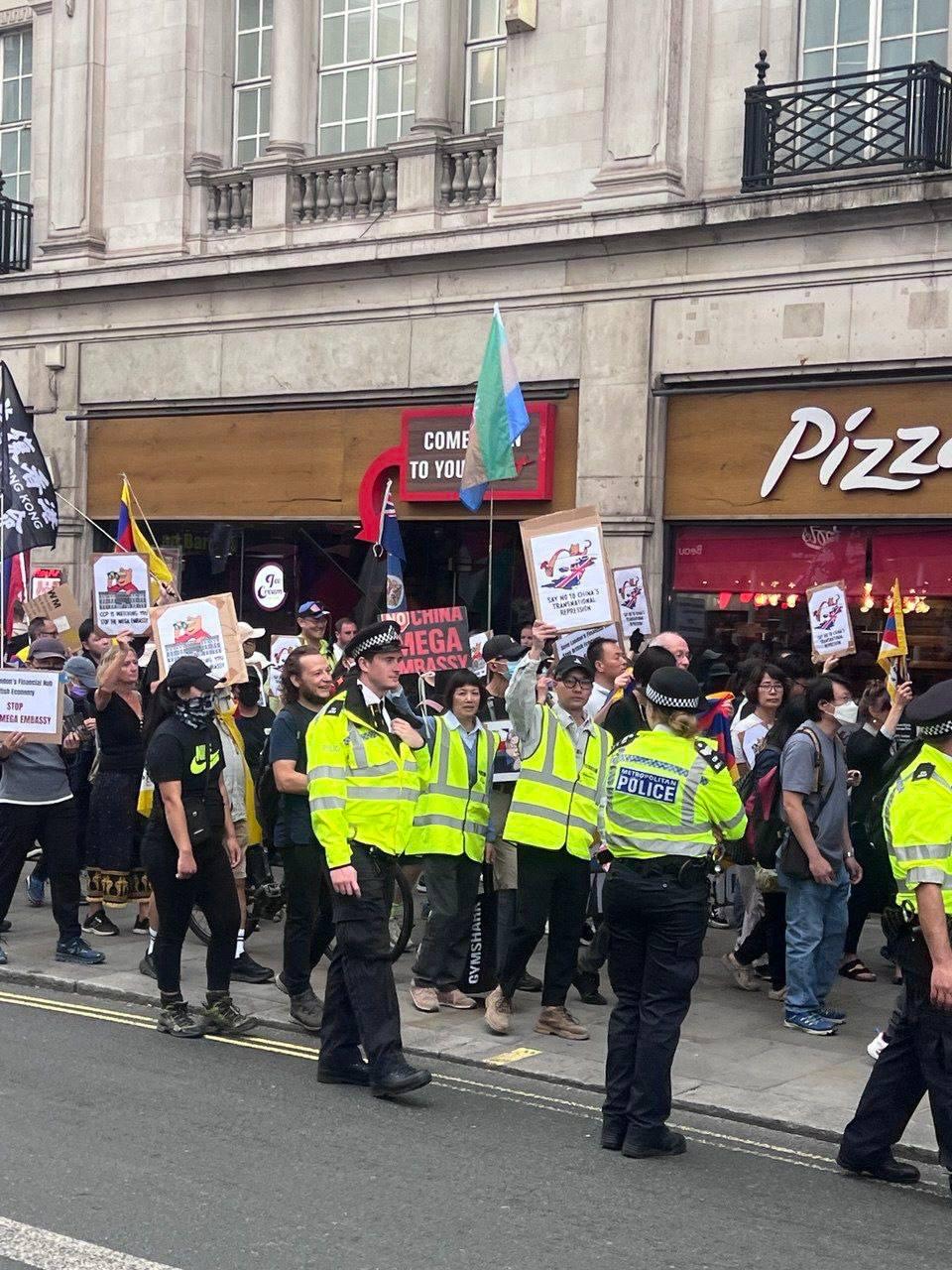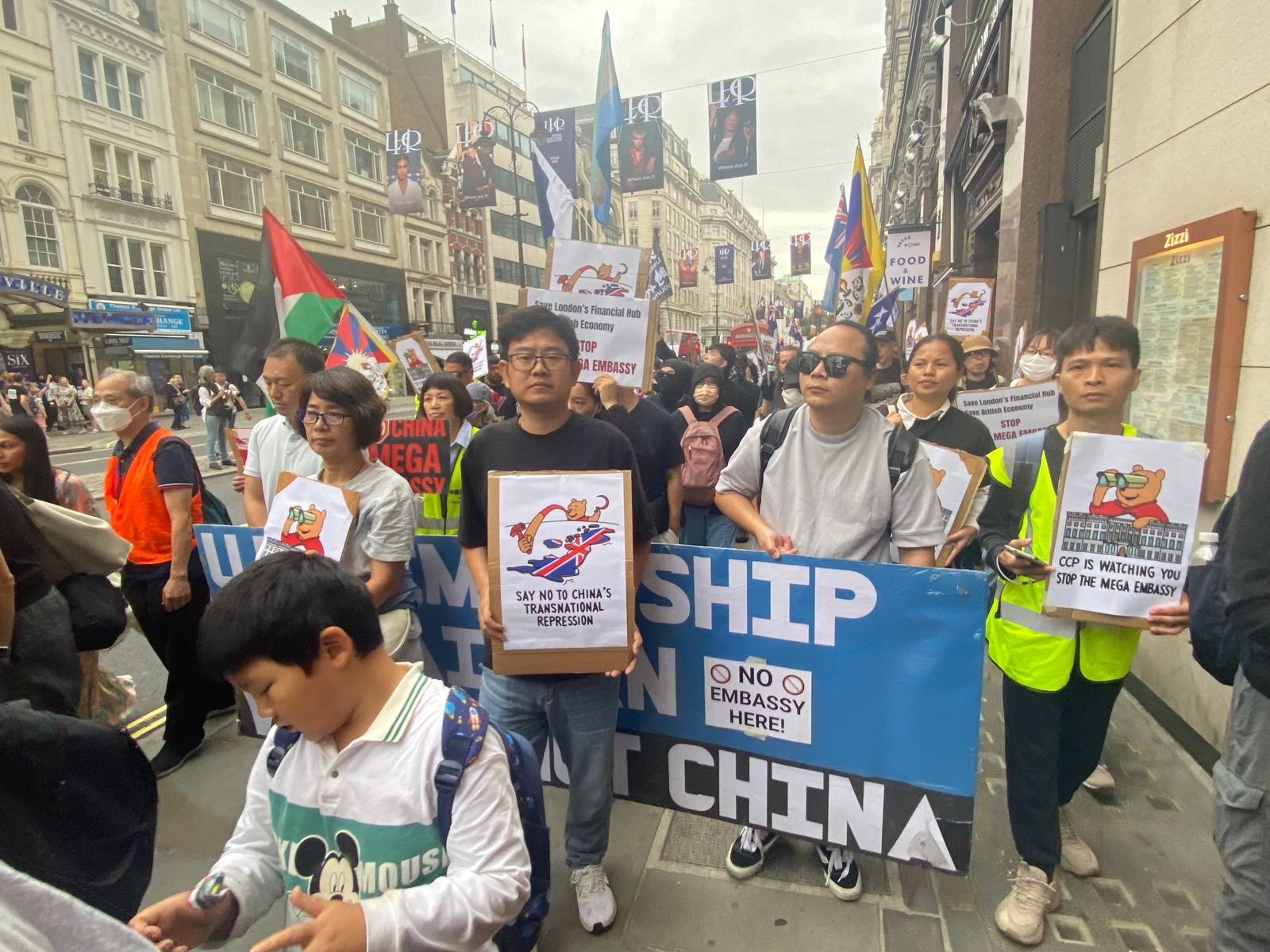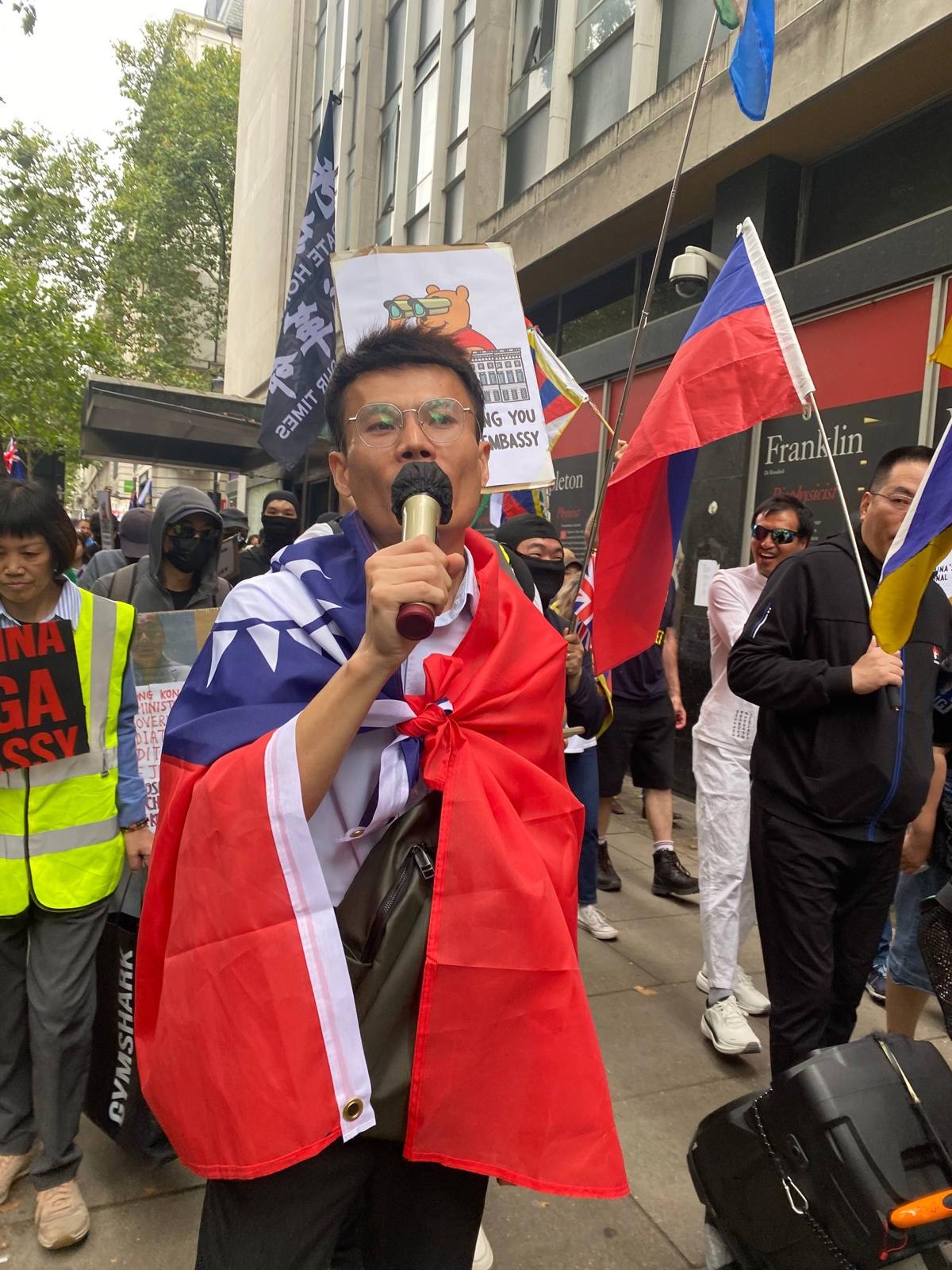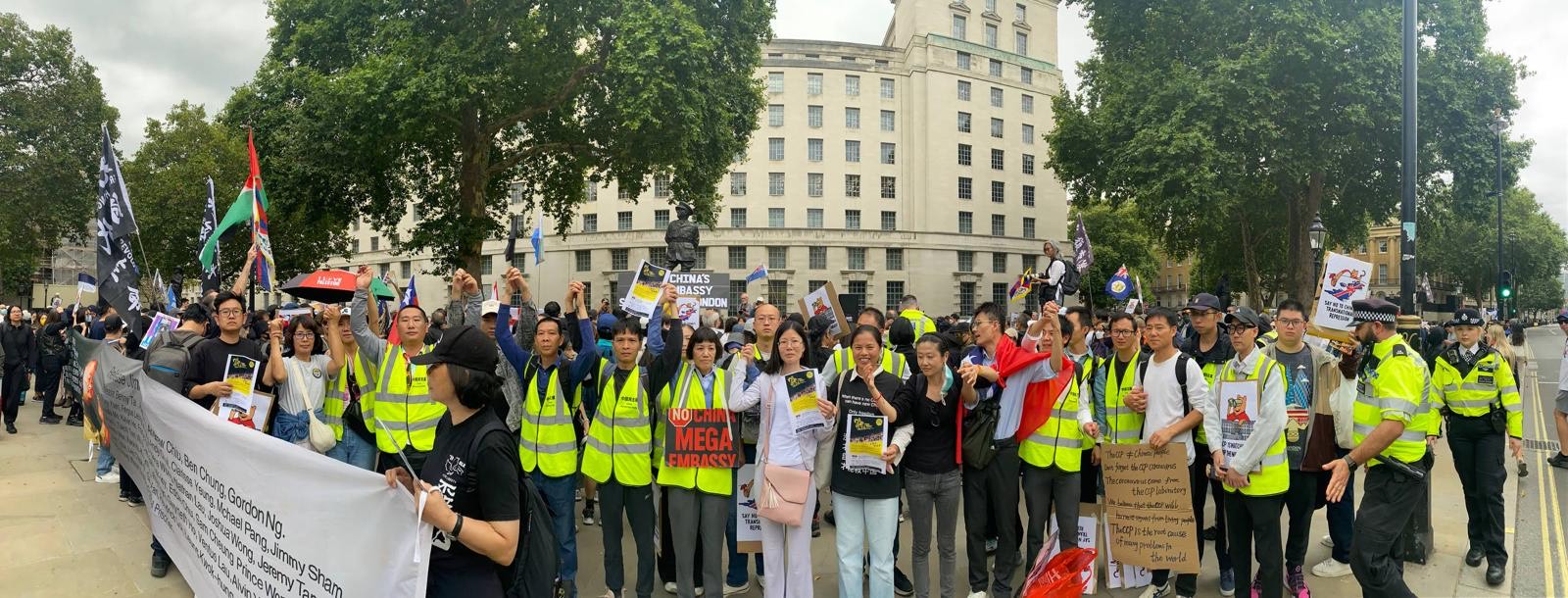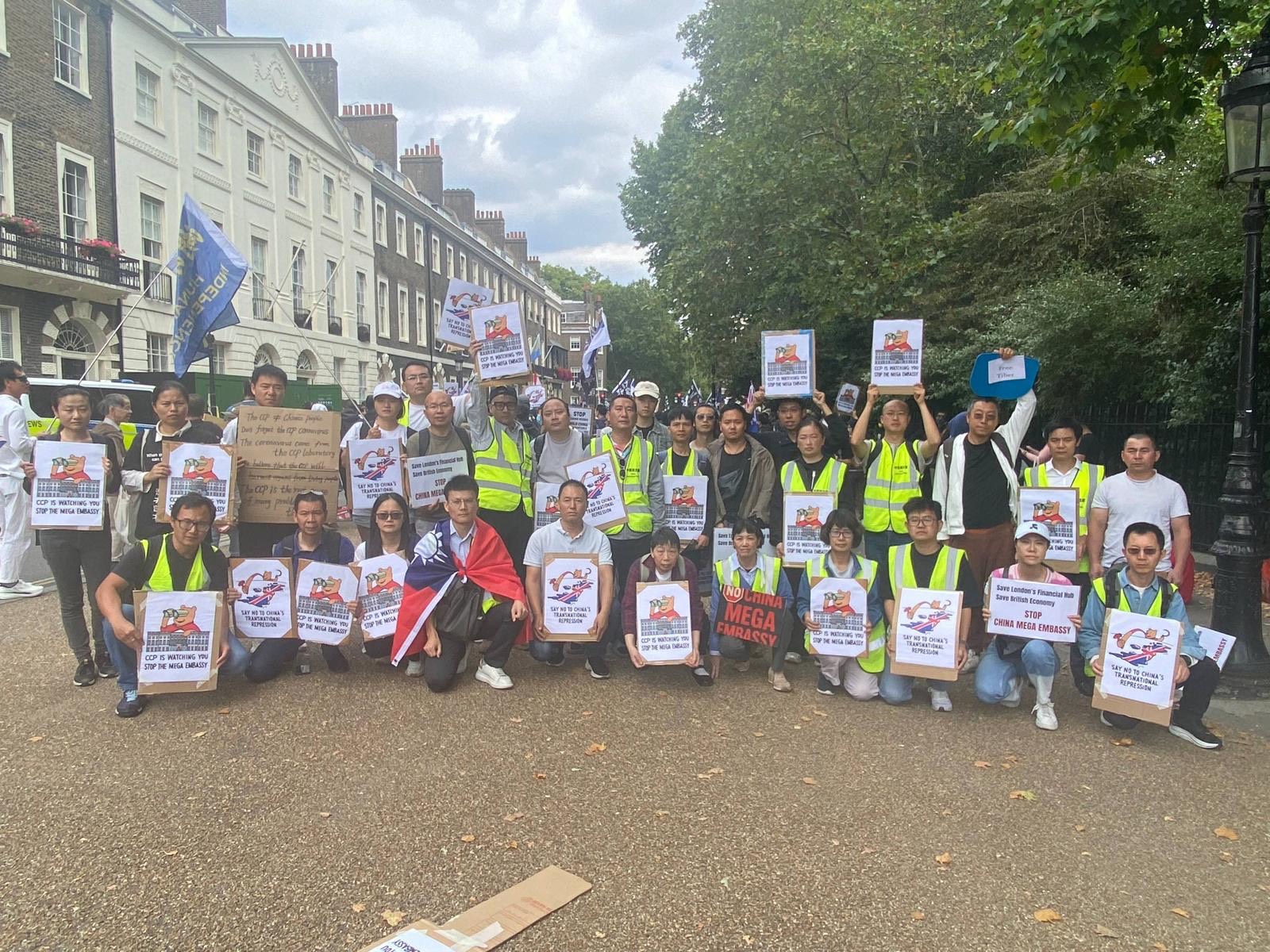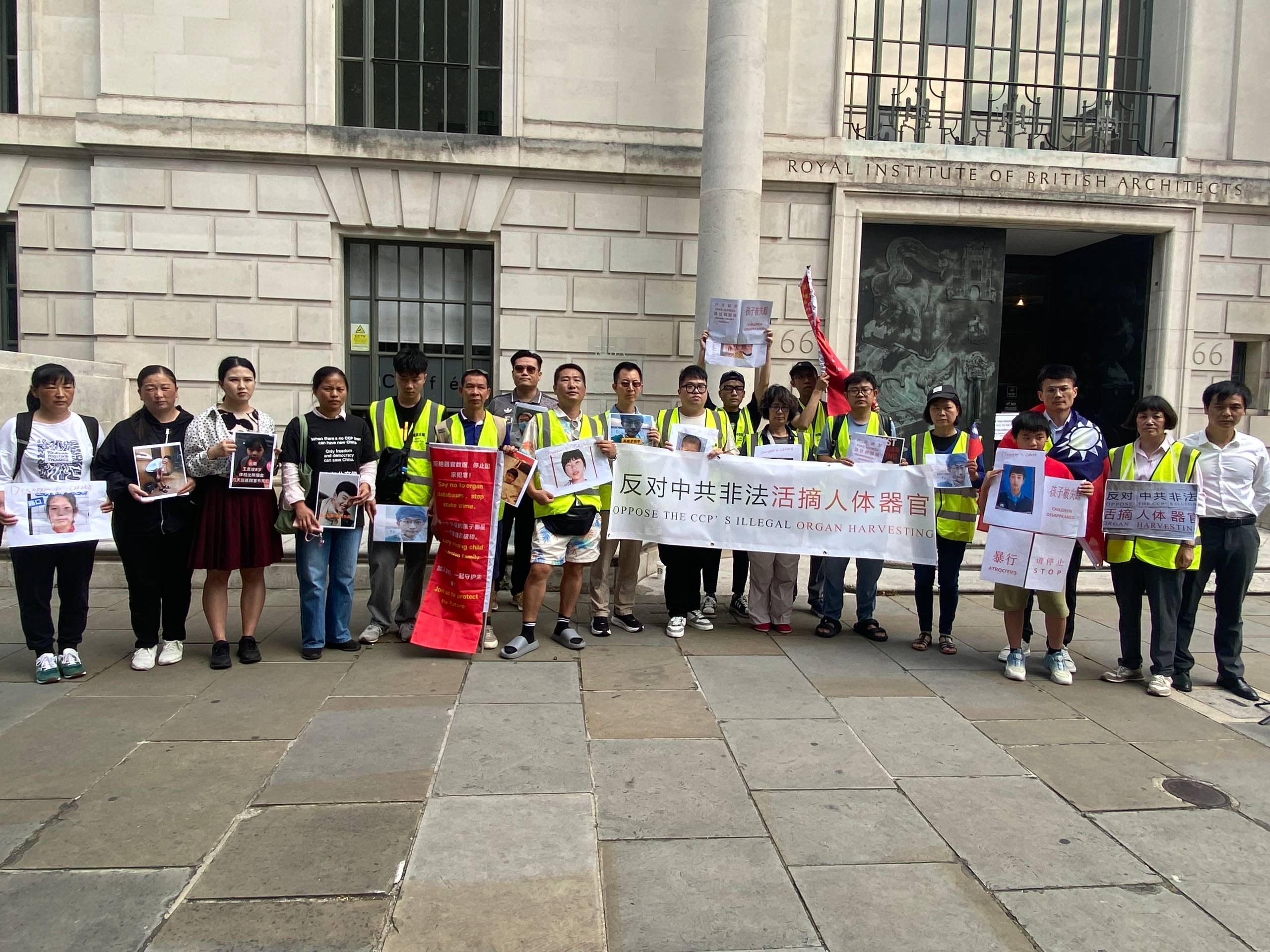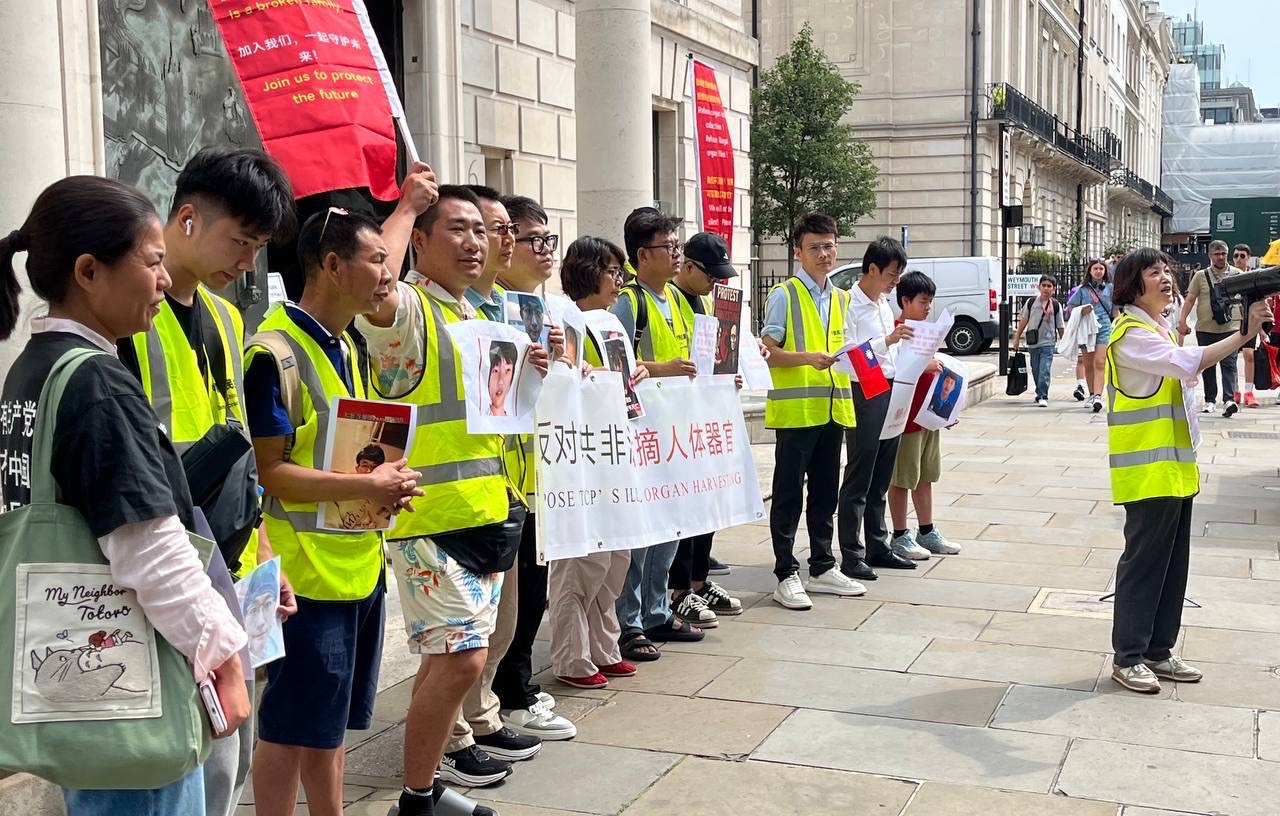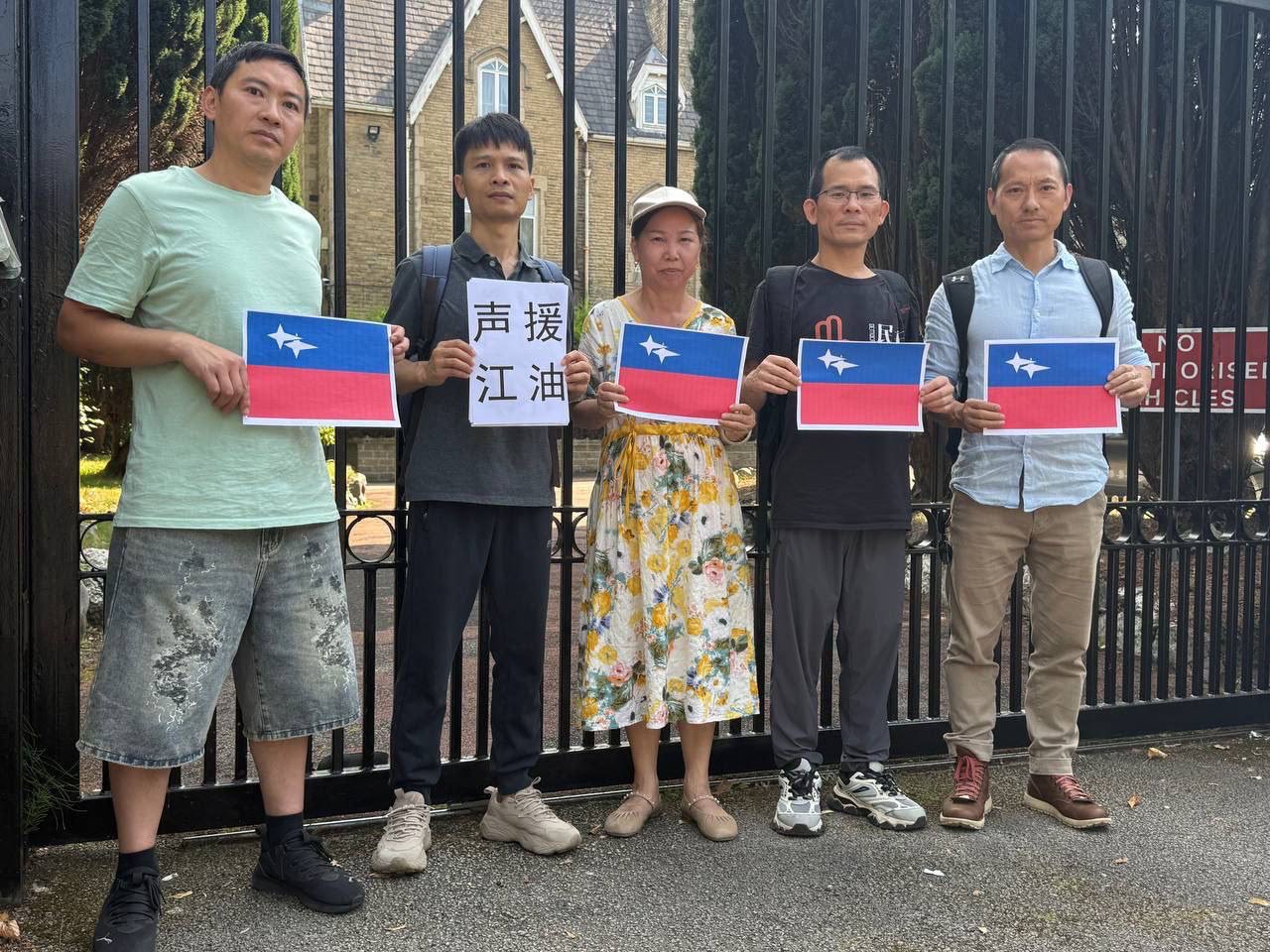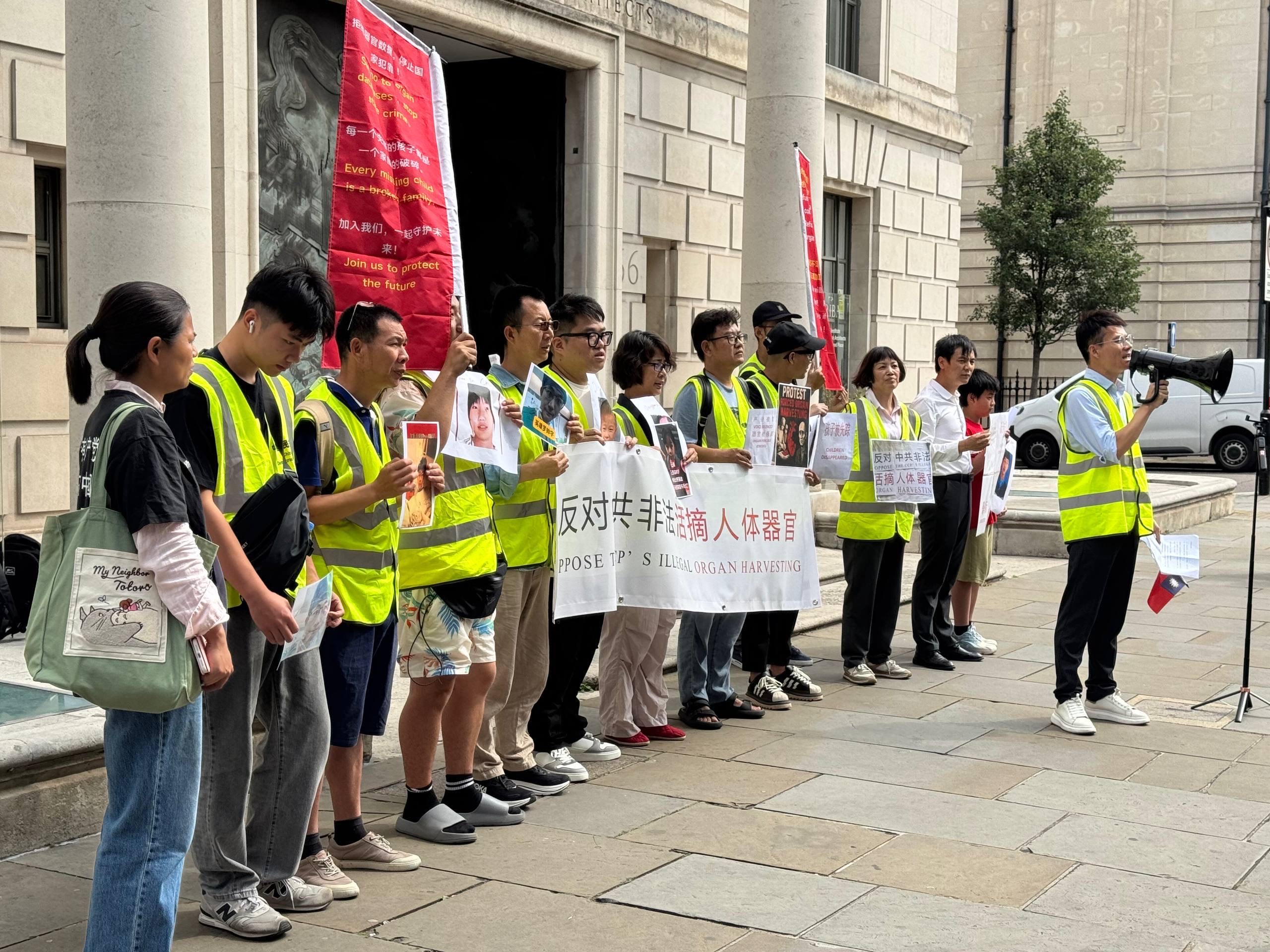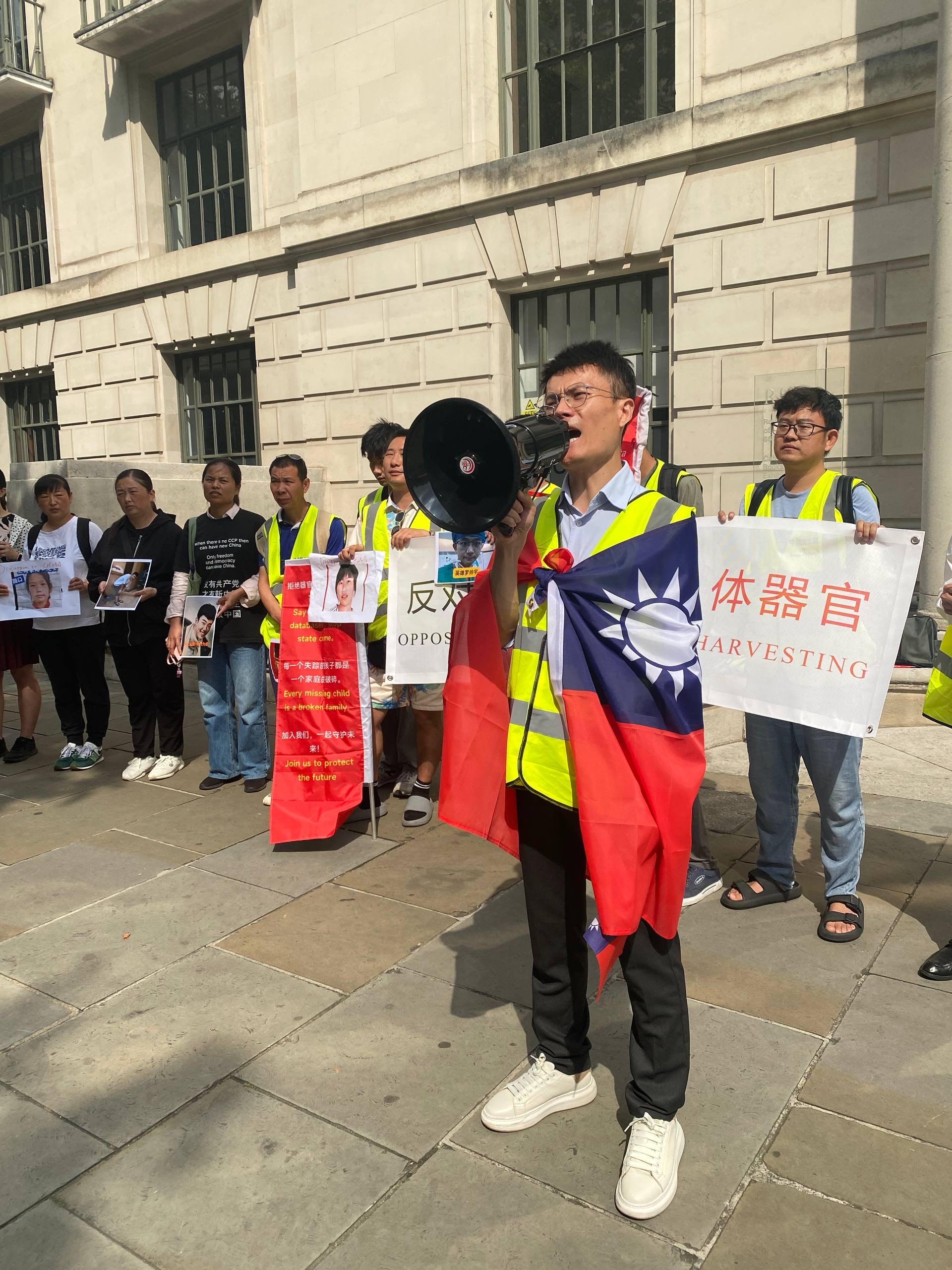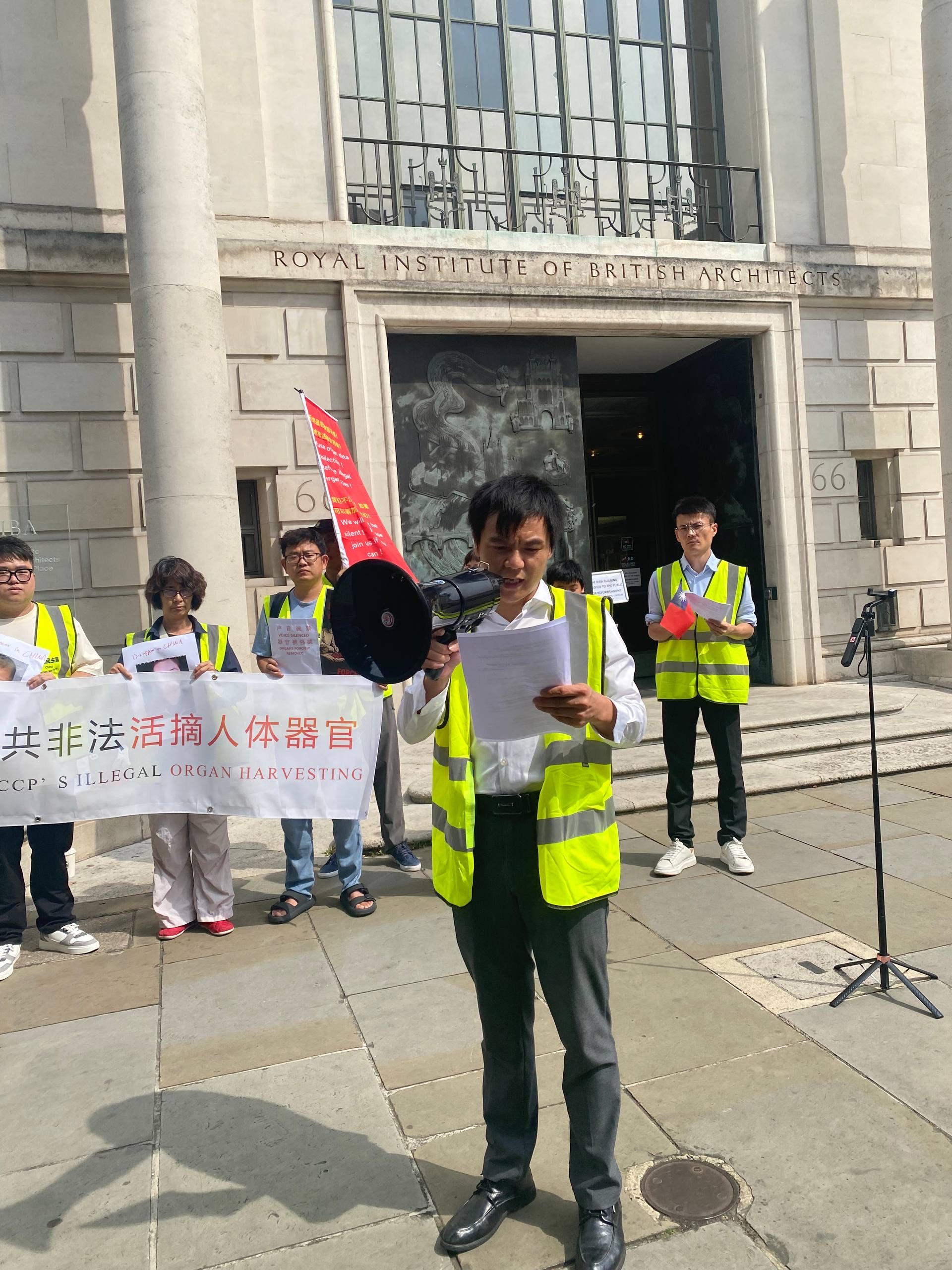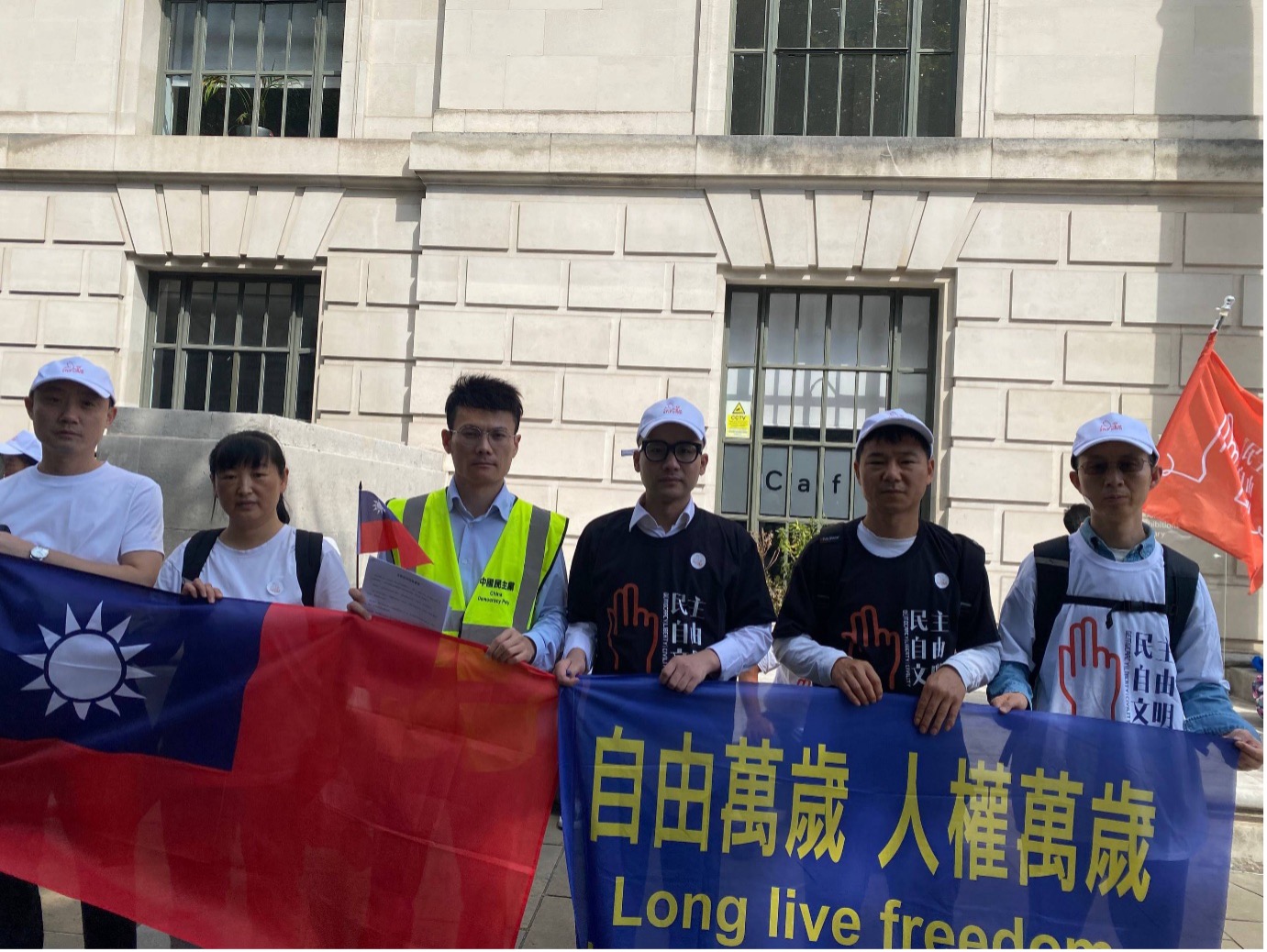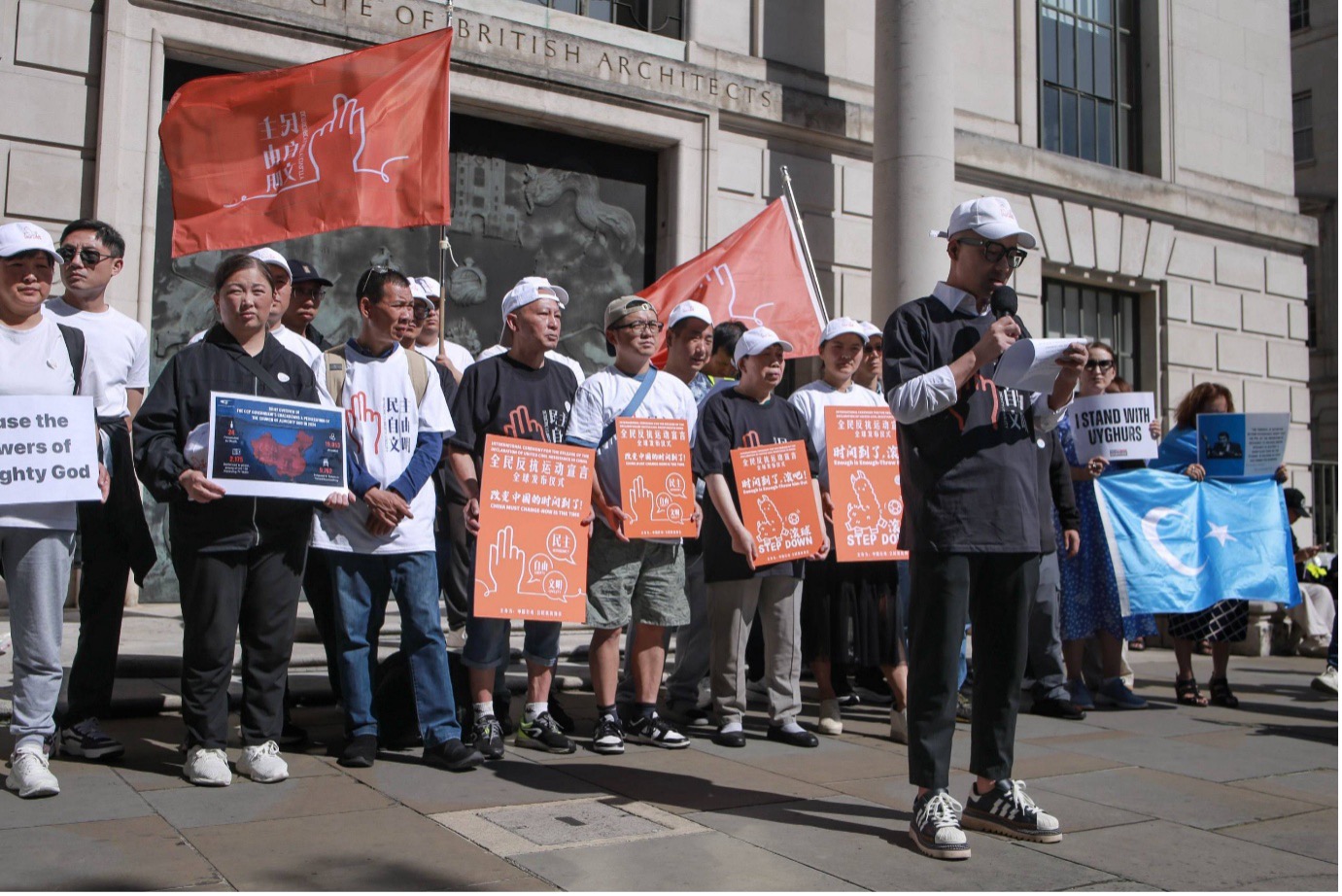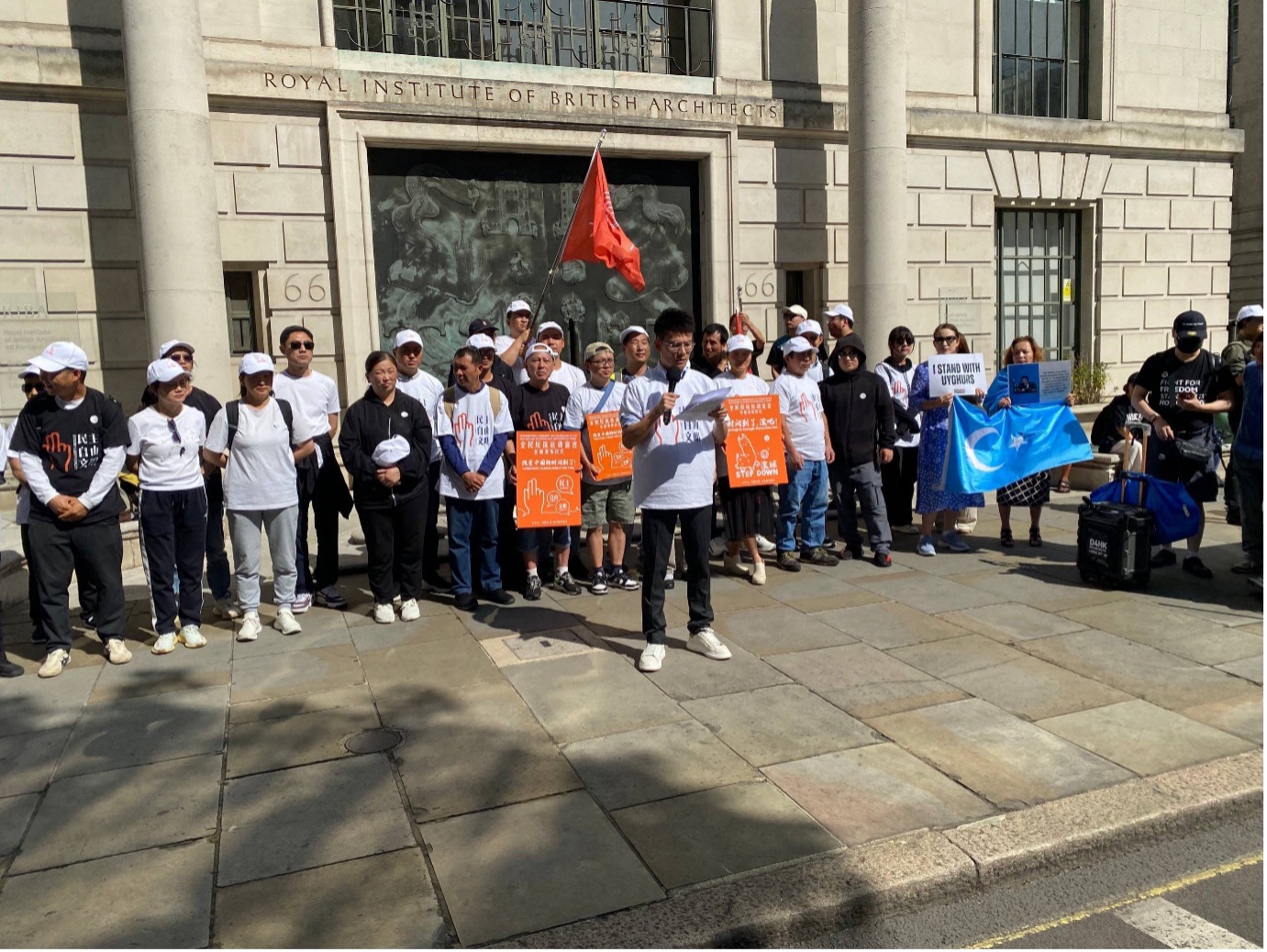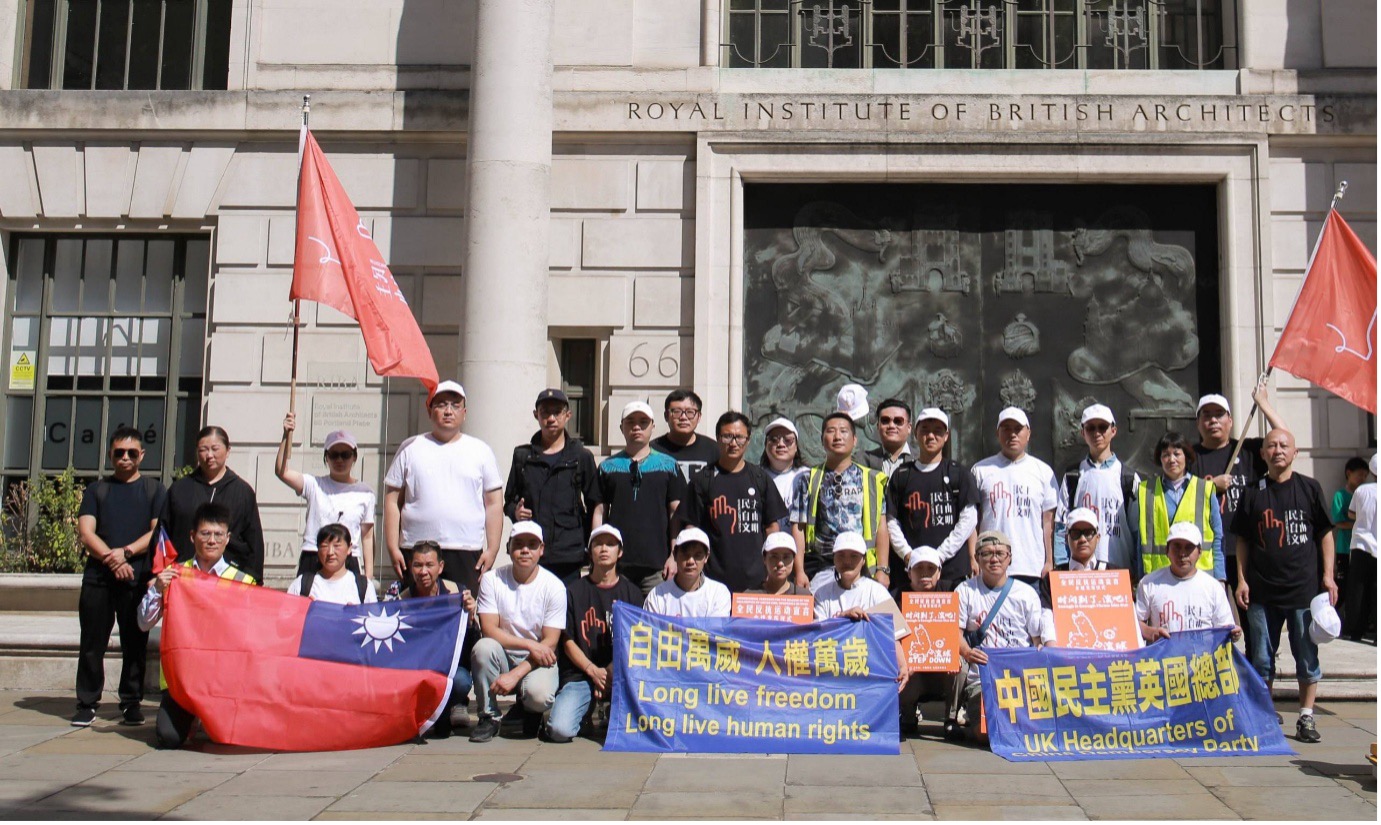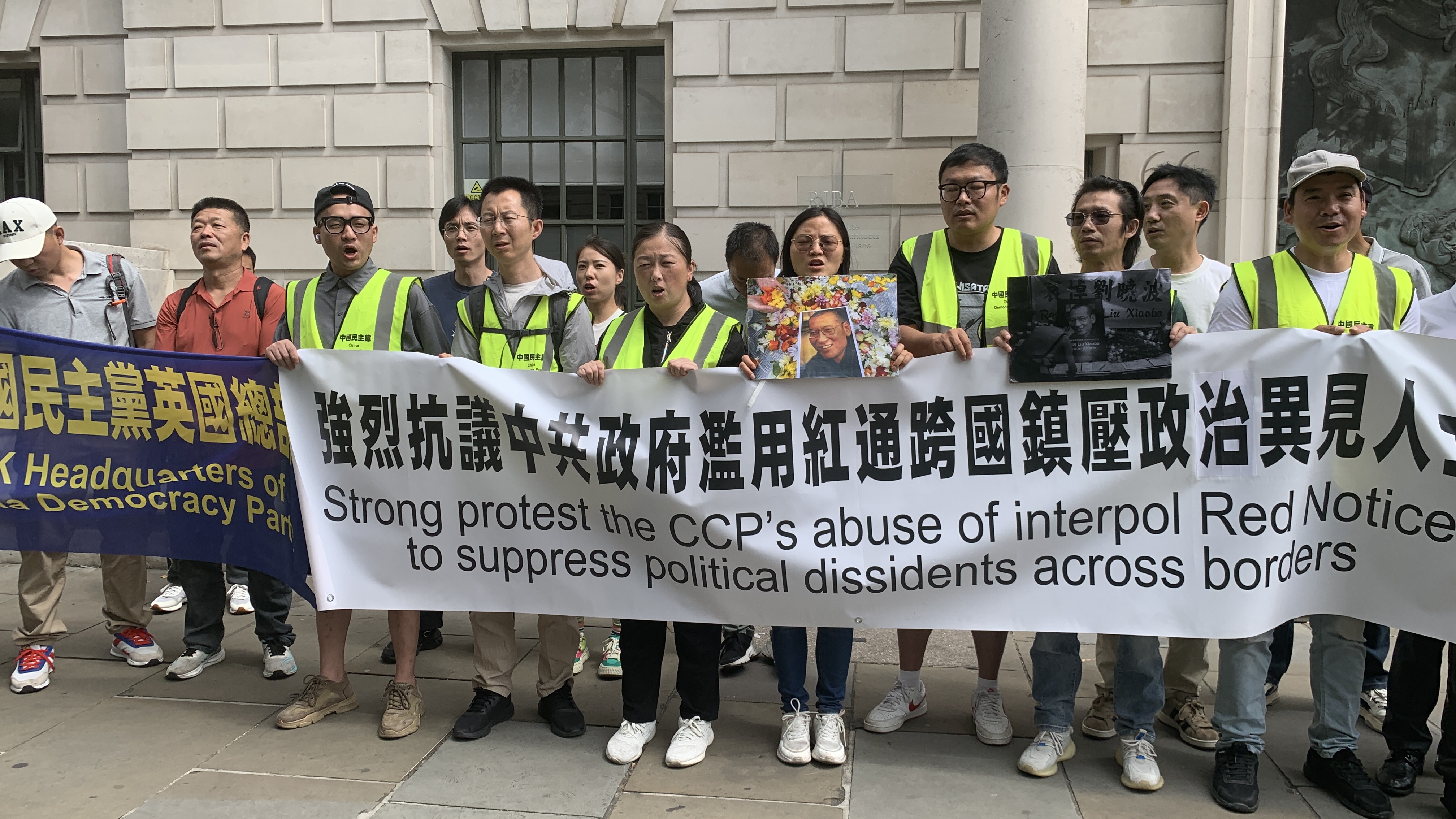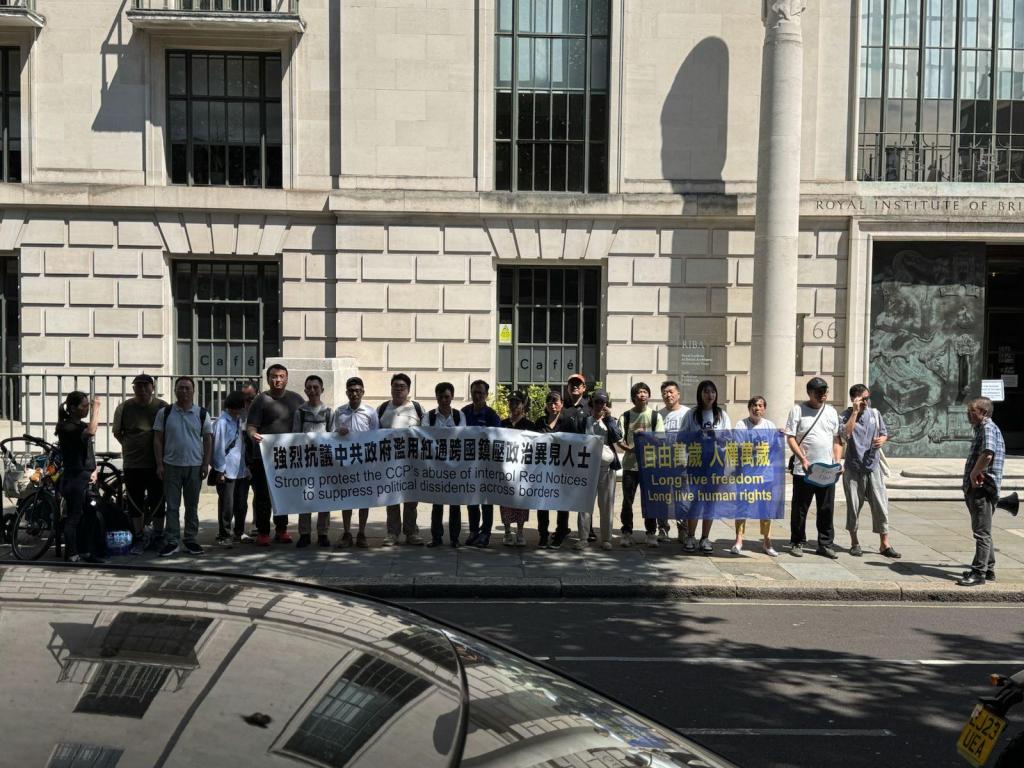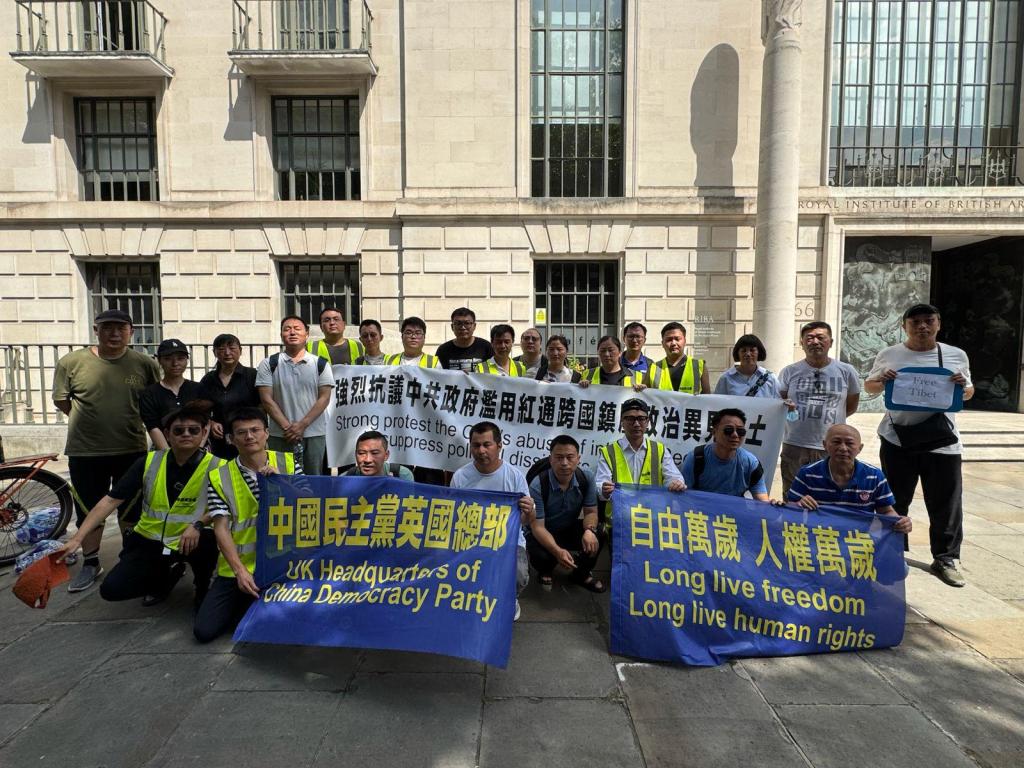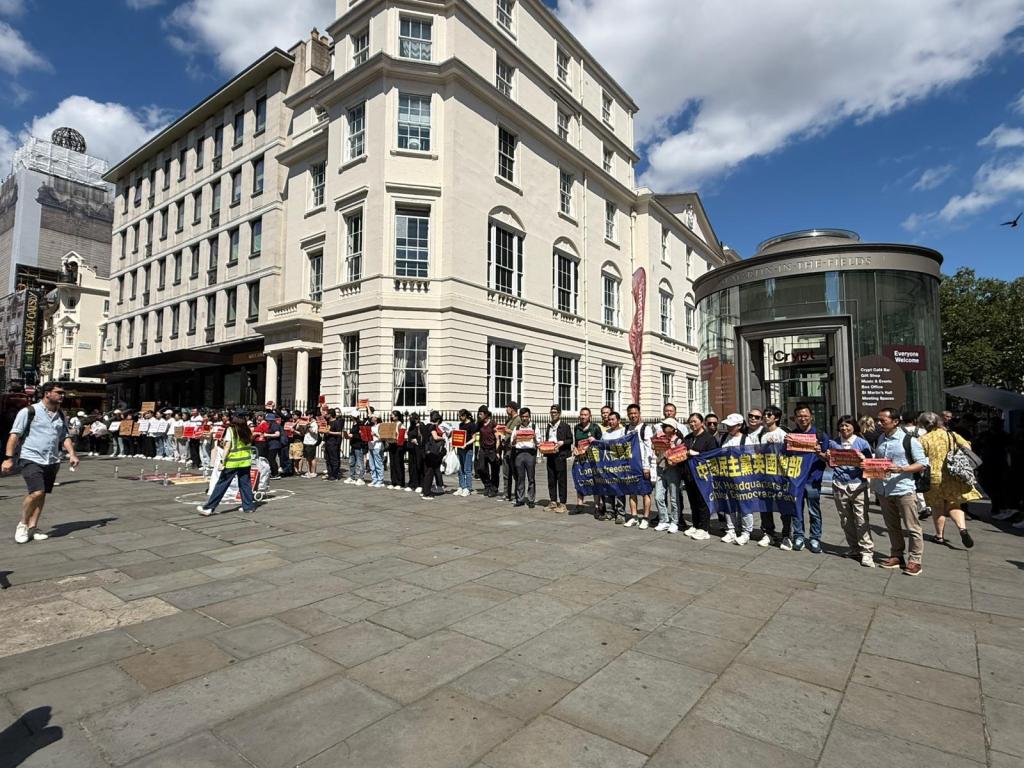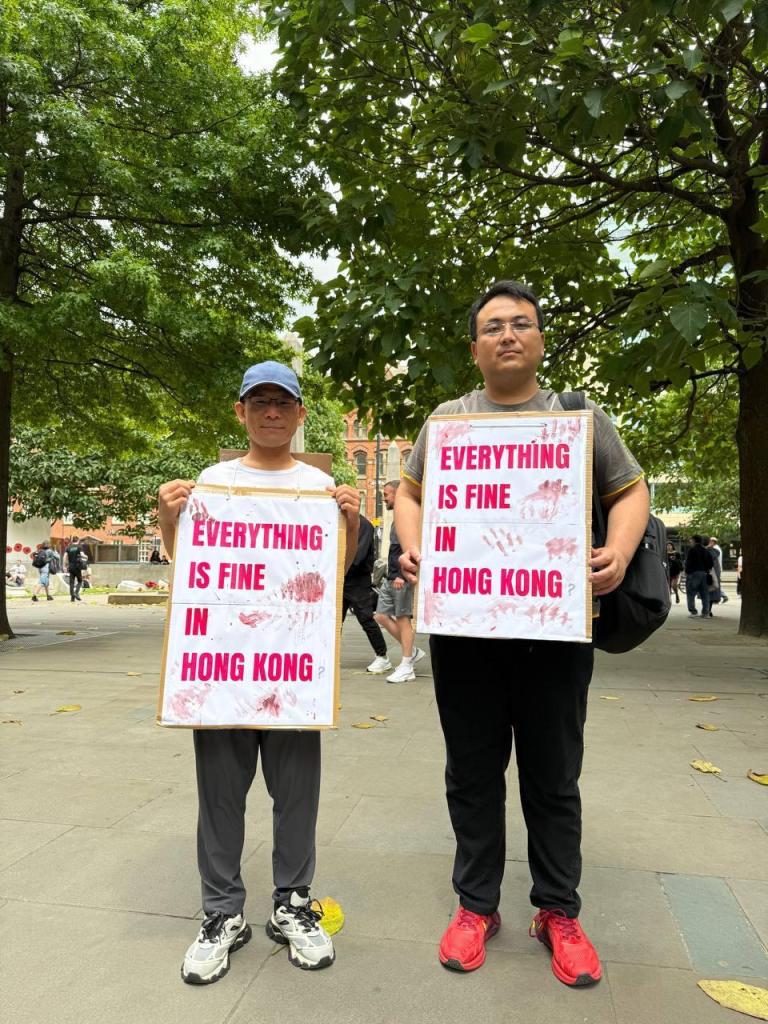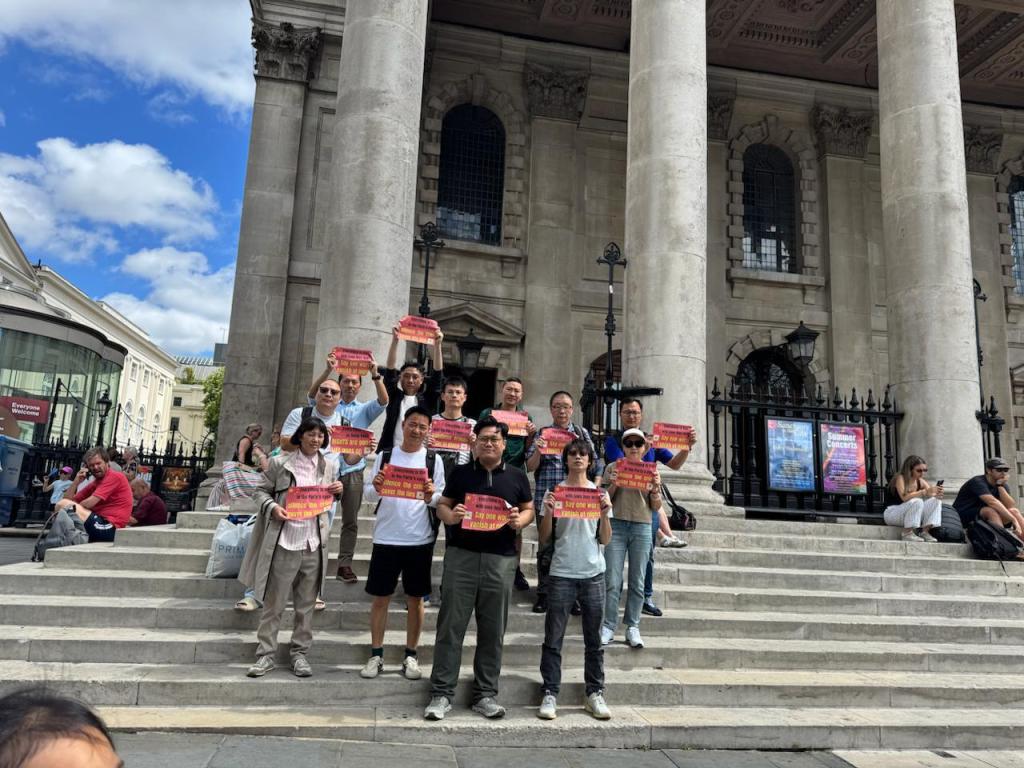
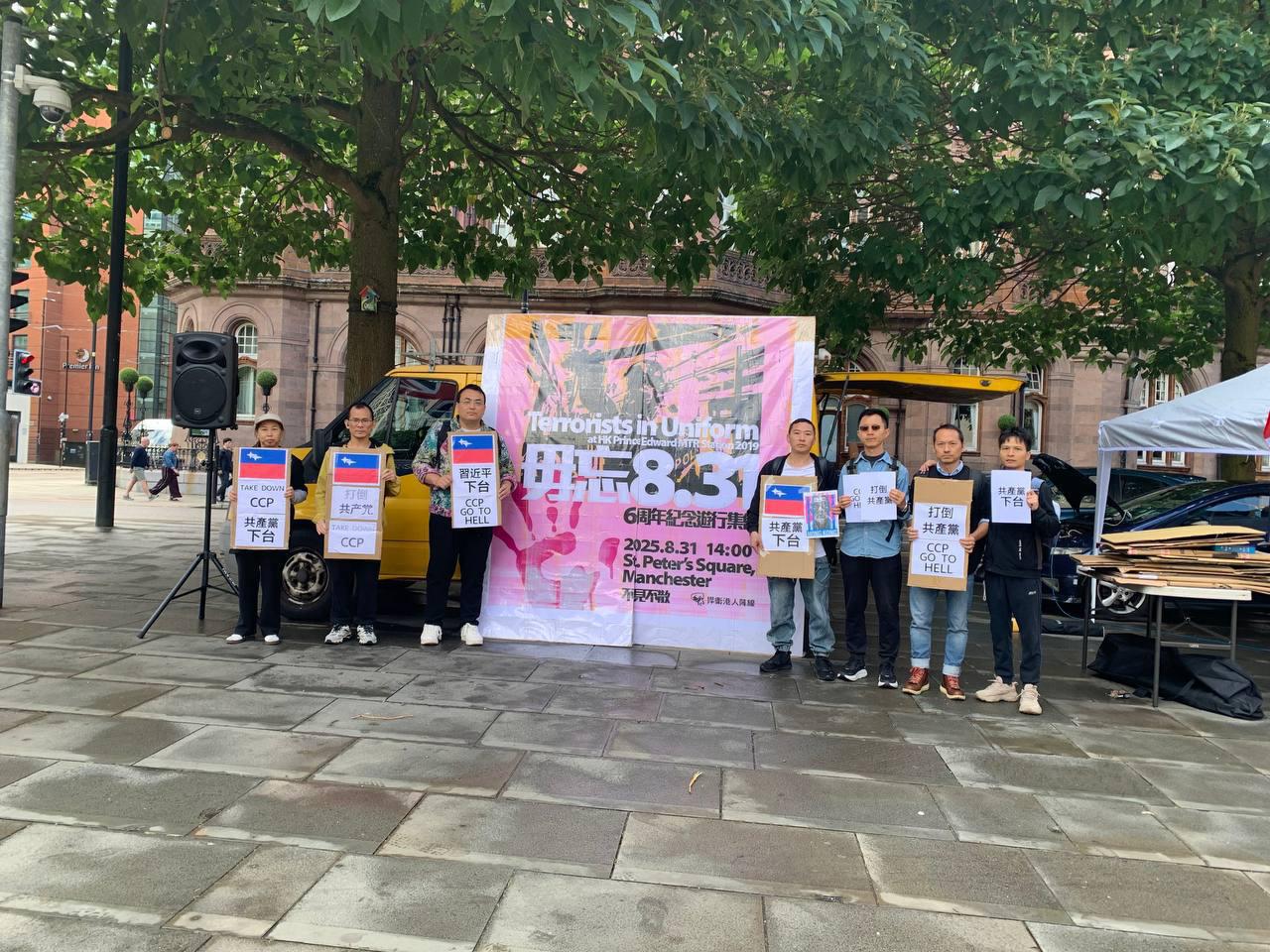
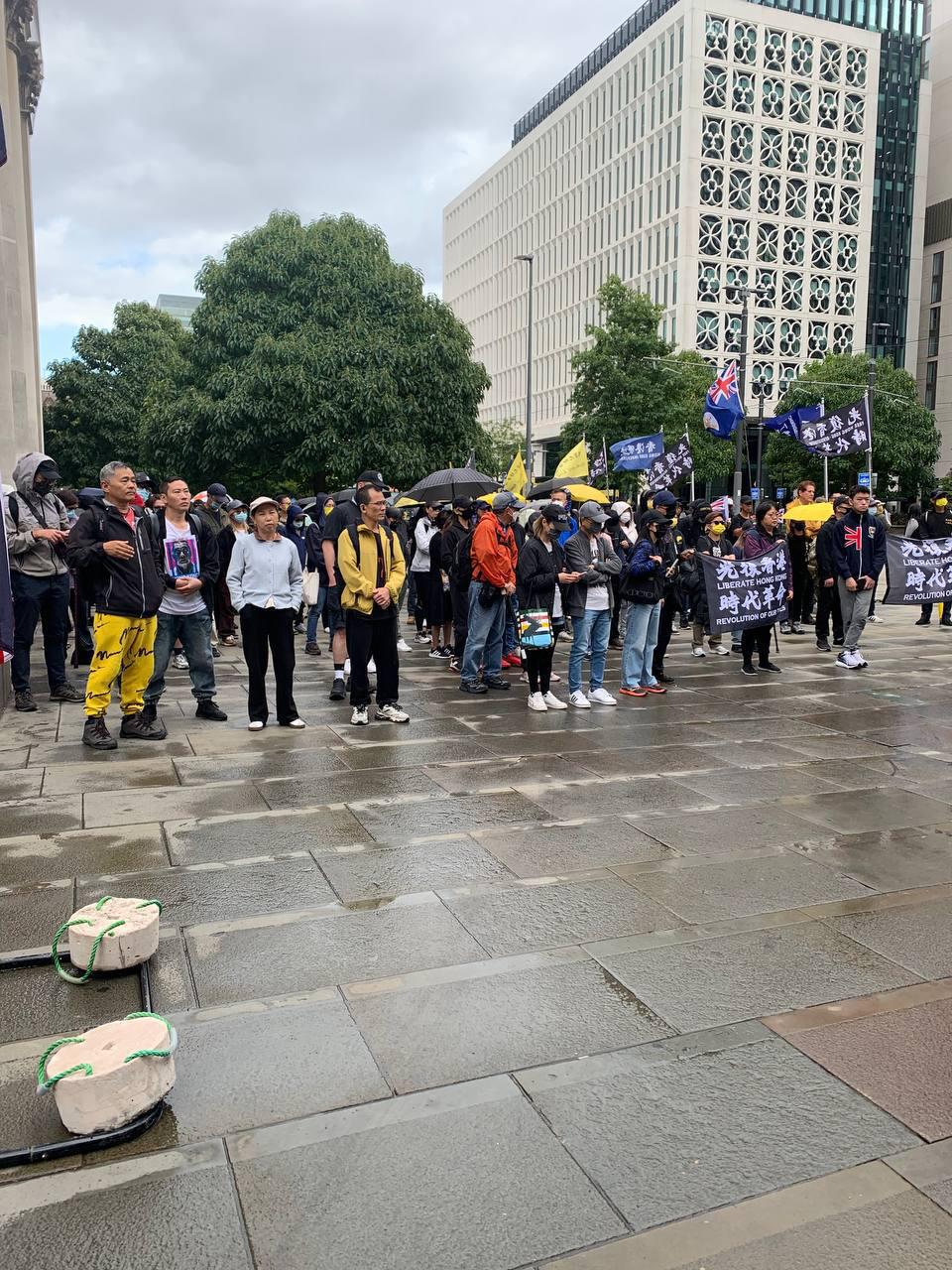
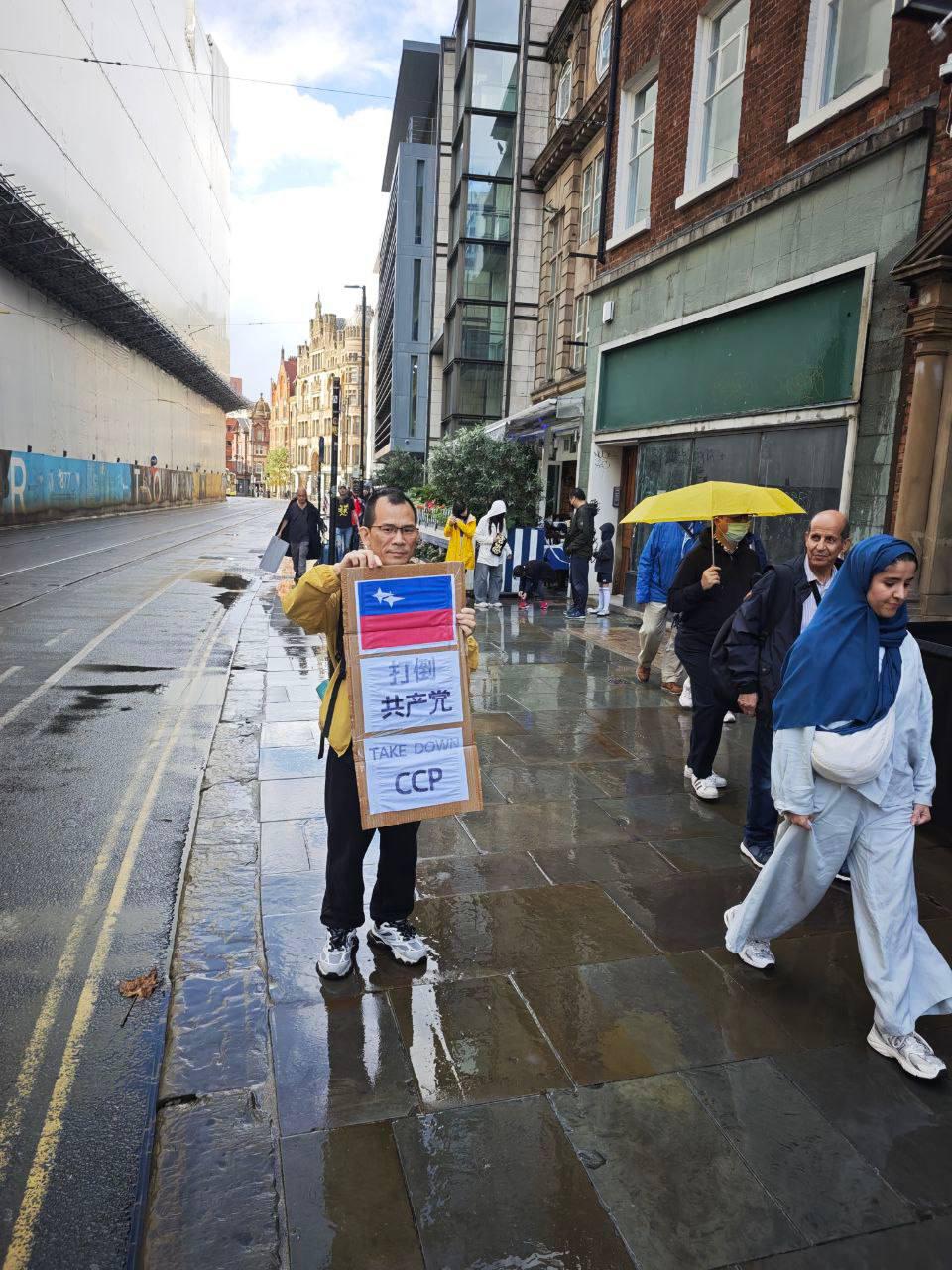
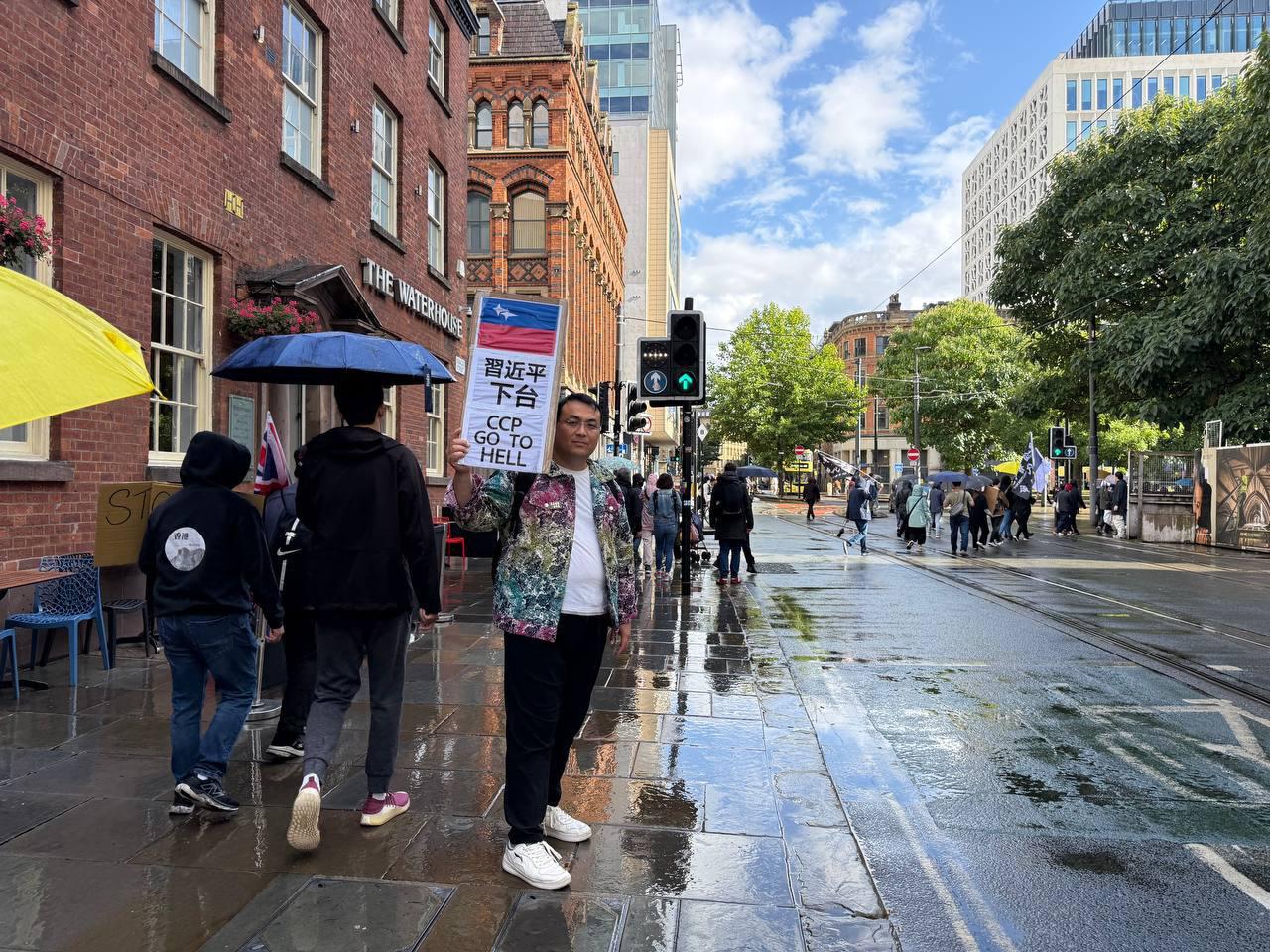
2025年6月14日(周六)下午2时至5时,英国伦敦皇家铸币厂(Royal Mint Court)门前再度响起反对中共的怒吼。第四轮“反对中国超级大使馆计划”抗议集会顺利举行,吸引逾2000名来自香港、台湾、西藏、新疆及英国本地的公民参与。中国民主党英国总部组织了数十名党员到场,与港人团体并肩发声,现场气氛高涨。
China Democracy Party UK Headquarters Actively Participates in the June 14 Protest Against the “Chinese Super Embassy Plan”
Joining Multi-Ethnic Groups to Oppose CCP Expansion and Defend British Democracy and Sovereignty
Author: Jun Huang (Member of China Democracy Party Headquarters)
On Saturday, June 14, 2025, from 2:00 PM to 5:00 PM, protest chants once again echoed outside Royal Mint Court in London. The fourth round of demonstrations against the “Chinese Super Embassy Plan” was successfully held, attracting over 2,000 participants from Hong Kong, Taiwan, Tibet, Xinjiang, and the local British community. The China Democracy Party UK Headquarters mobilized dozens of party members to join the event, standing in solidarity with Hong Kong groups in a powerful show of resistance.
The rally focused on two main themes: “China’s Global Surveillance Network” and “Cross-border Repression of Dissidents.” Organizers warned that the Chinese Communist Party (CCP) plans to convert the Royal Mint Court site into its largest embassy in Europe—an act cloaked in diplomacy but aimed at exporting authoritarian influence, endangering UK national security, local community safety, and the freedoms of overseas Chinese.
A representative from the China Democracy Party declared on-site:
“This is a symbolic act of flag-planting, a provocation to the core values of the UK. We stand up not out of hatred, but out of conscience and a pursuit of freedom.”
On the eve of the rally, some protest groups independently marched across Tower Bridge holding banners reading “Reject CCP’s Flag in the UK,” raising public awareness of the embassy’s dangers. Although this action was not officially part of the event due to police safety arrangements, it went viral online and became a powerful visual highlight.
To safeguard participants’ rights, the protest provided legal support services to help handle potential law enforcement conflicts and ensure onsite response strategies. Organizers urged all attendees to remain calm, orderly, and lawful in expressing their views, and not to fall into provocation traps.
Our Call to Action:
The UK government must immediately reject China’s application to redevelop the embassy site, defend national sovereignty, and protect fundamental human rights. Freedom is not born naturally—it is earned through generations of struggle and action.
China Democracy Party UK Headquarters
June 14, 2025
Lead Organizers: Jun Huang, Tian Huang
Co-organizer: Yong Wu
Attending Party Members:
Jun Huang, Tian Huang, Lin Feng, Tihe Yang, Yan Wang, Yanjun Dong, Jinxiu Wang, Jian Wang, Weijin Wang, Tao Li, Zuotuan Wen, Jiehui Yu, Zhifen Wu, Kaney Huang, Tao Wang, Xiaodan Cheng, Lz Tan, Shaonan Xu, Lin Bai, Kewei Fan, Wei Jiang, Xizhe Lei, Chonghua Wei, Shitou Zhang, Su Yang, Chenguang Ding, Wu Zhao, Yong Wu, Erbin Hou, Xuemei Zhang, Lingfei Lu, Yaohang Liu, Chao Dai, Xiaofeng Gu
Upholding the Principles of Peace, Rationality, and Nonviolence to Build a Strong, Free, Democratic, and Law-Based China
By Huang Hua
June 4, 2025, London
Dear friends, greetings to all.
Today we gather here to commemorate June 4, 1989—the tragic event that shocked the world thirty-six years ago. On this day thirty-six years ago, young students and citizens marched peacefully through the streets of Beijing, calling for an end to corruption and the pursuit of democracy. They were peaceful, rational, and nonviolent. Their vision was to build a more just and free China.
Yet, in response to these peaceful demands, the state deployed tanks and bullets. This was not only an assault on human life, but also a grave wound inflicted on the moral conscience of the nation. An entire generation’s dreams were crushed in blood, and the entire nation was plunged into prolonged silence.
Thirty-six years have passed, but this memory cannot be erased. Precisely because of this tragic history, we are even more convinced that only by upholding the principles of peace, rationality, and nonviolence, by awakening society with morality and truth, and by promoting change through dialogue and action, can China truly become a strong and prosperous nation that respects democracy, freedom, the rule of law, and human rights.
Many people ask: Since the students of 1989 pursued peace, hunger strikes, and dialogue, and were ultimately crushed by tanks, why should we continue to adhere to these principles of peace, rationality, and nonviolence?
This is a question that has been asked by many who experienced or studied the events of June 4th. When faced with violence and repression, does peace simply mean weakness? Does morality really matter?
Here, I would like to offer my thoughts from several perspectives:
I. We adhere to peace, rationality, and nonviolence not because it guarantees immediate success, but because it is the most legitimate, sustainable path that can build the broadest consensus.
In 1989, the students and citizens occupied the moral high ground. Precisely because they were peaceful and nonviolent, the world was able to clearly see the cruelty of the regime. This legitimacy is a force that history will ultimately recognize. Violence may suppress protests temporarily, but it cannot erase a people’s pursuit of justice.
On the contrary, if resistance resorts to violence, it loses moral legitimacy, and society becomes prone to chaos or even civil war. Reforms would then be derailed by bloodshed and polarization. This is not only the lesson of June 4th but also the consensus of many countries that have undergone democratic transitions.
II. The failure of June 4th was not because of the peaceful approach itself, but because there were no institutional channels or foundations for civil society at the time.
The crackdown on June 4th was not simply because students chose peace. Rather, it was because:
The regime was extremely closed and highly centralized;
Freedom of the press and speech was absent, leading to deep distrust between the government and society;
There were no independent mediating forces (such as strong civil organizations, media, or religious communities) to negotiate or exert pressure;
Society lacked sufficient democratic awareness and institutional preparation.
Therefore, today when we commemorate June 4th, we are not seeking another wave of emotional protest. Rather, we aim to foster lasting change: cultivating civic awareness, building independent social forces, and striving for institutional reform—not relying solely on repeated confrontations in public squares.
III. History shows that successful democratic transitions almost always arise from long-term, peaceful, gradual efforts—not violent revolution.
Look at South Korea, Taiwan, Poland, the Czech Republic, South Africa—their paths to democracy and the rule of law involved repression and sacrifice, but ultimately relied on the mobilization of all sectors of society, the persistence of nonviolent movements, and the awakening of internal reform forces.
By contrast, revolutions achieved through violence often result in another cycle of authoritarianism, chaos, or long-term conflict.
IV. Adhering to peace does not mean weakness—it means strategic wisdom.
Nonviolence is not compromise; it is wisdom that combines morality and strategy. It requires organization, long-term patience, information dissemination, cultural development, and the nurturing of public consciousness. We do not hope for a romantic “revolution.” Instead, we seek to awaken generation after generation, so that power can be ultimately bound by institutions.
In conclusion:
The bloodshed of June 4th is a condemnation of authoritarianism, but also a powerful reminder of the necessity of peaceful resistance. Precisely because of the brutality of that crackdown, we know that we must not repeat the same path—we cannot pursue freedom through emotional outbursts, but through carefully considered, peaceful transformation.
China’s path to becoming a nation of democracy, freedom, rule of law, and human rights will not be forged by a sudden uprising. It will require us to persist in using peaceful, rational, and nonviolent methods—gradually prying open the system, step by step expanding the space for change, and ultimately moving society forward.
2025 London “June 4th” Democracy Forum and Candlelight Vigil Successfully Held
Reported by: Huang Jun, Member of the UK Headquarters of China Democracy Party
On June 4, 2025, the UK Headquarters of China Democracy Party, in collaboration with Voice of Europe and other organizations, solemnly hosted the “Commemorate June 4th · Oppose Totalitarian Dictatorship” Democracy Forum at the St Giles Conference Hall in London. The event was chaired by Huang Hua, with an opening speech by Chairman Wang Guanru. The forum was coordinated by Huang Jun and Huang Tian, fully demonstrating the overseas Chinese democratic movement’s continued commitment to historical responsibility.
International Support Converges in London — A Global Voice of Conscience
The forum gathered democracy advocates, cultural scholars, and human rights defenders from the UK, France, Germany, Taiwan, and other regions. Crossing national borders, they came together to commemorate the Tiananmen Massacre and denounce CCP tyranny. In total, 70 representatives attended the event.
Key guests included:
Wu’er Kaixi — leading student figure of the 1989 Beijing Democracy Movement, now Secretary-General of the Human Rights Commission of Taiwan’s Legislative Yuan, who flew from Taiwan to London for the forum.
Tianqi Liao — Honorary President of the German PEN Centre, attending from Germany.
Maria — renowned French Sinologist.
Benedict Rogers — Vice-Chair of the UK Conservative Party Human Rights Commission.
Pan Yongzhong — Editor-in-Chief of Voice of Europe.
Wang Guoxing — Convenor of the Democratic China Front.
Ma Jian — exiled writer, President of Independent Chinese PEN Centre, who attended with human rights activist Hou Zhiming, traveling from France.
Invited by the UK Headquarters of China Democracy Party, these guests joined Chinese people worldwide to commemorate history and resist authoritarianism, embodying profound humanitarian spirit and political courage.
As one attendee put it:
“This is not merely a memorial — it is a cross-border, timeless call for democracy.”
Morning Forum — Remembering the Past, Calling for the Future
At 9 AM, the forum commenced in a solemn atmosphere.
In his opening remarks, Chairman Wang Guanru stated:
“We commemorate June 4th not to dwell in the past, but to awaken. Democracy and freedom have never left our responsibility and struggle.”
Three keynote speeches marked the forum’s high point:
Wu’er Kaixi, drawing on his personal experience, offered deep reflections on China’s democratic challenges and international responsibility, sparking lively interaction with Party members.
Ma Jian publicly displayed rare original photographs of the Tiananmen Massacre for the first time, declaring: “Truth must be preserved — history cannot be erased.”
Benedict Rogers emphasized: “Democratic values transcend borders. The Chinese people’s right to freedom must not be denied.”
Huang Hua spoke on adhering to principles of peace, rationality, and nonviolence, to help China become a nation of democracy, freedom, rule of law, and human rights.
Song Shuyuan, Chairman of the Overseas Committee of the China Democracy Party, and Ho Ka Chi, representative of the Hong Kong Parliament, delivered speeches online.
Afternoon — Poetry and Dialogue: Bridging History and Today
In the afternoon, renowned British poet Sarah Lawson recited her poem Blood-Stained Square, written after June 4th — a piece full of poignant emotion, moving the audience to a standing tribute.
Subsequent discussions centered on “Historical Memory and Contemporary Democratic Movements”, with in-depth exchanges on China’s political transformation, freedom of speech, and youth responsibility.
Evening Candlelight Vigil — Into the Streets, Lighting the Darkness
From 5 PM, participants marched to the Chinese Embassy in London on Portland Place to hold a candlelight vigil. Holding banners, flags, and candles, they chanted slogans that echoed through the streets:
“Redress June 4th! Oppose dictatorship! End tyranny!”
“Li Peng deserves death!”
“Deng Xiaoping deserves death!”
“Xi Jinping step down!”
“Down with the Communist Party!”
The event reached a peak with speeches by key guests:
Wu’er Kaixi and Tianqi Liao delivered impassioned speeches condemning the CCP’s authoritarian rule, drawing waves of applause.
Ma Jian again displayed photographic evidence of the massacre and called on overseas Chinese to speak out for those still silenced.
Hunger Strike Bands — Mourning the Victims, Persevering Through the Night
A particularly moving moment came at 6 PM, when all protesters tied white bands reading “Hunger Strike Protest” across their foreheads. In silence, they mourned the victims of June 4th and protested authoritarianism. This continued until 11 PM, with flickering candlelight and fluttering banners creating one of London’s most solemn scenes that night.
Party’s Closing Statement — Memory and Commitment
In a post-event statement, the UK Headquarters of China Democracy Party noted that the event had received broad support from political, cultural, and human rights circles, as well as the overseas Chinese community in the UK.
It was not only a powerful witness to the history of June 4th but a global democratic pledge.
As the closing statement read:
“We commemorate June 4th not only to remember, but to awaken. We will continue working toward China’s constitutional transformation — so that the future will no longer be written in blood.”
Command Team:
Huang Tian, Huang Jun, He Zhiwei
Participating China Democracy Party Members:
Wang Guanru, Jiang Yushan, Chen Bin, Hao Tao, Huang Hua, Huang Jun, Huang Tian, He Zhiwei, Li Tao, Xu Shaonan, Yu Jiehui, Wu Zhifen, Kaney Huang, Wang Weijin, Wu Yong, Feng Lin, Wen Zuotuan, Yang Tihe, Wang Tao, Hu Xiao, Wang Jian, Guo Jiaxuan, LZ Tan, Cheng Xiaodan, Ding Chenguang, Zhou Weihao, Huang Lin, Hou Erbin, Zhang Xuemei, Lü Jianqi, Cheng Yali, Wei Chonghua, Zhao Wu, Zhu Siyong, Cheng Min, Deng Wei, Cai Bo, Zhong Shuqin, Fan Kewei, Zhao Yulian, Dai Xuemei, Dai Chao, Li Haobo, Lu Lingfei, Xu Weihua, Li Jingtang, Wang Yinghe, Gu Xiaofeng, Lan Ziming, Zhu Shuanglin, Tong Xin, Lei Xizhe, Lin Zhong.
Reflections on “Two Fundamentally Different Types of Political Parties”: A Warning from the History of Soviet-Style Totalitarianism
By Cheng Min, Member of the UK Headquarters of China Democracy Party
Reading Hu Shih’s essay Two Fundamentally Different Types of Political Parties left a profound impression on me. The piece is not only a sharp analysis of party systems but also a historical alarm bell for generations to come. In it, Mr. Hu makes a clear distinction between multi-party competition and one-party dictatorship, pointing out that Soviet-style communist parties are not genuine political parties in the democratic sense, but rather machines of control that strip the people of their freedom and rights.
In modern political systems, a real democratic party must accept competition, tolerate opposition, obey constitutional law and the will of voters, and have the grace to win with humility and lose with dignity. In contrast, the one-party rule inherited by the Chinese Communist Party (CCP) from the Soviet model is founded entirely on violence and fear. It sustains its rule through ideological indoctrination, media censorship, suppression of dissent, and the elimination of opposition.
Unlike its Soviet predecessors, the CCP has mastered the art of disguise. It manufactures a handful of so-called “democratic parties” to participate in government as symbolic ornaments, clapping hands in staged meetings to paint a false picture of a multi-party system. Its leaders, often “elected” with 100% of the vote, demonstrate the absurdity of its dictatorship masquerading as democracy—both grotesque and farcical.
But no matter how well-dressed, the nature of this Soviet-style dictatorship has always refused to recognize the legitimacy of any political rival, has never allowed public debate, and has never permitted a peaceful transition of power. At its core, it is an extreme form of totalitarian rule. This, in my view, is one of the fundamental reasons why the CCP will never be able to peacefully unify with Taiwan. No matter how sweet the promises it makes, they are merely delay tactics. The CCP’s true goal is always to turn every area it controls into another mainland China—without freedom of speech or press, ruled by fear and a single party.
Hong Kong is the most striking recent example of this reality.
The most insidious threat of Soviet-style totalitarianism lies not only in its deprivation of material freedom, but in its destruction of spiritual freedom and moral dignity. After Hu Shih was brought to Taiwan by Chiang Kai-shek, his longtime friend—scholar and university president Chen Yuan—was forced to publish a denunciation of Hu in the People’s Daily, calling him a “traitor to the people.” In the years that followed, Mao Zedong personally launched two large-scale campaigns to vilify Hu Shih (in 1951 and 1957), mobilizing over 160 writers and scholars to attack him.
Hu’s younger son, Hu Sidu, was pressured into publicly denouncing his father and praising communism. Eventually, he was driven to take his own life. In such a terrifying system, the people are forced to obey a single source of truth, and any dissenting view is labeled as “reactionary” or even “evil.” Education becomes indoctrination, the media becomes propaganda, and criticism is branded as hostility. Those deemed “enemies” are tortured or killed with cruelty. Over time, the entire society falls into silence and hypocrisy, as independent thought and moral judgment are gradually destroyed.
Hu Shih once said, “Tolerance is more important than freedom.” And the very thing that totalitarian systems cannot tolerate is dissent, doubt, and criticism. The Soviet model permits no space for independent personality, nor political dialogue or negotiation. The result is a society that appears stable under pressure, but in reality, silences public opinion and builds legitimacy on fear rather than trust. When external pressure or internal fractures appear, the whole regime, like a tower of sand, may collapse at any moment.
Looking back from today, Hu Shih’s words remain deeply relevant. When a party grows too powerful—without supervision, transparency, or checks and balances—it inevitably descends into totalitarianism, even if it claims to act “on behalf of the people.” Chinese people often say Mao Zedong was great because he was the first leader to shout “Long live the people.” But long before Mao, ancient Chinese philosophy had already declared, “The people are more important than the ruler.”
Mao Zedong caused the deaths of tens of millions, yet few in China truly understand that part of history. We must not only listen to what those in power say—we must watch what they do. And we must ensure that when they do wrong, we have the right to criticize them, or even remove them from office. That is the essence of democracy.
If democracy is a shaky carriage—bumpy but always moving forward—then dictatorship is a speeding car: fast and decisive, but once it steers in the wrong direction, everyone inside is doomed to crash with the driver.
We must remain vigilant. The collapse of the Soviet Union did not mean the end of totalitarianism. The CCP still cloaks its dictatorship and repression under the names of “stability” and “unity” every single day.
2025年5月11日,内蒙古人民党主席特木其勒图(席海明)赴伦敦主持“International Southern Mongolia Support Day(国际南蒙支援日)”系列抗议示威活动。中国民主党英国总部部分党员代表在总部顾问黄华的倡议下,以个人身份参加本次抗议示威活动,来到伦敦中国驻英国大使馆门前,表达对中国少数民族地区捍卫自己的语言、文化和生活方式的支持,以及对民族平等、人权保障等普世价值观的认可。中国民主党英国总部党员何智威、黄天、黄俊参与了协调与组织工作。
UK Headquarters of China Democracy Party Attends and Supports “International Southern Mongolia Support Day” Protest
Submitted by: Huang Tian (UK Headquarters of China Democracy Party)
On May 11, 2025, Temtsiltu Shobtsood (Xi Haiming), Chairman of the Inner Mongolian People’s Party, led a series of demonstrations in London to mark International Southern Mongolia Support Day. At the initiative of Huang Hua, advisor to the UK Headquarters of China Democracy Party, a number of party members attended the event in a personal capacity. They gathered in front of the Chinese Embassy in London to express support for ethnic minorities in China defending their languages, cultures, and ways of life, and to show recognition of universal values such as ethnic equality and human rights. Party members He Zhiwei, Huang Tian, and Huang Jun were involved in the coordination and organization of the event.
The protest began at 2:00 PM. Representatives from the Inner Mongolian People’s Party led the crowd in chanting slogans, calling on the Chinese government to respect regional autonomy, end the persecution of ethnic minorities, and stop erasing cultural identities through assimilation policies.
Chairman Temtsiltu Shobtsood then delivered a speech, stating that the ideology of national unification is like a “Great Wall” left behind by the Qin imperial system, entrenched in the minds of Chinese people. He argued that it continues to obstruct the pursuit of ethnic equality and autonomy for China’s minority peoples, while intensifying misunderstanding and conflict between Han Chinese and minority communities. He emphasized that resisting CCP tyranny and fighting for ethnic autonomy are interconnected, and that all minority regions should stand in solidarity to overthrow CCP rule, rather than falling into division or mutual suspicion. Differences in vision should be addressed through democratic procedures after the CCP has fallen.
After the protest, representatives from the UK Headquarters of China Democracy Party, led by advisor Huang Hua, engaged in friendly exchanges with Chairman Temtsiltu and members of the Inner Mongolian People’s Party. They discussed lessons and experiences in the shared struggle for freedom and constitutional democracy against the CCP dictatorship.
International Southern Mongolia Support Day commemorates the tragic death of Mergen, a Mongolian herder who died while defending his grasslands from illegal mining. On May 11, 2011, Mergen, along with other herders, blocked access to a local coal mine to protest environmental destruction and to safeguard the traditional nomadic lifestyle of the Mongolian people. During the protest, he was fatally struck and dragged for 145 metres by a coal truck driver, sparking widespread concern over the CCP’s erosion of Mongolian culture and the nomadic way of life.
The UK Headquarters of China Democracy Party has always adhered to the principle of “seeking common ground while respecting differences”, and is open to working with all parties, groups, and individuals who oppose CCP tyranny and support China’s democratic transformation. Despite ideological differences or divergent visions for China’s future, the Party firmly supports the right of all freedom-loving people to express their views, and is willing to temporarily set aside disagreements in order to stand united against authoritarianism.
The Party believes that open competition of ideas under constitutional democracy is the foundation of true freedom. This confidence in freedom is a faint but unwavering light amid the darkness of CCP dictatorship. The UK Headquarters of China Democracy Party will continue to work alongside democratic activists and organizations worldwide to overthrow the CCP and build a free, democratic, and constitutional China.
Speakers (in order):
Yu Jiehui, Jiang Wei
Attending Members:
Yu Jiehui, Jiang Wei, Wang Jinxiu, Wang Yan, Wu Zhifen, Dong Yanjun, Kaney Huang, Feng Lin, Huang Lin, Zhang Xuemei, Hou Erbin, Wei Chonghua, Wang Tao, Zhao Wu, Lu Lingfei, Guo Jiaxuan, Dai Chao, Yang Tihe, Wen Zuotuan, Li Tao, Yang Su, Huang Tian, Fan Kewei, Cheng Xiaodan, Huang Hua, He Zhiwei, Xu Weihua, Zhu Siyong, Lü Jianqi, Xin Tong.
UK Headquarters of China Democracy Party Organizes May 3 Protest Against CCP’s Mega Embassy in London
Reported by: Huang Jun (UK Headquarters of China Democracy Party)
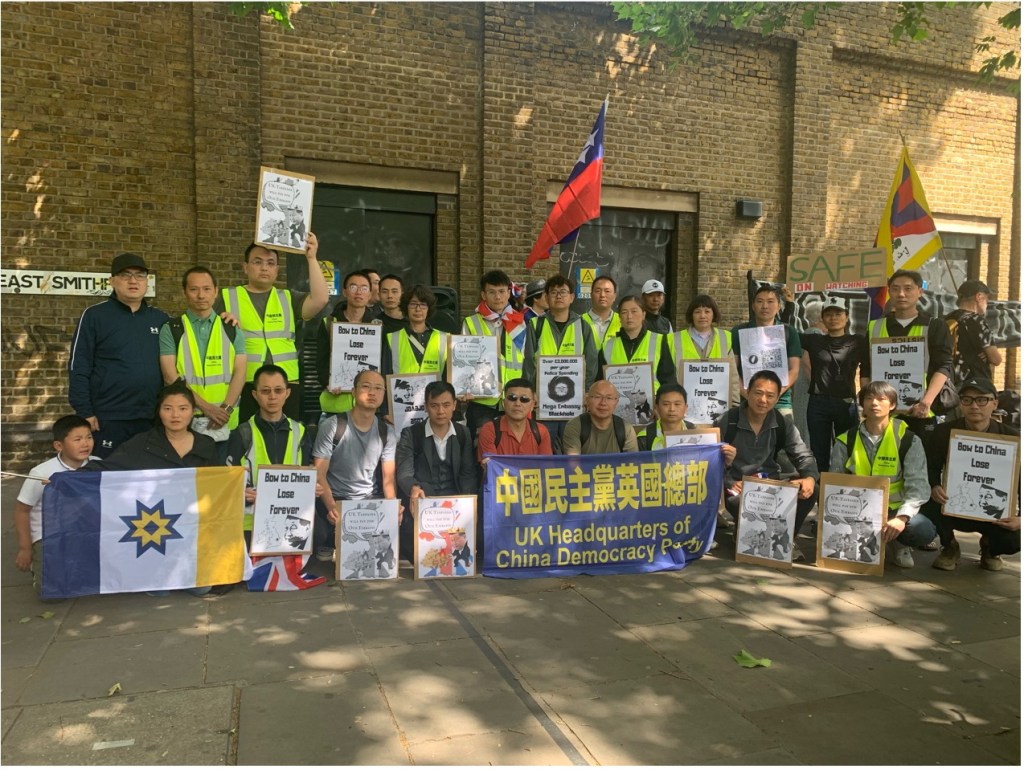
On May 3, 2025, the UK Headquarters of China Democracy Party, in collaboration with Hong Kong, Uyghur, and Tibetan human rights groups, organized a large-scale protest and march outside Royal Mint Court in London. The demonstration was held in strong opposition to the Chinese government’s proposed construction of a so-called “mega embassy” at the site.
The protest expressed deep concern over the CCP’s infiltration into Western democratic societies, and called on the UK government to immediately terminate the project in order to safeguard public safety and freedom of speech in London. As the British authorities are expected to make a final decision on the project within May, organizers stressed that now is a crucial moment for all sectors of society to speak out.
[At the Scene: Nearly 3,000 Protesters Surround Royal Mint Court]
The protest officially began at 2:00 PM, gathering approximately 3,000 demonstrators, the majority of whom were from the Hong Kong community. The crowd formed a one-kilometer marching route around Royal Mint Court. The procession was so extensive that by the time the front of the march returned to the starting point, the rear had not yet begun moving—a powerful and visually striking demonstration.
Participants held banners reading “No Mega Embassy”, “CCP Out of London”, and “Human Rights Are Not Negotiable”, while chanting slogans such as “Xi Jinping Step Down” and “CCP Get Out of the UK”. These messages conveyed strong opposition to the Chinese regime and a clear demand to halt the construction of the CCP’s mega embassy in London.
Many participants also took the initiative to engage with bystanders, explaining the protest’s purpose and the political position of the UK Headquarters of China Democracy Party, winning considerable understanding and support from local residents.
While police were present to maintain order and the atmosphere remained largely peaceful, it was reported that one volunteer paramedic assisting protesters was arrested, which drew concern among some attendees.
UK Headquarters of China Democracy Party: Peaceful Resistance Against Authoritarian Expansion
The protest was organized by Huang Jun, Huang Tian, and He Zhiwei, and received widespread support from groups including Hongkongers in Britain, Stand with Hong Kong, as well as Tibetan and Uyghur rights advocates. Numerous senior members and supporters of the UK Headquarters of China Democracy Party attended, showing firm resistance to authoritarianism and a steadfast commitment to democracy and freedom.
The UK Headquarters of China Democracy Party adheres firmly to the principles of peace, reason, and nonviolence, maintaining close communication with the Metropolitan Police to ensure the event proceeded legally, safely, and in an orderly manner. The demonstration was well-organized, with all participants respecting public order and demonstrating a high level of discipline and responsibility.
During the gathering, party members followed the principles of encouraging free expression and unity in diversity, actively interacting with the public, facilitating open dialogue, and receiving positive feedback.
The UK Headquarters of China Democracy Party remains committed to standing alongside democratic movements both in China and around the world, resolutely opposing authoritarian influence in free societies, and striving to build a future of constitutional democracy in China.
Organizers:
Huang Jun, Huang Tian, He Zhiwei
Attending Party Members and Supporters (May 3):
Zhou Huan, Feng Lin, Lin Mingqiang, Guo Jiaxuan, Yang Su, Zhu Shuanglin, Li Haobo, Li Tao, Wang Jian, Zhao Wu, Ding Chenguang, Wen Zuotuan, Hou Erbin, Gu Xiaofeng, Zhang Xuemei, Zhao Yulian, Wu Yong, Wei Chonghua, Fan Kewei, Huang Jun, Cheng Yali, Cheng Xiaodan, Huang Tian, Lü Jianqi, Lan Ziming, Dai Chao, Dai Xuemei, Bai Lin, He Zhiwei, Yu Jiehui, Jiang Wei, Wang Yan, Dong Yanjun, Wu Zhifen, Kaney Huang, Wang Jinxiu, Liu Yaoxing, Xu Shaonan, Guo Yuxuan, Zeng Fu.
UK Headquarters of China Democracy Party Holds May Day Protest
Contributor: Huang Tian (UK Headquarters of China Democracy Party)
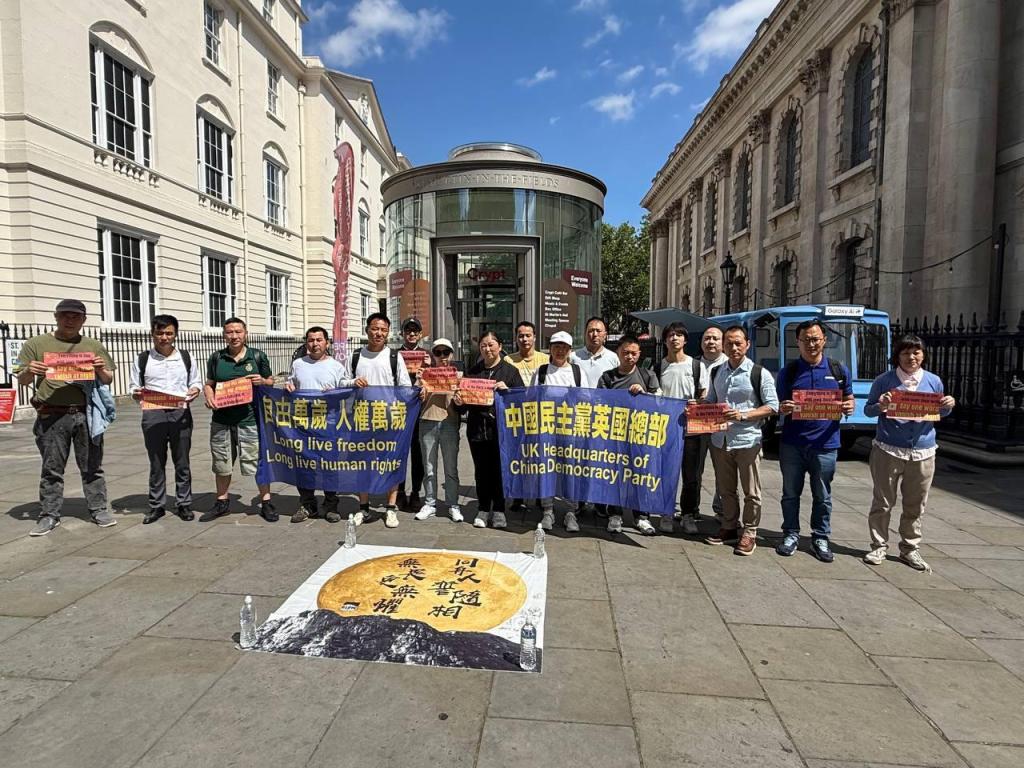
On May 1, 2025, International Workers’ Day, the UK Headquarters of China Democracy Party organized a powerful protest in front of the Chinese Embassy in London, demanding that the Chinese government genuinely protect workers’ rights, legalize independent trade unions, shut down sweatshops, and release all political prisoners—including Xu Zhiyong and Ding Jiaxi.
The protest was coordinated by Huang Tian, Huang Jun, and He Zhiwei, and officially began at 2:00 PM. Party members Fan Kewei, Wen Zuotuan, Huang Tian, Huang Jun, and Zhu Siyong delivered speeches one after another.
In his speech, Fan Kewei emphasized that labor rights in China have long been ignored and suppressed, and workers are not allowed to speak out. He called on overseas members of the China Democracy Party to take initiative and speak up for those imprisoned for defending their rights. Wen Zuotuan declared that only the fall of the Chinese Communist Party can save China, whether for the oppressed working class or the ethnic minorities struggling for autonomy—“our common enemy is the CCP.”
Huang Tian stated that the UK Headquarters of China Democracy Party’s protest on May Day was not just a matter of political disagreement, but a strong condemnation of the CCP’s betrayal of its own founding promise—the alliance of workers and peasants. Huang Jun pointed out that a truly strong nation should not fear the voices of its people, nor treat citizens who defend law and human rights as enemies. He stated that history will remember the CCP’s repression of rights activists, just as it will remember those who lit a torch in the darkness.
Zhu Siyong delivered his speech while wearing a face mask, satirizing the CCP’s attempts to silence the people. He asserted that censorship cannot suppress justice and conscience.
Protesters held banners with slogans such as “Long Live Freedom, Long Live Human Rights”, “CCP ≠ Chinese People”, and “Free Xu Zhiyong, Ding Jiaxi, and All Political Prisoners”, and chanted loudly: “Xi Jinping Step Down!”, “Down with the Communist Party!” The protest conveyed strong support for workers’ rights and independent unions, solidarity with all political prisoners, and the demand that Xi Jinping and the Communist Party step down and face the people’s judgment.
Party members actively engaged with passers-by, introducing the purpose of the protest and explaining the political platform of the UK Headquarters of China Democracy Party, which received understanding and support from many local British citizens.
The UK Headquarters of China Democracy Party and its organizers adhered to the principles of peacefulness, rationality, and nonviolence, took the initiative to maintain order and cleanliness at the scene, and ensured that the protest proceeded in a safe and orderly manner. Members were encouraged to express their views freely, demonstrating—through action—the stark contrast in values and behavior between the China Democracy Party and the Chinese Communist Party.
The UK Headquarters of China Democracy Party will continue to work alongside democracy activists and organizations, both in China and abroad, to overthrow the CCP dictatorship and achieve true constitutional governance in China.
Speakers (in order):
Fan Kewei, Wen Zuotuan, Huang Tian, Huang Jun, Zhu Siyong
Attending Party Members:
Lingda Tan, Cheng Xiaodan, Cai Bo, Lin Mingqiang, Zhang Xuemei, Hou Erbin, Yu Jiehui, Wu Zhifen, Kaney Huang, Wang Yan, Dong Yanjun, Jiang Wei, Huang Lin, Meng Jing, Bai Lin, Dai Chao, Guo Jiaxuan, Wang Jian, Feng Lin, Lan Ziming, Zhao Wu, Zhu Shuanglin, Wu Yong, Zhu Siyong, Fan Kewei, Wen Zuotuan, Huang Jun, Huang Tian, Li Haobo, Zhou Huan, Xu Weihua, Wei Chonghua, Yang Su, He Zhiwei.
Xi Jinping’s Step-Down? A Long Life Would Be Better
By Cheng Min, Member of the UK Headquarters of the China Democracy Party
As we all know, under the diligent efforts of our present ruler, Xi Jinping, China’s once-prized economic growth and already scarce freedom of speech have rapidly regressed toward the era of the Cultural Revolution. The stark contrast between the state media’s grand proclamations of a “prosperous era” and the grievances voiced by ordinary citizens has never been more evident. Ironically, this reflects the so-called “core socialist values” that the Chinese government promotes—terms like democracy and freedom are deemed positive when used by state media, yet when an ordinary citizen dares to hold up a sign advocating for them, they are accused of “picking quarrels and provoking trouble.”
Many Chinese people, including even some overseas anti-CCP activists, seem to believe that if Xi Jinping, the “emperor in new clothes,” steps down, many of China’s problems will be resolved. They attribute the country’s current plight to a foolish and obstinate ruler, often reminiscing about a past when freedom of speech in China seemed less restricted.
Personally, I do not think Xi Jinping stepping down would be beneficial for China. In fact, from the perspective of China’s democratization, I sincerely hope Xi Jinping remains in power indefinitely—perhaps even living to a hundred. Within anti-CCP circles, there is a saying: “One loyal CCP supporter is worth ten critics.” It means that a die-hard CCP loyalist can cause more damage to the Party than ten dissidents combined. Another saying goes: “A thousand words from dissidents cannot compare to one punch from the CCP.” No matter how hard we try to wake the Chinese people up, we are often labeled as conspirators trying to overthrow the “great socialist system.” But when the CCP itself delivers a harsh blow—through repression or economic failure—loyal patriots are often left bewildered, sometimes even awakening to the reality that they are nothing more than expendable “leeks” for the regime to harvest.
Despite officially leading the CCP, Xi is, in practice, one of the most effective anti-communist figures in the world. Many jokingly call him China’s “Supreme Accelerator-in-Chief”—a title that is well-deserved and based on solid evidence.
The “Acceleration” of Xi Jinping
Since taking office, Xi Jinping has made countless reckless moves, much like his old friend Donald Trump. His constitutional amendment to abolish term limits shattered many people’s hopes for a democratic transition in China. His suppression of Hong Kong exposed to the world that the CCP is a faithless and lawless mafia organization. His handling of Hong Kong also made it crystal clear to the Taiwanese that the so-called “One Country, Two Systems” was nothing more than a ruse—a tactic to lure and then strangle.
Xi’s ruthless pandemic control measures, his relentless crackdown on freedom of speech, his deepening of brainwashing education, and his aggressive “wolf warrior diplomacy” have all contributed to the rapid erosion of the CCP’s already fragile credibility—both domestically and internationally. His reckless foreign aid spending, while neglecting his own citizens’ healthcare and education, has only further disillusioned the Chinese people. These factors combined have led to China’s plummeting global reputation, deterring foreign tourists and fueling widespread discontent. Today, China is viewed with growing suspicion and resentment worldwide.
In other words, when it comes to “undermining the foundations of socialism,” no democratic movement or religious opposition group can compare to Xi Jinping. He has single-handedly done more damage to the CCP than any organized resistance ever could.
What If Xi Jinping Steps Down?
If Xi were to step down under normal circumstances, his successor might continue his “acceleration” efforts, pushing the regime further toward collapse. However, if he were ousted through a coup or internal power struggle, the new leader would likely be a pragmatic “fake reformer” in the mold of Deng Xiaoping—someone who pays lip service to economic openness while making superficial concessions to the West. This new leader might loosen some speech restrictions, allowing controlled dissent to create an illusion of change. The regime could ease restrictions just enough to pacify public anger, leading to a temporary illusion of a “wise ruler’s return.”
In such a scenario, the fundamental political structure would remain unchanged. The public would remain largely unaware of their continued oppression, and the West, driven by economic interests, would eagerly turn a blind eye once again. China would sink back into its cycle of authoritarian resilience. If that is the case, why risk a chaotic leadership transition for superficial change? It would be far better to let Xi continue his self-destructive path—after all, a consistent fool is far less dangerous than a cunning manipulator.
Let Xi Jinping “Accelerate” to the End
There’s a saying: “Whom the gods would destroy, they first drive mad.” Xi Jinping’s continued leadership ensures that he will keep pushing the CCP toward its own demise. Every day that he remains in power, the CCP weakens, public dissatisfaction grows, and the free world becomes more wary of China’s authoritarianism.
So, rather than wishing for Xi’s resignation, let us wish him a long and healthy life—so that he may continue his work of self-sabotage. Long live Xi Jinping’s acceleration!
As for what comes next once Xi Jinping finally brings down the CCP? That is a question for another day.
Thousands Gather to Continue Protesting the “Super Embassy” Plan
On March 15, 2025, a large-scale protest was held in front of the Royal Mint Court in London against the Chinese government’s plan to establish a “super embassy” at this location. The protest was jointly organized by multiple Hong Kong groups in the UK, along with Tibetan, Uyghur, and other ethnic communities. The aim was to express to the UK government and the London police that the site is unsuitable for the construction of a Chinese embassy.
UK Headquarters of China Democracy Party UK actively participated in the protest. A representative at the scene reaffirmed: “Only by upholding freedom and democracy can we effectively resist the Chinese Communist Party’s expansion overseas.”
The protest began at 3:00 PM and attracted thousands of demonstrators. The crowd quickly gathered, and due to the large number of participants, some protesters overflowed from the designated gathering area, leading to the temporary closure of some streets and disrupting traffic. The London police dispatched several police vehicles and over a hundred officers to maintain order.
Several British Members of Parliament and local representatives attended to show their support. In their speeches, they stated that the new Chinese embassy would not only undermine the safety and freedom of British citizens but could also pose a threat to national security. Some MPs stressed that the government should stand firm against pressure from the Chinese Communist Party and never bow to authoritarian forces.
As the protest continued for several hours, order was gradually restored under the guidance of the police. However, the voices of the protesters and the related discussions continued to spread on social media. The event organizers stated that they would continue to closely monitor the UK government’s review process regarding the embassy construction application and plan to organize further actions to express public opinion if necessary.
List of attendees on March 15: Dai Chao, Dai Xuemei, Zhao Yulian, Cai Bo, Gu Xiaofeng, Cheng Xiaodan, Cheng Yali, Xu Shaonan, Yang Su, Li Tao, Zhang Xuemei, Wang Jian, Guo Jiaxuan, Huang Tian, Fan Kewei, Huang Jun, Wu Yong, He Zhiwei, Wei Songhua, Wen Zuotuan
Reporter of UK Headquarters of China Democracy Party: He Zhiwei
Strong Demand for the Release of All Female Political Prisoners and Prisoners of Conscience
On March 8, 2025, International Women’s Day, the UK Headquarters of the China Democracy Party organized a protest outside the Chinese Embassy in London. On this day, demonstrations were held worldwide, calling for gender equality, opposition to gender-based violence, and the eradication of all forms of discrimination. In London, in addition to addressing human rights issues both domestically and internationally, overseas Chinese and feminist groups also took this opportunity to criticize the Chinese government’s human rights violations. Meanwhile, several human rights organizations from Hong Kong and Taiwan also participated in the protest. At its peak, the event saw over a hundred attendees.
The protest began at 3 PM, with the UK Headquarters of the China Democracy Party holding banners with slogans such as “Release All Female Political Prisoners!” and “Women’s Rights Persist, Freedom Endures!”. Advisor Huang Hua was the first to speak, focusing on the urgent situation of citizen journalist Zhang Zhan, who is currently persecuted by the Chinese government. He called on the international community to pay attention to Zhang Zhan’s human rights conditions. Holding a loudspeaker, Huang Hua led all members in chanting: “Release Zhang Zhan!”, “Xi Jinping Step Down!”, “Down with the Communist Party!”, “Long Live Freedom!”, and “Long Live the People!”
The atmosphere was passionate, and the chants were powerful, but the protest remained orderly. Some groups specifically highlighted the ongoing human rights violations in China, calling on the international community to focus on the plight of political prisoners and demanding the release of all feminist activists imprisoned for their political beliefs.
Opposition to CCP’s Overseas Expansion
The protest also included criticism of the Chinese Communist Party’s use of overseas institutions to monitor and suppress Chinese citizens both domestically and abroad. Demonstrators called for resistance against the CCP’s influence and strongly demanded that the Chinese government immediately release all female political prisoners detained for their political beliefs and cease repression of feminist dissidents. Protesters emphasized that these women have suffered prolonged and unjust persecution simply for advocating for freedom of speech and gender equality, and their plight should receive urgent international attention.
On the same day, the UK Headquarters of the China Democracy Party also sent representatives and members to actively participate in other human rights demonstrations.
Cross-Community Collaboration for Justice and Freedom
This event was an important initiative by overseas Chinese to unite in defense of democracy, freedom, and women’s justice. Only by upholding freedom and justice can the oppressive policies of the CCP be effectively resisted.
The protest also received support from Hong Kongers, Uyghurs, Tibetans, Taiwanese, and other pro-democracy and human rights groups in the UK, forming a cross-cultural and multi-issue united resistance movement to pressure the Chinese government and raise international awareness of the dire conditions faced by female political prisoners in China. Protesters voiced their demands through chants and banners, and some representatives delivered speeches on-site, calling for the “Release of All Female Political Prisoners” and urging the Chinese government to cease its suppression of female dissidents.
Some participants stated that this gathering was not only a protest against the Chinese government’s policies but also an essential action for overseas Chinese in their fight for fundamental human rights and gender equality. Through direct street demonstrations, participants demonstrated the firm stance of the overseas Chinese community in advocating for freedom of speech and gender equality.
Furthermore, participating groups plan to establish long-term cooperation with more international human rights organizations to secure greater global support for the release of imprisoned female political prisoners. Leveraging International Women’s Day as an opportunity, the protest embodied a cross-ethnic, cross-issue coalition against the Chinese government’s prolonged suppression of female political prisoners. In the future, such cross-issue protests may become a key approach for overseas Chinese and allied groups in defending democracy and freedom while pushing the international community to focus on the plight of female political prisoners in China.
Speakers:
Cheng Yali, Fan Kewei, Wen Zuotuan, He Zhiwei
Attending Party Members:
Xu Shaonan, Dai Chao, Lan Ziming, Cheng Xiaodan, Wei Chonghua, Cai Bo, Zhang Xuemei, Guo Jiaxuan, Wang Jian, Fan Kewei, Cheng Yali, Yang Su, Zhu Shuanglin, Gu Xiaofeng, Zhu Siyong, Wen Zuotuan, Wu Yong, Liu Liyan, Liu Yaoxing, Xu Weihua, Huang Tian, Cheng Min, Huang Jun, He Zhiwei, Li Haobo, Zhou Liang, Yan Lei, Yu Gang, Huang Hua, Wang Guanru, Lu Lingfei, Lin Mingqiang.
Reported by He Zhiwei, Journalist, UK Headquarters of the China Democracy Party