中国的跨国迫害 China’s Transnational Persecution

作者:中国民主党记者俞滨 2025年1月20日
中国,作为全球最大且最为封闭的国家之一,其国内的言论和信息管制向来严密。国内民众无法自由访问全球社交平台,只有通过VPN等技术手段才能绕过这一封锁,而使用这些工具本身在中国也被视为违法行为。封锁限制了国内对外界的接触,讽刺的是,中国的跨国迫害影响力已经远远超出了国界,渗透到全球各地。

跨国迫害的背后,是一个精密且系统化的国家机器运作,它不依赖于单一形式的威胁,而是通过多样的手段和渠道,构成了一个在全球范围内不断扩张的恐惧体系。

我的朋友Lyndon Li之前为美国之音调查了一起前皇家海军陆战队员被指控为香港情报机构工作间谍的离奇死亡案件。死者与中国政府的间谍网络有关联。这一事件不仅暴露了中国跨国行动的深度,也突显了中国对外部世界进行渗透与干扰的恐怖。

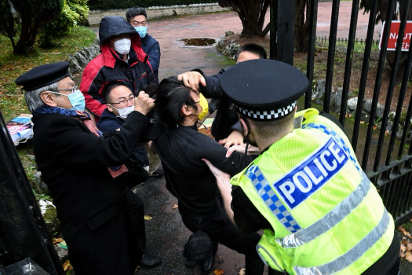
类似的暴力事件并非个别。中国驻曼彻斯特总领事馆内的工作人员曾在2019年对香港抗议者实施暴力行为。一位在领馆外进行抗议的香港人遭到殴打,并被强行拖入领馆内。动用暴力来维护所谓的“国家尊严”。这种行径不仅直接威胁到受害者的人身安全,也挑战了人权的的基本保护。

在同一地点,中国领馆工作人员还曾威胁自由亚洲的记者,试图阻止其进行新闻报道。当记者在领馆门口拍摄时,工作人员声称该行为违反了《维也纳公约》中的外交特权,并扬言报警。虽然记者强调其拍摄的是公共区域,属于言论自由的范畴,但这些工作人员依然对记者进行了干扰和恐吓。

除了暴力和恐吓外,中国还通过国际刑警发布“红通”,将跨国追捕作为常规手段。许多被中国政府视为“威胁”的民主人士,甚至无辜的香港青年,均成为中国政府跨国打压的目标。一位19岁的香港女孩張晞晴因涉嫌“分裂国家”而被悬赏100万港币通缉。

我自己也曾遭遇过类似的跨国迫害。作为长期关注中国政治和人权的活动人士,我也曾被不明身份的人士袭击,伦敦警察局逮捕了袭击者,已经做出了起诉决定。

中国的跨国迫害系统是精密且具有全球扩张性的。无论是通过暴力、恐吓、间谍活动,还是利用外交手段限制言论自由,中国的跨国行动都在无形中侵蚀了全球的民主与人权空间。更重要的是,这一系统并非单纯的局部事件,而是一整套由国家机器驱动的全球性压制机制。

跨国迫害的力量,并非仅在于肉体上的伤害,而在于它让人们在无形中丧失了自我表达的权利,逐渐让恐惧成为无法摆脱的阴影。

而最危险的压迫,是在表达之前的恐惧。

China’s Transnational Persecution

By— Bin Yu, Journalist of China Democracy Party(UK) 20th, Jan, 2025

China, as one of the largest and most closed-off countries globally, has always maintained strict control over speech and information within its borders. Domestic citizens are unable to freely access global social platforms and can only bypass these blocks through technologies like VPNs, which are considered illegal in China. This censorship limits the domestic population’s interaction with the outside world, yet ironically, China’s transnational persecution influence stretches far beyond its borders, infiltrating nations across the globe.

Behind this transnational persecution lies a sophisticated and systematic state apparatus. It does not rely on a single form of threat but instead employs a variety of methods and channels, creating a growing system of fear that expands worldwide.

My friend Lyndon previously investigated the bizarre death of a former Royal Marine who was accused of working as a spy for Hong Kong intelligence agencies. The deceased had connections to China’s spy network. This case exposed not only the depth of China’s transnational operations but also highlighted China’s terrifying efforts to infiltrate and disrupt the external world.

Such violent incidents are not isolated. Staff at the Chinese Consulate in Manchester were involved in violent acts against Hong Kong protesters in 2019. A Hong Kong protester outside the consulate was beaten and forcibly dragged inside the consulate. This use of violence was purportedly to protect the so-called “national dignity.” Such actions not only directly endanger the safety of victims but also challenge fundamental human rights protections.

At the same location, consulate staff also threatened a journalist from Radio Free Asia in an attempt to prevent reporting. When the journalist was filming outside the consulate, staff claimed the action violated the diplomatic privileges outlined in the Vienna Convention and threatened to call the police. Despite the journalist’s clarification that the filming was in a public space, within the scope of free speech, the staff continued to harass and intimidate the reporter.

In addition to violence and intimidation, China also utilizes Interpol’s “Red Notice” to pursue transnational arrests as a routine method. Many individuals the Chinese government deems as “threats,” including innocent Hong Kong youth, have become targets of China’s global crackdown. A 19-year-old Hong Kong girl, Cheung Hei Ching. was even offered a reward of 1 million Hong Kong dollars for her capture on charges of “separatism.”

I myself have encountered similar transnational persecution. As a long-time advocate for Chinese politics and human rights, I have been attacked by individuals of unknown identity. The London Metropolitan Police arrested the assailant, and prosecution has already been decided.

China’s transnational persecution system is sophisticated and expansively global. Whether through violence, intimidation, espionage, or diplomatic means to restrict freedom of speech, China’s transnational actions subtly erode the global space for democracy and human rights. More importantly, this system is not merely a series of localized incidents but a comprehensive global suppression mechanism driven by the state apparatus.

The power of transnational persecution lies not only in the physical harm it causes but in its ability to gradually strip individuals of their right to self-expression, making fear an inescapable shadow.

And the deepest oppression, is the fear before expression.
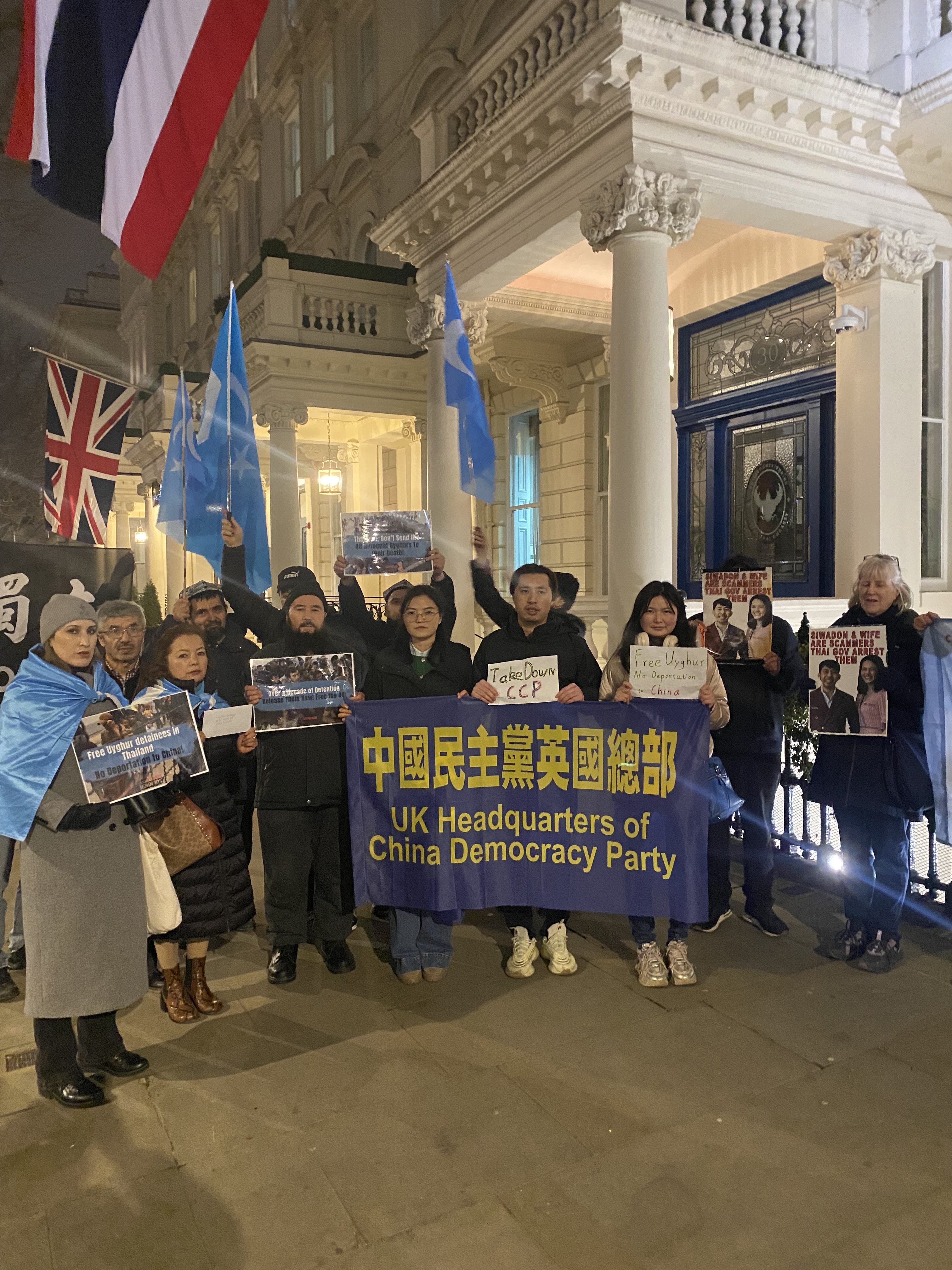
声援维吾尔族,促请泰国政府停止遣返并释放无辜维吾尔族人士  Stand in Solidarity with Uyghurs, Urge the Thai Government to Stop Deportation and Release Innocent Uyghur Individuals

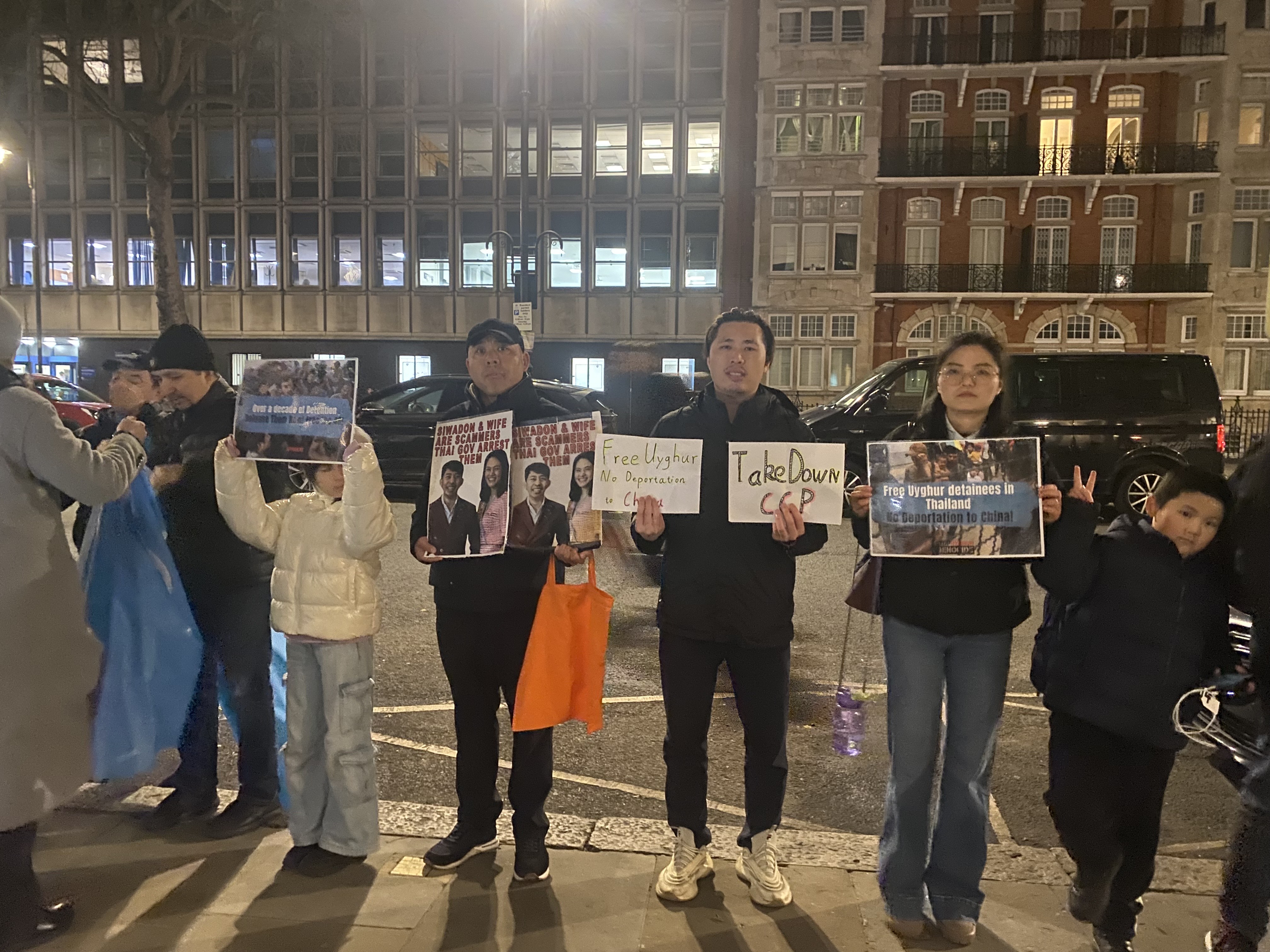
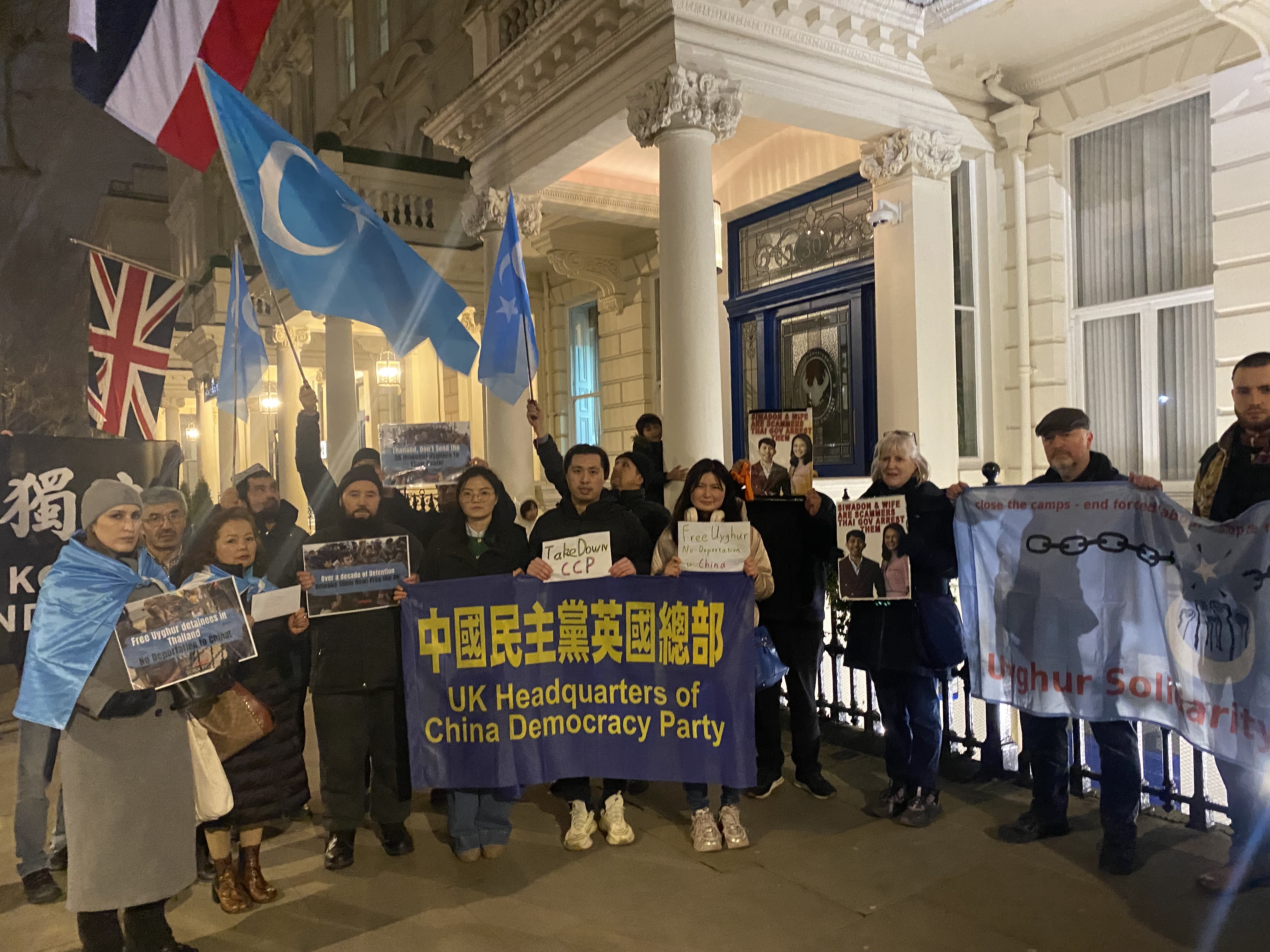
 2025年1月17日,中国民主党英国总部声援维吾尔族社区代表,在伦敦泰国驻英大使馆门口发起抗议活动,呼吁泰国政府不要将48名被拘留的维吾尔族人士遣返中国,并敦促其采取行动,捍卫这些难民的基本人权。 

 2025年1月,泰国政府计划将被拘留的48名维吾尔族难民遣返中国的消息引发了国际社会的广泛关注和担忧。这些维吾尔族人于2013年和2014年逃离中国,寻求在土耳其重新定居,但在泰国被拘留至今,已有十余年。 据报道,泰国移民官员于1月8日要求这些被拘留者签署“自愿遣返”文件,但他们全部拒绝签署。人权组织和家属担心,一旦被遣返回中国,这些维吾尔族人可能面临监禁、酷刑,甚至失去生命的风险。2015年,泰国曾将109名维吾尔族人遣返中国,导致国际社会的强烈谴责。联合国人权专家在2024年2月曾致函泰国政府,指出对这些被拘留者的待遇可能违反国际法,并提醒泰国应遵守国际不驱回原则。 鉴于此,国际人权组织呼吁泰国政府停止遣返计划,遵守国际人权义务,确保这些维吾尔族难民的安全。他们强调,泰国应与国际人权机构合作,寻求解决方案,避免重蹈2015年的覆辙。 

 活动当天,抗议者手举标语,高呼“停止遣返”“保护难民权利”等口号,以引起国际社会对这批维吾尔族难民处境的关注。维吾尔族代表在现场发言,讲述了维吾尔族群体在中国遭受的迫害,并强调这些难民一旦被遣返,极有可能面临酷刑、监禁甚至生命威胁。泰国政府应该站在国际人道主义的一边,避免成为中国政府人权迫害的帮凶。” 

 抗议活动中,组织者和参与者联名签署了一封正式信件,并递交给泰国驻英大使馆的代表。信件中严正要求泰国政府遵守国际义务,拒绝将难民遣返至中国,同时与国际人权机构合作,确保这些难民得到公平的待遇和保护。

 此次中国民主党英国总部的抗议不仅是对被压迫的维吾尔族同胞的声援,更是对国际社会维护人权和捍卫正义的呼唤。维吾尔族难民问题不仅关乎人道主义,也直接反映了全球人权捍卫的现状。 

 中国民主党英国总部将继续与各界人士和组织一道,推动国际社会对维吾尔族困境的关注,并为受迫害者争取更多的国际支持。我们坚信,只有通过团结与努力,才能让每个人都享有自由与尊严的基本权利。

 出席活动党员:成小丹、成亚丽、何智威、Thomas Hao 

中国民主党英国总部记者成小丹报道

Stand in Solidarity with Uyghurs, Urge the Thai Government to Stop Deportation and Release Innocent Uyghur Individuals

January 17, 2025, Outside the Thai Embassy in London

On January 17, 2025, the UK Headquarters of the Chinese Democratic Party, in solidarity with representatives of the Uyghur community, organized a protest outside the Thai Embassy in London. The protest called on the Thai government to refrain from deporting 48 detained Uyghur individuals back to China and urged the government to take action to defend the basic human rights of these refugees.

In January 2025, the news that the Thai government planned to deport 48 detained Uyghur refugees to China sparked widespread international concern. These Uyghurs had fled China in 2013 and 2014, seeking resettlement in Turkey, but have been detained in Thailand for more than a decade.

Reports indicate that on January 8, Thai immigration officials asked the detainees to sign “voluntary deportation” documents, but all of them refused to sign. Human rights organizations and family members fear that if deported to China, these Uyghurs could face imprisonment, torture, or even death. In 2015, Thailand deported 109 Uyghurs to China, which led to strong international condemnation. In February 2024, UN human rights experts sent a letter to the Thai government, noting that the treatment of these detainees might violate international law, and reminding Thailand to uphold the principle of non-refoulement.

In light of this, international human rights organizations have called on the Thai government to halt the deportation plan, comply with international human rights obligations, and ensure the safety of these Uyghur refugees. They emphasized that Thailand should cooperate with international human rights organizations to seek a solution and avoid repeating the mistakes of 2015.

On the day of the protest, demonstrators held banners and chanted slogans such as “Stop Deportation” and “Protect Refugee Rights” to raise awareness of the plight of these Uyghur refugees. A representative from the Uyghur community spoke at the event, describing the persecution faced by the Uyghur people in China. The speaker stressed that these refugees, if deported, could face torture, imprisonment, and even life-threatening risks. Protesters called on the Thai government to align with international humanitarian principles and avoid becoming complicit in China’s human rights violations.

During the protest, the organizers and participants jointly signed an official letter, which was submitted to a representative at the Thai Embassy. The letter strongly urged the Thai government to fulfill its international obligations, refuse to deport the refugees to China, and cooperate with international human rights organizations to ensure that these refugees receive fair treatment and protection.

This protest organized by the UK Headquarters of the Chinese Democratic Party is not only an act of solidarity with the oppressed Uyghur community but also a call for the international community to uphold human rights and justice. The issue of Uyghur refugees is not only a humanitarian issue but also directly reflects the state of global human rights advocacy.

The UK Headquarters of the Chinese Democratic Party will continue to work with individuals and organizations worldwide to increase international attention to the plight of the Uyghurs and secure more international support for those persecuted. We firmly believe that only through unity and effort can every person enjoy the fundamental rights of freedom and dignity.

Participants in the event: Xiaodan Cheng ,Yali Cheng, Zhiwei He, Thomas Hao

Reporter: Xiaodan Cheng, Chinese Democratic Party UK Headquarters

浅谈邪教与中共的共通性  A brief discussion on the commonalities between cults and the CCP


我们都知道,在近几十年来全球经济一体化,文化多元化的大背景下,世界各地存在着多种宗教信仰,这些信仰包括宣扬神爱世人的基督教,教导行善积德的佛教,崇尚道法自然的道教,敬畏自然万物的神道教等等,而此类宗教信仰往往有几个共同点,一是致力于引导人们追求内心的宽容与善念,二是组织透明,教义透明,可以自由延伸与发展不同教派,信众可以自由加入与退出,这种无害的信仰往往也受到文明国家的法律保护。

至于邪教的定义,几乎可以说是与宗教完全背道而驰,他们往往致力于宣扬极端思想并以此洗脑信众,强调个人崇拜,教主被神化,拥有至高无上的权威,信众必须遵循教义要求去仇视指定的群体。同时几乎所有邪教一律对宗教与普世价值抱有强烈的排斥性,它们声称只有自己才是唯一真理,其余都是异端邪说。同时邪教往往采取秘密封闭式运作,禁止信众接触外界信息,甚至长期对信众强制隔离洗脑,通过恐吓,孤立,诱导等手段对成员进行精神控制,从而使他们丧失独立思考与逻辑推理的能力,成为”让恨谁就恨谁,让杀谁就杀谁”的提线木偶。

其实懂的人看到这里应该都感觉似曾相识了,没错,中共的统治逻辑,其实就是典型的邪教组织理念。而他们对中国人的洗脑手法说穿了其实和一般的邪教一样的简单粗暴。

首先我们应该给洗脑下定义,什么情况可以称之为洗脑呢?比如我在YouTube看反共视频,算不算被西方敌对势力洗脑?比如我的一位老师给我灌输他的小众思想,算不算洗脑?综合上面对邪教的定义,我认为洗脑应该同时具备三个不可或缺的特性,一是强制性,二是长期性,三是隔绝性。要认定是否是洗脑,我个人认为这三点缺一不可。

一,强制性,人民必须接受中共的思想灌输,中共的强制思想灌输要求每个人都接受它赋予的价值观与思想理念,久而久之便剥夺了人民独立思考的能力,同时它严厉惩罚一切公开反对思想灌输的异见人士,你还想不想毕业?想不想保住工作?想不想家人团聚?

二,长期性,洗脑不是一朝一夕的事,是需要重复不断的灌输,直到在人的大脑中打下不可磨灭的思想钢印,从而发自本能的去尊崇教主的神化和对教派的认同感。关于这点,每一个在中国长大的反贼想必都深有体会,从80,90后童年时期每天不间断播放的红色电影和歌曲,到从小学到初中语文教科书上先烈们”保家卫国”血洒疆场的感人事迹,再到高中与大学时期政治课上”伟大祖国”的热血历史,以及这些年遍地开花的”中老年特供版”谍战与抗日神剧,中国人的一生可谓是被中国360度无死角洗脑的一生。这一点我也认为是最重要的一点,试想就算是一条对你狺狺狂吠了三十年的狗,想必一般人多少也会有点感情,遑论是将自己包装成”人民救星”,”人民公仆”的中共呢?

三,隔绝性,这一点也尤为重要,正如先前所说,邪教普遍具有强烈的排他性,因为他们的教义往往既经不起逻辑推理,同时也反人性,所以必须将信众其他思想隔绝在外,禁止信众接触。因为多种思想教派必然会对人产生冲击,继而引发思考与讨论,而邪教充斥着谎言与暴论的极端思想在宗教与普世价值面前往往不堪一击。中共一早就洞悉并深谙其道,早早的建立起了长城防火墙,拒敌于国门之外,强化言论审查与信息封锁,确保了中国人民必须且只能接受中共二十年如一日的思想灌输。中国人一切关于人权,民主,乃至于普世价值的认知全部只能来源于中共的官方解释,中共不只是既当选手又当裁判,甚至直接禁止其他选手入场,将隔绝性这一点发挥的淋漓尽致。

综上,宗教信仰引导人们追求自由、真理与善良,而中共的统治手法不过是一套以谎言和恐惧为核心的典型邪教精神控制手段。它剥夺了人们的独立思考能力,封闭了思想的多元交流,其目的从来不是为了人民的福祉,而是与其他邪教一样,不过是为了维护少数人的权力。然而,这种建立在控制与虚假的基础上的体制,注定也会和其他邪教一样,在将来的某一天分崩离析。在信息化时代,思想的自由与真相的传播注定是最强大的力量。每个人的觉醒,都是瓦解精神枷锁的第一步;当人们开始追求真相,拥抱普世价值,历史必将再一次证明——任何违背人性与自由的体制,终将走向瓦解,而自由的曙光终将如期而至!

A brief discussion on the commonalities between cults and the CCP

We all know that in the context of global economic integration and cultural diversity in recent decades, there are many religious beliefs around the world. These beliefs include Christianity, which advocates God’s love for the world, Buddhism, which teaches good deeds, Taoism, which advocates the law of nature, and Shintoism, which respects all things in nature. Such religious beliefs often have several common points. One is that they are committed to guiding people to pursue inner tolerance and kindness. The other is that the organization is transparent, the doctrine is transparent, and different sects can be freely extended and developed. Believers can freely join and withdraw. This harmless belief is often protected by the laws of civilized countries.

As for the definition of cults, it can almost be said to be completely contrary to religion. They are often committed to promoting extreme ideas and brainwashing believers, emphasizing personal worship, and the leader is deified and has supreme authority. Believers must follow the doctrine to hate the designated group. At the same time, almost all cults have a strong rejection of religion and universal values. They claim that only they are the only truth, and the rest are heresy. At the same time, cults often operate in a secret and closed manner, prohibiting believers from contacting outside information, and even forcibly isolating and brainwashing believers for a long time. They use intimidation, isolation, induction and other means to control members’ minds, so that they lose the ability to think independently and reason logically, and become puppets who “hate whoever they are told to hate and kill whoever they are told to kill”.

In fact, those who understand should feel familiar when they see this. Yes, the ruling logic of the CCP is actually a typical cult organization concept. And their brainwashing methods for Chinese people are actually as simple and crude as ordinary cults.

First of all, we should define brainwashing. What situations can be called brainwashing? For example, if I watch anti-communist videos on YouTube, is it considered brainwashing by Western hostile forces? For example, if one of my teachers instills his niche ideas in me, is it considered brainwashing? Based on the definition of cults, I think brainwashing should have three indispensable characteristics at the same time. One is compulsory, the second is long-term, and the third is isolation. To determine whether it is brainwashing, I personally think that these three points are indispensable.

First, it is mandatory. People must accept the CCP’s ideological indoctrination. The CCP’s mandatory ideological indoctrination requires everyone to accept the values ​​and ideas it has given them. Over time, it deprives people of their ability to think independently. At the same time, it severely punishes all dissidents who openly oppose ideological indoctrination. Do you still want to graduate? Do you want to keep your job? Do you want to reunite with your family?

Second, it is long-term. Brainwashing is not a matter of one day or one night. It requires repeated indoctrination until an indelible ideological stamp is stamped in people’s brains, so that they instinctively respect the deification of the leader and identify with the sect. Every anti-communist who grew up in China must have a deep understanding of this. From the red movies and songs that were played every day during the childhood of the post-80s and post-90s, to the touching deeds of the martyrs who “protected the country” and shed blood on the battlefield in the Chinese textbooks from elementary school to junior high school, to the passionate history of the “great motherland” in the political classes in high school and college, and the “special edition for middle-aged and elderly people” spy war and anti-Japanese dramas that have blossomed everywhere in recent years, the life of the Chinese people can be said to be a life of 360-degree brainwashing by China. I also think this is the most important point. Imagine that even if it is a dog that has been barking at you for thirty years, most people will have some feelings for it, let alone the CCP that packages itself as the “savior of the people” and “people’s servant”?

Third, isolation, this is also particularly important. As mentioned earlier, cults generally have a strong exclusivity, because their doctrines often cannot withstand logical reasoning and are also anti-human, so other ideas of believers must be isolated and believers must be prohibited from contacting. Because various schools of thought will inevitably have an impact on people, and then trigger thinking and discussion, and the extreme thoughts of cults filled with lies and violence are often vulnerable to religion and universal values. The CCP has long understood and understood this, and has long established the Great Wall Firewall to keep the enemy out of the country, strengthen speech censorship and information blockade, and ensure that the Chinese people must and can only accept the CCP’s ideological indoctrination for 20 years. All the Chinese people’s cognition of human rights, democracy, and even universal values ​​can only come from the official explanation of the CCP. The CCP is not only a contestant and a referee, but also directly prohibits other contestants from entering the venue, which fully demonstrates the isolation.

In summary, religious beliefs guide people to pursue freedom, truth and kindness, and the CCP’s ruling methods are nothing more than a typical cult mind control method with lies and fear as the core. It deprives people of their independent thinking ability and closes off the diversified exchange of ideas. Its purpose has never been for the welfare of the people, but like other cults, it is just to maintain the power of a few people. However, this system based on control and falsehood is destined to fall apart one day in the future, just like other cults. In the information age, freedom of thought and the spread of truth are destined to be the most powerful forces. Everyone’s awakening is the first step to dismantling spiritual shackles; when people begin to pursue the truth and embrace universal values, history will once again prove that any system that violates human nature and freedom will eventually collapse, and the dawn of freedom will eventually arrive as expected!

2024中國人權狀況與改善總結 Summary of China’s Human Rights Situation and Improvement in 2024

中國在2024年經歷了一系列反社會事件,這些事件暴露出底層社會深刻的結構性問題與人權危機,並引發了國內外的廣泛關注。然而,中共政府對這些問題的回應仍顯得遲緩甚至迴避,使得人們對改善中國人權狀況的期望蒙上陰影。在2025年新的一年裡,中國政府如何改善人權現狀成為了關鍵議題。本文將探討2024年反社會事件的根源、中共政府的應對方式以及未來可能的改革方向。

2024年的反社會事件及其根源

2024年,中國多地爆發了一系列與底層民眾相關的反社會事件,包括工人集會抗議、農村土地糾紛、城鎮強拆衝突,以及涉及勞工剝削的極端暴力事件。一些地區的年輕人因缺乏工作機會和經濟壓力而陷入困境,最終選擇極端方式表達不滿。這些事件的根本原因可以歸納為:

經濟壓力增大:中國經濟增長放緩導致就業機會減少,特別是在製造業和服務業領域,許多農民工和大學生難以找到穩定工作。

社會不平等加劇:財富分配不均的問題越發嚴重,農村與城市、沿海與內陸地區的差距進一步擴大。

法律與監管缺失:底層民眾的權益無法通過法律手段得到有效保護,地方政府的強制手段引發民怨。

中共政府的回應

對於2024年的反社會事件,中共政府主要採取了以下策略:

加強控制與壓制:在社交媒體上嚴格審查相關信息,防止事件進一步發酵;對參與抗議的民眾進行逮捕或懲戒。

有限的經濟補償:對部分事件中的受害者提供經濟補償,但未觸及深層次的制度改革。

宣傳穩定的重要性:官方媒體集中宣傳“穩定壓倒一切”的理念,將事件歸咎於外部勢力煽動。

儘管如此,這些應對措施未能從根本上解決問題,甚至在某些地區引發更大的不滿。

2025年的改善方向

面對日益突出的社會問題和國內外壓力,中共政府在2025年需要採取更全面和負責的行動,以改善人權狀況和民生條件:

改革法律體系:加強對底層民眾權益的法律保護,確保土地糾紛、勞工權益等問題能通過公平的法律程序解決。

縮小貧富差距:推進財稅改革,加強對農村和貧困地區的扶持,創造更多公平的經濟機會。

提升社會透明度:允許媒體和民間組織參與監督,讓底層民眾的聲音能夠被傾聽和回應。

教育與培訓:為失業的年輕人和農民工提供技能培訓,幫助他們適應經濟轉型的需求。

國際合作:通過與國際組織合作,學習其他國家的成功經驗,推動人權保障的進一步制度化。

2024年的反社會事件是中國底層社會積累多年的結構性問題的集中爆發,這既是一個挑戰,也是一個契機。中共政府如果能在2025年採取積極而務實的改革措施,不僅能夠改善人權狀況,還能為國家發展注入新的動力。然而,如果政府選擇繼續迴避或壓制問題,則可能面臨更大的社會動盪與國際壓力。未來的中國需要一個更公平、更包容的社會結構,這是所有人共同努力的方向。

撰稿者:李亞倫

Summary of China’s Human Rights Situation and Improvement in 2024

China experienced a series of anti-social incidents in 2024, which exposed deep structural problems and human rights crises at the grassroots level and aroused widespread concern both domestically and internationally. However, the CCP government’s response to these issues has been slow or even evasive, overshadowing expectations for an improvement in China’s human rights situation. In the new year of 2025, how the Chinese government will improve the human rights situation will be a key issue. This article examines the root causes of the 2024 antisocial incidents, the Chinese Communist government’s response, and possible directions for future reform.

Anti-social incidents in 2024 and their root causes

In 2024, a series of anti-social incidents related to the grassroots erupted in many parts of China, including workers’ rallies and protests, rural land disputes, forced demolitions in cities and towns, and extreme violence involving labour exploitation. Young people in some districts, who are in dire straits due to the lack of job opportunities and financial pressure, have eventually chosen to express their discontent in an extreme manner. The root causes of these incidents can be summarised as follows:

Increased economic pressure: China’s slowing economic growth has led to a reduction in job opportunities, especially in the manufacturing and service sectors, where many migrant workers and university students have difficulty finding stable employment.

Worsening social inequality: The uneven distribution of wealth has become more serious, widening the gap between rural and urban areas and between coastal and inland areas.

Lack of law and regulation: The rights of the grassroots are not effectively protected through legal means, and the coercive measures of local governments have led to public discontent.

Response from the Chinese Communist Government

The CCP government has adopted the following strategies in response to the anti-social events of 2024:

Enhanced control and suppression: Strict censorship of information on social media to prevent further escalation; arrests and punishment of protestors.

Limited financial compensation: Financial compensation was offered to some victims of the incident, but did not touch on deeper systemic reforms.

Promotion of the importance of stability: The official media focused on the idea that ‘stability overrides everything’ and blamed external forces for instigating the events.

Nonetheless, these responses have failed to address the root causes of the problem, and have led to greater discontent in some areas.

Directions for Improvement in 2025

In the face of growing social problems and domestic and external pressures, the Chinese government will need to take more comprehensive and responsible action to improve the human rights situation and livelihood conditions in 2025:

Reform the legal system: Strengthen the legal protection of the rights of the grassroots and ensure that issues such as land disputes and labour rights can be resolved through fair legal procedures.

Reduce the wealth gap: Promote fiscal reform, strengthen support for rural and poor areas, and create more equitable economic opportunities.

Enhance social transparency: Allow the media and civil society organisations to participate in monitoring, so that the voices of the grassroots can be heard and responded to.

Education and Training: Provide skills training for unemployed young people and migrant workers to help them adapt to the demands of economic restructuring.

International Co-operation: Through co-operation with international organisations and learning from the successful experiences of other countries, we will promote the further institutionalisation of human rights protection.

The antisocial events of 2024 are a challenge but also an opportunity, as the structural problems of China’s underclass that have been accumulating for years have exploded in a concentrated manner. If the CCP government adopts positive and pragmatic reforms in 2025, it will not only improve the human rights situation, but also inject new momentum into the country’s development. However, if the government chooses to continue to avoid or suppress the issue, it could face greater social unrest and international pressure. The future of China needs a fairer and more inclusive social structure, and this is a direction we can all work towards.

Written by Yalun Li

中国民主党英国总部受邀参加香港议会筹委会自由香港宣言会议 UK headquarters of China Democracy Party was invited to attend the Free Hong Kong Declaration Conference of the Hong Kong Parliament Preparatory Committee

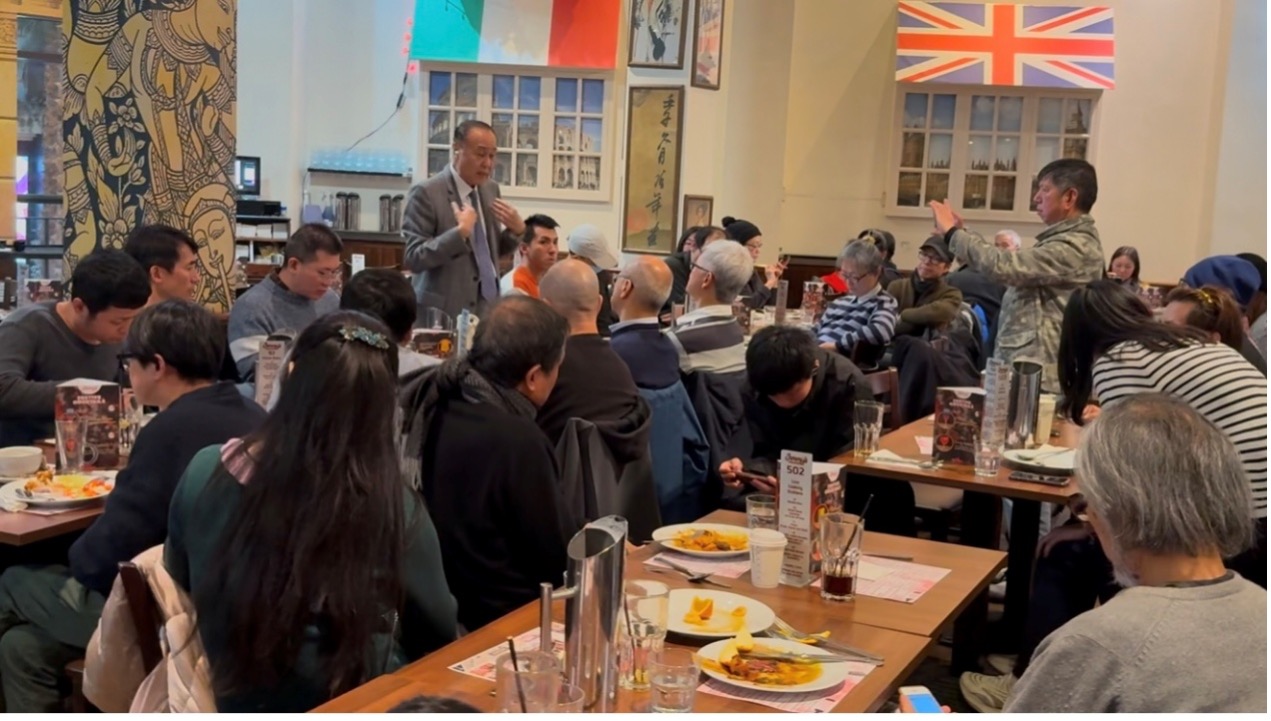
2025年1月1日,中国民主党英国总部受邀参加了香港议会筹委会在伦敦O2举办的一场备受关注的活动——《自由香港宣言》发布会及问答宴会。这场活动吸引了来自世界各地的民主人士、香港移民社区代表以及媒体的广泛关注,为推动香港民主与自由事业再次注入了力量。

《自由香港宣言》发布:呼吁国际社会关注香港

在会上香港议会筹委会发起人袁弓夷先生发表了讲话。他说:《自由香港宣言》明确表示,香港的自治与自由不仅是香港人民的基本权利,也是国际社会共同维护的价值。宣言呼吁各国政府采取更强有力的行动,制裁破坏香港民主的相关人士和机构,敦促中国政府履行《中英联合声明》承诺。

袁弓夷表示:“自由与人权是普世价值,香港人民的抗争精神不会被历史遗忘。我们必须团结一致,让香港的声音被世界听见。”

发布会结束后,与会者参加了以“自由香港”为主题的晚宴。席间,大家深入交流,为共同的目标献计献策。气氛既庄重又温暖,展现了香港人在困境中依然团结一致的精神。

此次活动不仅是一场宣言的发布,更是一场团结的象征。中国民主党英国总部对香港议会筹委会的支持,显示了海外民主力量的凝聚力,也为未来更多的合作打下了基础。 活动结束后,许多参与者表示,这场发布会和晚宴让他们感受到了希望与力量,也更加坚定了继续为香港自由与民主奋斗的决心。

在活动结束前,中国民主党英国总部党员与其他所有参会者一起高唱了《愿荣光归香港》。激昂的歌声回荡在现场,现场气氛热烈而感人,许多人难掩内心的激动,眼中闪烁着泪光。这一刻,所有人仿佛重新找回了团结的力量和对自由的坚定信念,整个场面既庄严又充满希望。自由香港,人人有责!愿这场斗争的火种永不熄灭!

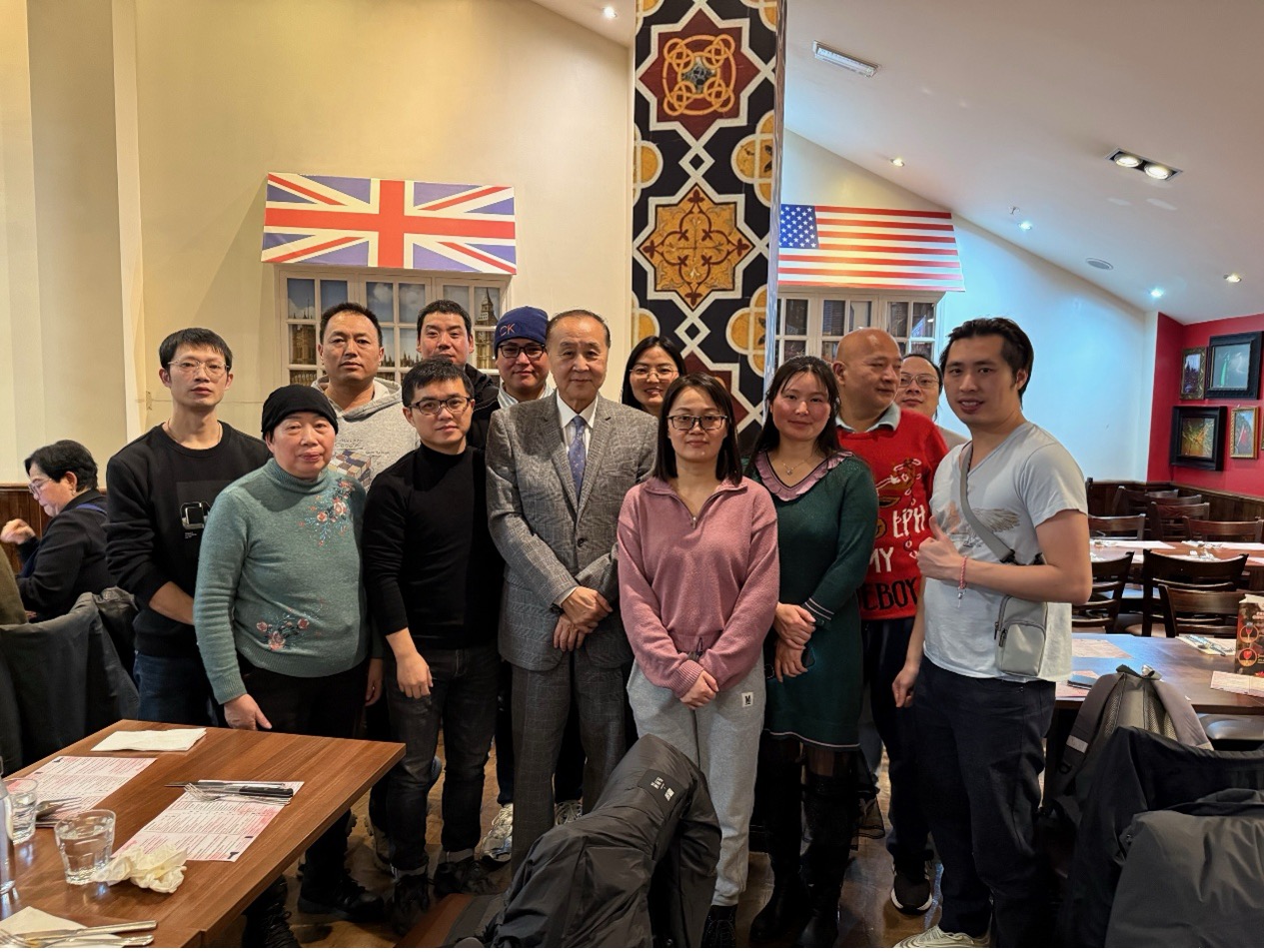
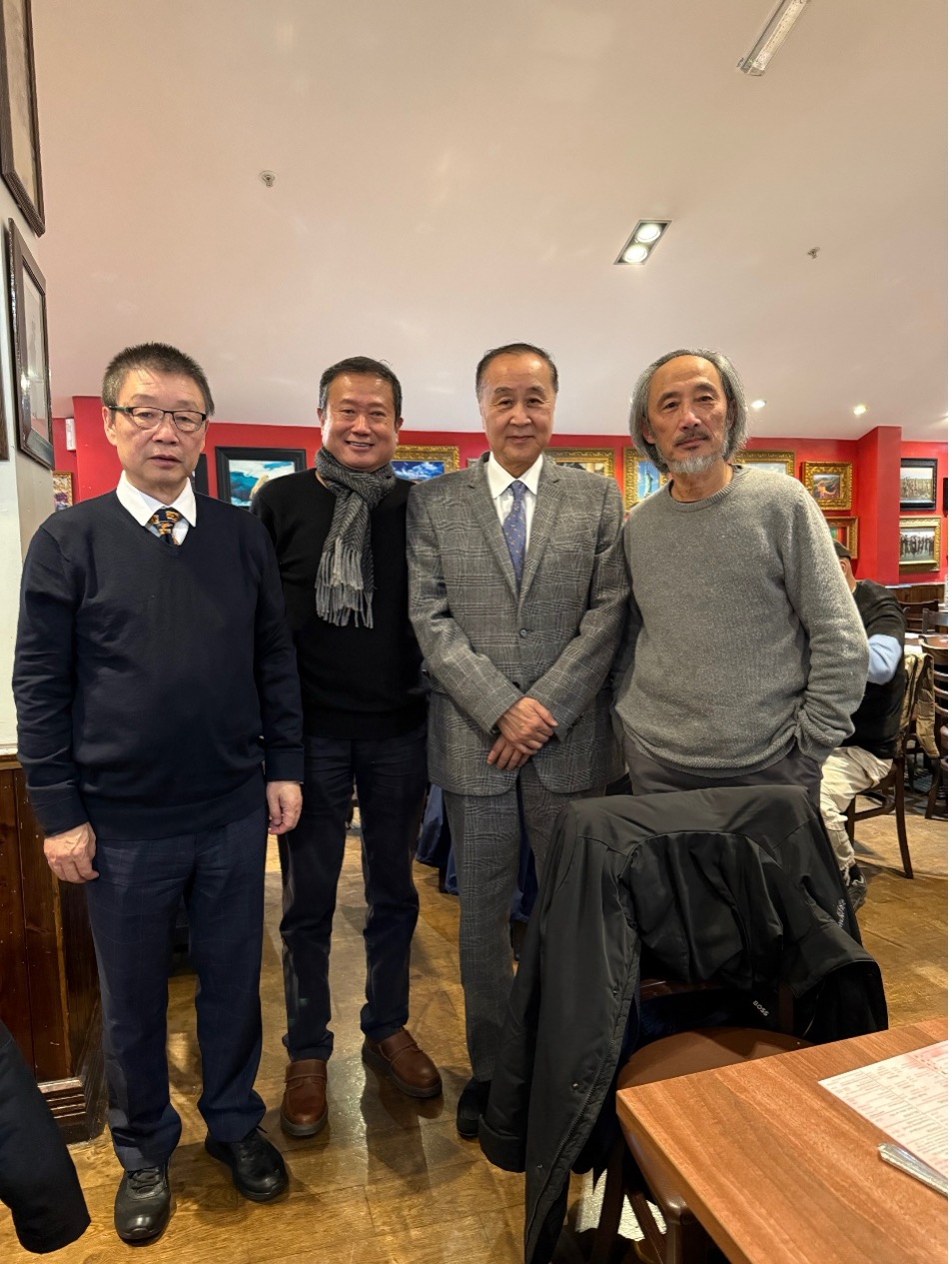
袁弓夷先生向中国民主党英国总部的支持表示感谢,并和参加党员合影留念。

本次活动组织者:成亚利,李皓博

参加本次活动的党员:成亚利,李皓博 、成小丹、顾晓峰、兰子明 、李景棠、王应如、何智威、王建,沈超、戴超、戴雪梅,赵玉莲,黄华。

中国民主党英国总部供稿人:李皓博

UK headquarters of China Democracy Party was invited to attend the Free Hong Kong Declaration Conference of the Hong Kong Parliament Preparatory Committee

On January 1, 2025, the UK headquarters of the China Democratic Party was invited to attend a highly anticipated event held by the Hong Kong Parliament Preparatory Committee at the O2 in London – the launch of the Free Hong Kong Declaration and a Q&A banquet. This event attracted widespread attention from democrats from all over the world, representatives of Hong Kong immigrant communities and the media, and once again injected strength into the cause of democracy and freedom in Hong Kong.

The Free Hong Kong Declaration was released: calling on the international community to pay attention to Hong Kong

At the meeting, Mr. Yuan Gongyi, the initiator of the Hong Kong Parliament Preparatory Committee, delivered a speech. He said: The Free Hong Kong Declaration clearly stated that Hong Kong’s autonomy and freedom are not only the basic rights of the Hong Kong people, but also the values ​​jointly maintained by the international community. The declaration calls on governments to take stronger actions to sanction relevant individuals and institutions that undermine Hong Kong’s democracy and urge the Chinese government to fulfill its commitments in the Sino-British Joint Declaration.

Yuan Gongyi said: “Freedom and human rights are universal values, and the spirit of resistance of the Hong Kong people will not be forgotten by history. We must unite and let the voice of Hong Kong be heard by the world.”

After the press conference, the participants attended a dinner with the theme of “Free Hong Kong”. During the dinner, everyone had in-depth exchanges and offered suggestions for common goals. The atmosphere was solemn and warm, showing the spirit of Hong Kong people to remain united in the face of difficulties.

This event is not only the release of a declaration, but also a symbol of unity. The support of the China Democratic Party UK Headquarters to the Hong Kong Parliament Preparatory Committee shows the cohesion of overseas democratic forces and lays the foundation for more cooperation in the future. After the event, many participants said that this press conference and dinner made them feel hope and strength, and also strengthened their determination to continue to fight for Hong Kong’s freedom and democracy.

Before the end of the event, members of the China Democratic Party UK Headquarters sang “Glory to Hong Kong” with all other participants. The passionate singing echoed in the scene, and the atmosphere was warm and touching. Many people could not hide their inner excitement, and tears flashed in their eyes. At this moment, everyone seemed to have regained the power of unity and the firm belief in freedom. The whole scene was solemn and full of hope. Free Hong Kong, everyone is responsible! May the fire of this struggle never go out!

Mr. Yuan Gongyi expressed his gratitude to the China Democracy Party UK Headquarters for their support and took a group photo with the participating party members.

Organizers of this event: Cheng Yali, Li Haobo

Participating party members of this event: Cheng Yali, Li Haobo, Cheng Xiaodan, Gu Xiaofeng, Lan Ziming, Li Jingtang, Wang Yingru, He Zhiwei, Wang Jian, Shen Chao, Dai Chao, Dai Xuemei, Zhao Yulian, Huang Hua.

Contributor of China Democracy Party UK Headquarters: Li Haobo

王炳章行动委员会宣言 Declaration of the Wang Bingzhang Action Committee

2024年12月29日,伦敦

在历史的洪流中,总有英雄挺身而出,燃烧自己,为黑暗中的人们点亮通往自由的火炬。王炳章,正是这样一位舍身忘我、为中华民族自由与民主而献身的伟大斗士!他的一生是抗争的缩影,是信念的丰碑!

自1983年创建海外第一个民主运动组织以来,王炳章先生以无畏无惧的精神冲破禁锢,以行动和智慧推动中国民主化进程。他用生命践行了“推翻中共独裁,建立民主中国” 的誓言!即便在2002年被中共非法绑架、判以无期徒刑,他仍未屈服,仍以铁一般的意志,昭示着自由的光辉!

如今,腐败无能的中共政权将中国拖入深渊:经济停滞,民生凋敝,贪官横行,国家已内外交困!而这一切的根源,正是中共的独裁专制!

我们不能再沉默!我们不能再忍受!站在历史的十字路口,唯有唤醒更多中国人民,秉承王炳章的精神,为中华民族的复兴砸碎独裁的枷锁,才能迎来民主与自由的曙光!

什么是王炳章精神?
王炳章精神,就是以行动为旗帜,以牺牲为代价,以民主为目标!
王炳章精神,就是中华民族不屈的脊梁,是勇敢、坚定、不畏强权的象征!
王炳章精神,就是继承孙中山先生“驱除鞑虏,恢复中华”的伟大遗志,不惜一切代价,推翻中共暴政,还政于民,还天下以公道!

当局横暴,但民心不可欺!
政权腐朽,但历史不可逆!

今天,我们宣布成立“王炳章行动委员会”!
我们的使命和目标不仅是营救王炳章,更要将王炳章精神播撒在每一个中国人的心中。我们誓以一切合法和正义手段,团结海内外力量,共同推翻中共的独裁统治,建立一个自由、民主、公平、正义的中国!

我们号召:
• 释放王炳章!让这位为国为民的英雄重获自由!
• 唤醒民众!唤起每一个普通中国人的觉醒和抗争意识!
• 推翻暴政!中共独裁已成历史毒瘤,唯有拔除,方能重生!

我们组织会员的原则:行动,奉献,律己,坚韧!

中国的希望在人民,人民的力量在觉醒!我们呼吁每一个有良知、有血性、有志于民族复兴的人,加入我们,为自由而战,为正义而战,为王炳章精神代言!

同胞们,黑夜再漫长,曙光终将到来!让我们肩并肩,手牵手,以血与火迎接一个新的时代:一个属于人民、属于民主、属于真正自由的中国!

王炳章行动委员会共同召集人:黄华,姜福祯,郝涛

wangbzaction@gmail.com

Declaration of the Wang Bingzhang Action Committee

December 29, 2024, London

In the torrent of history, there are always heroes who stand up, burn themselves, and light the torch to freedom for people in the dark. Wang Bingzhang is such a great fighter who sacrificed himself for the freedom and democracy of the Chinese nation! His life is a microcosm of struggle and a monument of faith!

Since the establishment of the first overseas democratic movement organization in 1983, Mr. Wang Bingzhang has broken through the shackles with a fearless spirit and promoted the process of democratization in China with action and wisdom. He used his life to fulfil his oath of “overthrowing the dictatorship of the Chinese Communist Party and establishing a democratic China”! Even though he was illegally kidnapped by the Chinese Communist Party in 2002 and sentenced to life imprisonment, he still did not give in, and still showed the glory of freedom with his iron will!

Today, the corrupt and incompetent Chinese Communist regime has dragged China into the abyss: the economy is stagnant, people’s livelihood is withered, corrupt officials are rampant, and the country is trapped both internally and externally! And the root of all this is the dictatorship of the Chinese Communist Party!

We can no longer be silent! We can’t stand it anymore! Standing at the crossroads of history, only by awakening more Chinese people, adhering to Wang Bingzhang’s spirit, and smashing the shackles of dictatorship for the rejuvenation of the Chinese nation can we usher in the dawn of democracy and freedom!

What is the Wang Bingzhang spirit?

The Wang Bingzhang spirit is to take action as the banner, sacrifice as the price, and democracy as the goal!

The Wang Bingzhang spirit is the unyielding backbone of the Chinese nation, and a symbol of bravery, firmness, and fearlessness of power!

The Wang Bingzhang spirit is to inherit Mr. Sun Yat-sen’s great legacy of “expelling the Tartars and restoring China”, at all costs, overthrow the tyranny of the Communist Party of China, return power to the people, and return justice to the world!

The authorities are tyrannical, but the people’s hearts cannot be deceived!

The regime is corrupt, but history is irreversible!

Today, we announce the establishment of the “Wang Bingzhang Action Committee”!

Our mission and goal is not only to rescue Wang Bingzhang, but also to spread the spirit of Wang Bingzhang in the hearts of every Chinese. We vow to unite forces at home and abroad by all legal and just means to overthrow the dictatorship of the Chinese Communist Party and build a free, democratic, fair and just China!

We call for:

• Release Wang Bingzhang! Let this hero who serves the country, and the people regain his freedom!

• Awaken the people! Arouse the awakening and resistance consciousness of every ordinary Chinese!

• Overthrow tyranny! The dictatorship of the Chinese Communist Party has become a historical cancer. Only by eradicating it can it be reborn!

The principles of our organization members: action, dedication, self-discipline, and tenacity!

China’s hope lies in the people, and the power of the people is awakening! We call on everyone with conscience, blood, and aspirations for national rejuvenation to join us, fight for freedom, fight for justice, and speak for the spirit of Wang Bingzhang!

Fellow countrymen, no matter how long the night is, the dawn will eventually come! Let us stand shoulder to shoulder, hand in hand, and welcome a new era with blood and fire: a China that belongs to the people, belongs to democracy, and belongs to true freedom!

Co-conveners of the Wang Bingzhang Action Committee: Huang Hua, Jiang Fuzhen, Hao Tao

wangbzaction@gmail.com

寒风中的呐喊:中国民主党英国总部要求释放王炳章博士抗议活动 Crying Out in the Cold Wind: Protest by the UK Headquarters of China Democracy Party Demanding the Release of Dr Wang Bingzhang

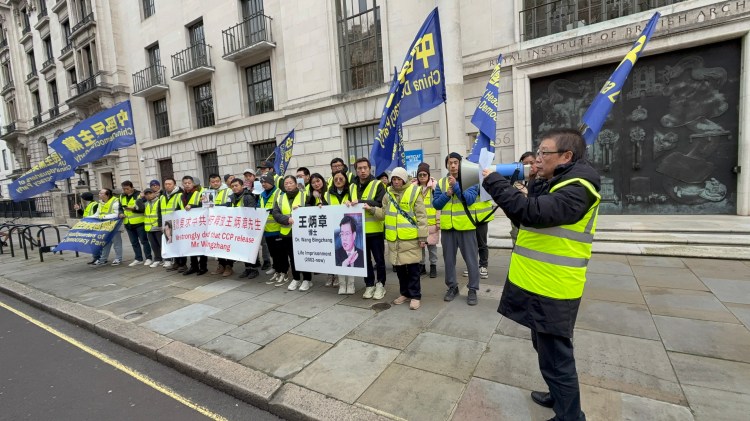
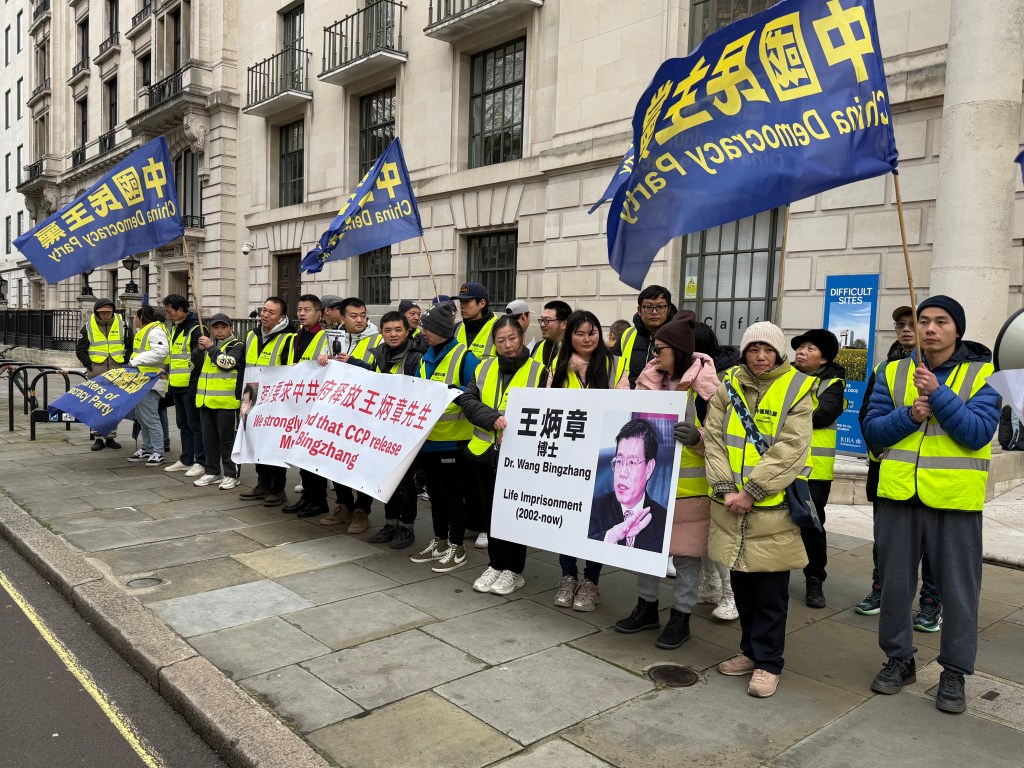
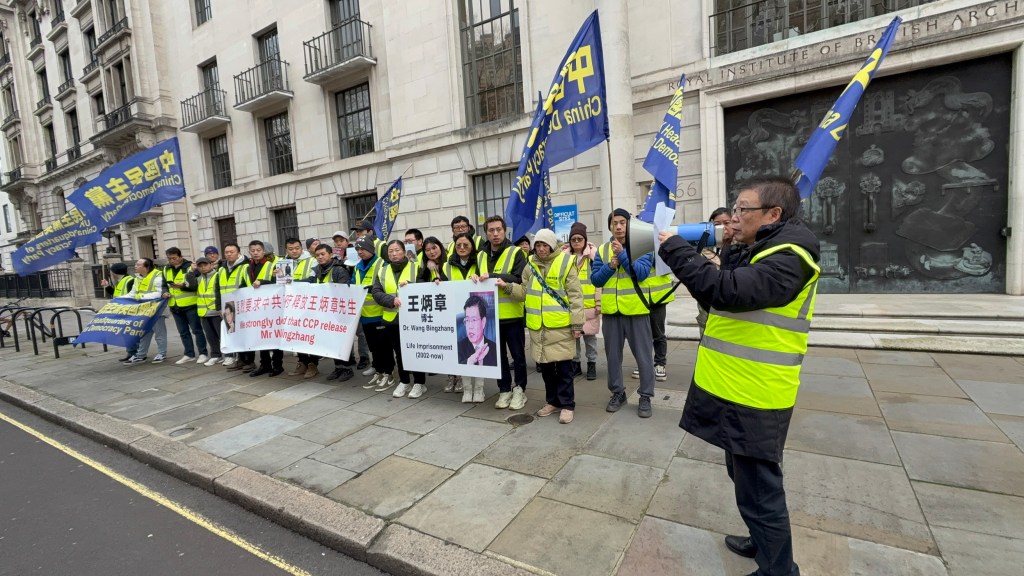
2024年12月29日,中国民主党英国总部在伦敦,中国驻英国大使馆门前,举行了强烈要求中共政府释放王炳章博士的抗议活动。

这一天,伦敦寒风刺骨,阴云密布。大约40多名中国民主党英国总部的党员和支持者,站在中国大使馆对面,他们身着党部马甲,挥舞党部旗帜,拉出红色横幅,上面写着:强烈要求中共政府释放王炳章先生。

该活动组织者黄华在现场宣读了“王炳章行动委员会宣言”。他先是回顾了王炳章先生在1999年5月9日在英国组织组织中国民主党英国党部党员在美国驻英国大使馆目前举行的抗议北约轰炸中国驻南斯拉夫大使馆事件。黄华说:我和王炳章先生有两次深入交谈。我敬佩他对信仰的执着和渊博的知识。所以,我联络了其他人,我们一起成立王炳章行动委员会。

黄华在宣言中说:什么是王炳章精神?
王炳章精神,就是以行动为旗帜,以牺牲为代价,以民主为目标!
王炳章精神,就是中华民族不屈的脊梁,是勇敢、坚定、不畏强权的象征!
王炳章精神,就是继承孙中山先生“驱除鞑虏,恢复中华”的伟大遗志,不惜一切代价,推翻中共暴政,还政于民,还天下以公道!

今天,我们宣布成立“王炳章行动委员会”!
我们的使命和目标不仅是营救王炳章,更要将王炳章精神播撒在每一个中国人的心中。我们誓以一切合法和正义手段,团结海内外力量,共同推翻中共的独裁统治,建立一个自由、民主、公平、正义的中国!

我们号召:
• 释放王炳章!让这位为国为民的英雄重获自由!
• 唤醒民众!唤起每一个普通中国人的觉醒和抗争意识!
• 推翻暴政!中共独裁已成历史毒瘤,唯有拔除,方能重生!

我们组织会员的原则:行动,奉献,律己,坚韧!

中国的希望在人民,人民的力量在觉醒!我们呼吁每一个有良知、有血性、有志于民族复兴的人,加入我们,为自由而战,为正义而战,为王炳章精神代言!

党员何智威代读因签证问题没有能够到场的姜福祯先生的发言。他说:王炳章是因其政治信仰和活动被判处无期徒刑,他并沒从事任何恐怖活动,然而无期徒刑并不等于无限期的关押。国际社会呼吁中国当局停止对他的羁押和迫害。王炳章的健康状况在监禁期间恶化,加之长期囚禁对其身心的负面影响,促使全球人权组织和个人行动起来,呼吁对他的释放。

党员成亚利,成小丹,于伟梁等等都在现场作了发言和呼喊口号。

路上来来往往的英国人注目凝视,鸣响车子喇叭,向示威者表示敬意!

活动结束以后,党员们为了国内受难党员家属现场举行了春节爱心捐款,总筹得捐款约2000英镑。

出席活动党员:李皓博、王建、戴超、戴雪梅、赵玉莲、郭宇轩、李亚伦、徐伟华、何智威、兰子明、侯尔斌、张学美、卢灵飞、成亚利、王燕、邓伟、沈超、闫磊、周亮、吕建启、朱双林、李景棠、刘耀行、成亚利、梁根、uncle leo、刘恩成、于伟梁、林明强、余刚

中国民主党英国总部供稿 2024年12月29日

1999年5月份王炳章在英国组织北约轰炸中国驻南斯拉夫大使馆
2024年12月29日黄华在中国大使馆目前宣布成立王炳章行动委员会

Crying Out in the Cold Wind: Protest by the UK Headquarters of China Democracy Party Demanding the Release of Dr Wang Bingzhang

On 29 December 2024, the UK Headquarters of China Democracy Party staged a protest in front of the Chinese Embassy in London, strongly demanding the release of Dr Wang Bingzhang by the Chinese government.

That day, London was gripped by biting cold winds under an overcast sky. More than 40 members and supporters of the UK Headquarters of China Democracy Party gathered across from the Chinese Embassy. Dressed in party vests, waving party flags, and holding red banners bearing the slogan “Strongly Demand the Chinese Government Release Dr Wang Bingzhang,” they expressed their demands with determination.

The event organiser, Mr Huang Hua, delivered the “Wang Bingzhang Action Committee Declaration” on-site. He began by recalling Dr Wang Bingzhang’s role in organising a protest on 9 May 1999 in the UK, where members of the UK Headquarters of China Democracy Party demonstrated in front of the US Embassy in London against NATO’s bombing of the Chinese Embassy in Yugoslavia. Huang Hua said, “I had two in-depth conversations with Dr Wang Bingzhang. I deeply admire his unwavering faith and profound knowledge. Therefore, I reached out to others, and together, we established the Wang Bingzhang Action Committee.”

In the declaration, Huang Hua explained, “What is the Spirit of Wang Bingzhang?

The Spirit of Wang Bingzhang is taking action as a banner, sacrifice as a cost, and democracy as the goal!

The Spirit of Wang Bingzhang is the unyielding backbone of the Chinese nation, symbolising courage, steadfastness, and defiance of tyranny!

The Spirit of Wang Bingzhang is inheriting Dr Sun Yat-sen’s great aspiration to ‘Expel the Manchus and restore China,’ overthrowing the CCP’s tyranny at any cost, returning governance to the people, and bringing justice to the nation!”

“Today, we announce the establishment of the ‘Wang Bingzhang Action Committee!’ Our mission and goal are not only to rescue Wang Bingzhang but also to spread his spirit into the heart of every Chinese person. We pledge to use all legal and just means to unite forces at home and abroad to overthrow the CCP’s dictatorial regime and establish a free, democratic, fair, and just China!”

Huang Hua continued with calls to action:

     •    “Release Wang Bingzhang! Let this hero for the nation and the people regain his freedom!

     •    Awaken the masses! Inspire the awareness and resistance of every ordinary Chinese person!

     •    Overthrow tyranny! The CCP dictatorship has become a cancer in history; only by uprooting it can rebirth be achieved!”

He emphasised the principles for membership in the organisation: action, dedication, self-discipline, and resilience.

“The hope for China lies with its people, and the strength of its people lies in awakening! We call on every person of conscience, courage, and commitment to national rejuvenation to join us, fight for freedom, fight for justice, and represent the Spirit of Wang Bingzhang!”

Party member He Zhiwei read a statement on behalf of Jiang Fuzhen, who could not attend due to visa issues. Jiang said, “Dr Wang Bingzhang was sentenced to life imprisonment for his political beliefs and activities. He has not engaged in any terrorist activity, and life imprisonment does not equate to indefinite detention. The international community calls on the Chinese authorities to cease their detention and persecution of him. Dr Wang Bingzhang’s health has deteriorated during his imprisonment, and the long-term incarceration has had severe physical and psychological impacts, prompting global human rights organisations and individuals to act for his release.”

Other party members, including Cheng Liya, Cheng Yali, and Yu Weiliang, also delivered speeches and chanted slogans on-site.

Passers-by in London observed the demonstration, with some honking their car horns to show support and respect for the protesters.

After the event, party members held a charity donation drive for the families of persecuted party members in China to celebrate the Lunar New Year. Approximately £2,000 was raised.

Attendees included: Li Haobo, Wang Jian, Dai Chao, Dai Xuemei, Zhao Yulian, Guo Yuxuan, Li Yalun, Xu Weihua, He Zhiwei, Lan Ziming, Hou Erbin, Zhang Xuemei, Lu Lingfei, Cheng Yali, Wang Yan, Deng Wei, Shen Chao, Yan Lei, Zhou Liang, Lü Jianqi, Zhu Shuanglin, Li Jingtang, Liu Yaoxing, Cheng Yali, Liang Gen, Uncle Leo, Liu Encheng, Yu Weiliang, Lin Mingqiang, Yu Gang.

Report by the UK Headquarters of China Democracy Party, 29 December 2024

为何反共分子聚集国外?有何效用? Why are anti-communists abroad? What’s the point?

作者:中国民主党英国总部—俞滨

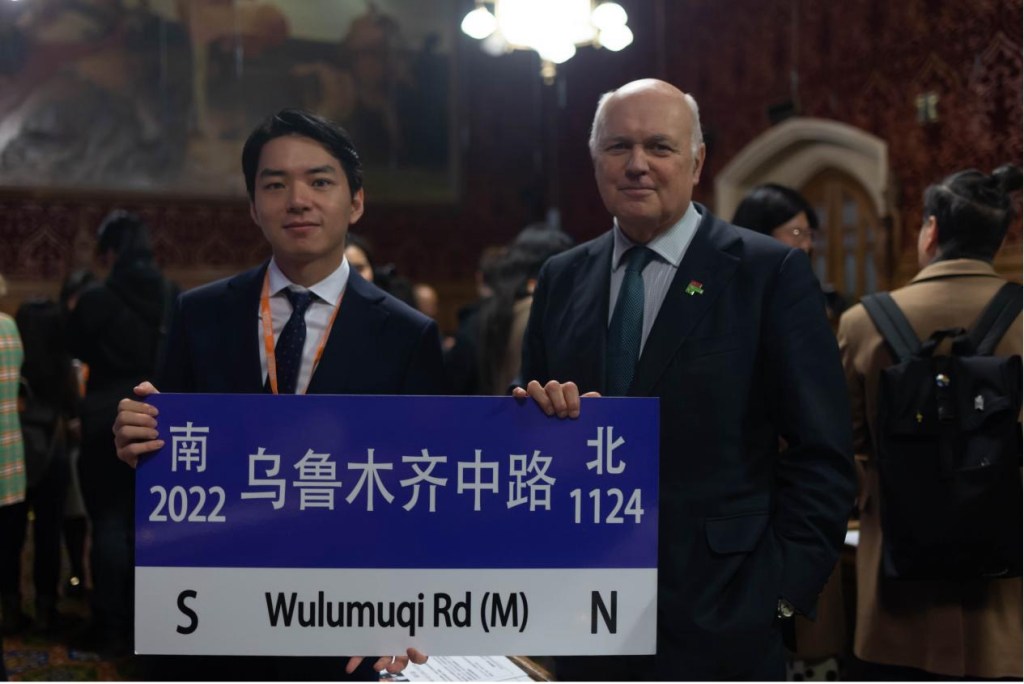
最近,我积极参与了多个国际活动,包括最近在英国议会举办的白纸运动纪念活动。该活动由跨党派议员Lain Duncan Smith MP和Alex Sobel MP组织,他们均为跨国议会联盟(IPAC)的成员。IPAC的目标是联合民主国家的立法议员,共同遏制中国共产党在国际上的影响力,并拒绝通过任何对中共有利的立法。值得注意的是,这两位议员分别来自保守党和工党,表明无论英国的执政党如何更替,针对中国专制政权的政策基调不会轻易改变。类似的跨党派合作,不仅有助于压制中共的国际扩张,还为异议者提供了广阔的参与空间和支持。

Bin Yu与前影子国防部长和前保守党党魁Iain Duncun Smith举起乌鲁木齐中路路牌。

今年11月26日,我还组织了一场白纸运动两周年的纪念活动。在活动之前,我收到了一系列威胁邮件,包括冒充国际特赦组织套取信息,以及利用我的真实身份进行恶意查询。这让我深思:为何中共对已经流亡国外的异议者仍然如此紧张甚至恐惧?这不仅仅是因为中国国内对异议行动的高压政策,还有更深层次的原因值得探讨。

Bin Yu和异议者手举白纸在中国大使馆门口合影

异议者选择在国际社会行动,首要原因在于这一平台的战略意义。在国内,异议声音被严厉打压,缺乏扩散和施压的渠道;而国际社会为异议者提供了宝贵的空间。通过揭露中国人权问题,异议者可以吸引全球舆论和媒体的关注,推动西方国家制定更强硬的对华政策。例如,香港流亡活动家罗冠聪成功将香港问题推向国际议程,使其成为西方国家对华关系中的重要议题。

中国社会结构的特点同样决定了反对运动更容易在国外展开。首先,国内公民的政治参与度极低。普通民众在高压环境下普遍选择沉默或冷漠,对政治风险保持距离。此外,中国迅速崛起的中产阶级为保护自身经济利益,通常更倾向于维护现状,而非挑战权力结构。

同时,国家宣传通过强化民族主义情绪,将异议者贴上“叛国者”或“卖国贼”的标签,进一步孤立他们。这种舆论导向使异议者在国内几乎无法获得支持,而被迫将目光投向国际社会。正如孙中山在清末时代选择于海外组建同盟会一样,现代异议者也在国际舞台上寻找突破口。

在国内宣传中,流亡的异议者经常被贴上“卖国贼”的标签,以削弱其国内支持。这种指控利用了民族主义的情绪,将异议者与“外国干预”挂钩,制造了国内舆论的割裂。然而,这种“卖国”论调是否成立?

从本质上看,反对中共与反对中国是两个完全不同的概念。异议者的目标并非毁灭中国,而是希望通过改变中共的专制体制,让中国社会变得更加自由、公正与民主。这种反对行动并不是为了迎合西方利益,而是出于对中国未来的责任感。事实上,历史上许多推翻专制政权的领导者都曾被执政者扣上“卖国”之名,例如孙中山被清政府视为“叛国者”,但后来的历史证明,他的努力是为了实现民族复兴与社会进步。

此外,国际社会的支持并非等同于“利用外国势力”。历史上,许多民主转型的国家都借助了外部力量,例如二战后欧洲在美国的支持下重建民主体制,南非种族隔离的结束也离不开全球的共同努力。这表明,国际声援是推动专制国家变革的重要力量,而非简单的“干涉内政”。

批评者常常质疑,流亡异议者远离国内,他们的行动是否真的能带来实质性改变?对此,需要从长期的角度来评估。

短期内,流亡者的影响力确实有限。中共依然拥有强大的宣传机器,能够淡化外部批评的影响;而国内民众在高压政策下,难以直接响应流亡者的号召。但这并不意味着流亡者的努力是徒劳无功的。事实上,历史证明,许多变革的发生都经历了漫长的积累过程。例如,苏联时期的持不同政见者在冷战中通过国际社会扩大影响,最终对苏联解体起到了推波助澜的作用。

长期来看,流亡者的影响力不可低估。他们不仅是对现体制的直接批评者,更是未来改革的潜在设计者。当体制出现裂缝时,流亡者的思想、组织和国际网络能够迅速填补空白,为新的社会秩序提供蓝图。香港的民主运动者正是在这一方面发挥了重要作用,通过争取全球的关注与支持,将民主价值观深植于国际社会的对华议程中。

流亡异议者的国际化行动,并非仅仅是一种无奈之举,而是对现实的战略性选择。从争取国际支持到推动国内觉醒,这些行动在多个层面上发挥着作用。虽然短期内的成效可能有限,但其长远影响不可忽视。中国的民主化进程,注定是一条漫长而曲折的道路,但正如历史所示,每一次真正的变革都始于那些敢于发声的人。而在今天的全球化时代,这种声音已经不再局限于国界之内。

Bin Yu在向异议者演讲。

Why are anti-communists abroad? What’s the point?

By Bin Yu, UK Headquarters of the CDP

Recently, I have actively participated in several international events, including a commemoration of the White Paper Movement held at the UK Parliament. This event was organized by cross-party MPs Iain Duncan Smith and Alex Sobel, both members of the Inter-Parliamentary Alliance on China (IPAC). IPAC aims to unite legislators from democratic nations to collectively counter the Chinese Communist Party’s influence on the global stage and reject any legislation that benefits the CCP. Notably, these two MPs represent the Conservative and Labour parties, respectively, highlighting that regardless of which party governs the UK, the fundamental policy stance against China’s authoritarian regime is unlikely to shift easily. Such cross-party cooperation not only helps curb the CCP’s international expansion but also provides dissenters with a broader platform for engagement and support.

On November 26 this year, I also organized an event to commemorate the two-year anniversary of the White Paper Movement. Prior to the event, I received a series of threatening emails, including attempts to impersonate Amnesty International to extract information and malicious inquiries targeting my real identity. This has led me to reflect deeply: why does the Chinese Communist Party remain so anxious and even fearful of dissenters who have already fled abroad? This phenomenon is not solely a result of the high-pressure policies against dissent within China but also suggests deeper underlying reasons that merit further exploration.

Dissenters choose to act on the international stage primarily because of its strategic significance. Within China, dissenting voices face severe suppression, lacking avenues for dissemination or exerting pressure, while the international community offers valuable space for their efforts. By exposing human rights issues in China, dissenters can draw global media attention and influence Western countries to adopt tougher policies toward China. For example, Hong Kong activist Nathan Law successfully brought Hong Kong’s struggles to the international agenda, making it a key issue in Western relations with China.

The unique characteristics of Chinese society also determine that opposition movements are more viable abroad. First, domestic political participation is exceedingly low. In a high-pressure environment, ordinary citizens often choose silence or apathy, distancing themselves from political risks. Moreover, China’s rapidly growing middle class, focused on safeguarding its economic interests, typically favors maintaining the status quo over challenging the power structure.

Simultaneously, state propaganda intensifies nationalist sentiments, branding dissenters as “traitors” or “sellouts,” further isolating them. This narrative leaves dissenters with almost no domestic support, forcing them to turn to the international stage. Just as Sun Yat-sen formed the Tongmenghui abroad during the late Qing Dynasty, modern dissenters seek breakthroughs on the global platform.

In domestic propaganda, exiled dissenters are often labeled as “traitors” to weaken their support at home. This accusation exploits nationalist sentiments, linking dissenters to “foreign interference” and fostering domestic division. But is the “traitor” label justified?

At its core, opposing the CCP is fundamentally different from opposing China. Dissenters do not aim to destroy China but to transform the CCP’s authoritarian system into a freer, fairer, and more democratic society. Their actions are not about catering to Western interests but stem from a deep sense of responsibility for China’s future. In fact, many leaders who overthrew authoritarian regimes were once branded as “traitors” by those in power—Sun Yat-sen was labeled a “rebel” by the Qing government, but history later proved his efforts were aimed at national rejuvenation and social progress.

Moreover, international support does not equate to “relying on foreign forces.” Historically, many democratic transitions have relied on external assistance. For example, post-World War II Europe rebuilt democratic systems with U.S. support, and the end of apartheid in South Africa depended on global solidarity. This demonstrates that international backing can be a vital force for change in authoritarian states, rather than mere “interference in internal affairs.”

Critics often question whether exiled dissenters, acting from afar, can bring about substantive change. This requires a long-term perspective.

In the short term, exiles’ influence is indeed limited. The CCP’s powerful propaganda machine can diminish the impact of external criticism, and domestic citizens, constrained by high-pressure policies, find it difficult to respond directly to exiles’ calls. However, this does not render their efforts futile. History shows that many transformative changes occur after prolonged accumulation. For instance, Soviet-era dissidents leveraged international platforms during the Cold War, ultimately contributing to the USSR’s collapse.

In the long run, exiles’ impact is significant. They are not only direct critics of the current system but also potential architects of future reforms. When cracks appear in the system, exiles’ ideas, organizational structures, and international networks can swiftly fill the void, providing blueprints for a new social order. Hong Kong’s pro-democracy activists exemplify this by embedding democratic values into the global agenda on China through their advocacy and international outreach.

The international actions of exiled dissenters are not merely acts of desperation but rather strategic responses to reality. From rallying global support to awakening domestic consciousness, these efforts operate on multiple levels. While short-term results may be limited, their long-term effects are undeniable. China’s path to democratization is destined to be long and challenging, but as history has shown, every meaningful transformation begins with those brave enough to speak out. In today’s globalized era, such voices are no longer confined by national borders.

无惧死亡威胁 —— 伦敦大使馆前纪念白纸革命两周年活动 Fearless Death Threats – Second Anniversary of the White Paper Revolution in front of the Embassy in London

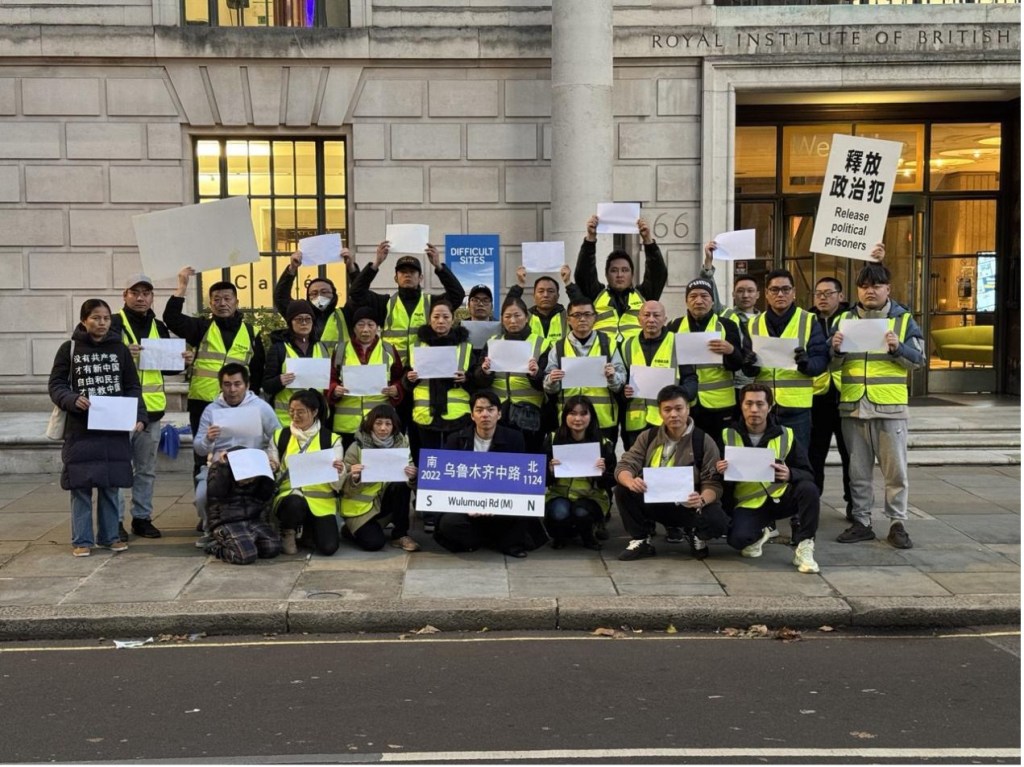
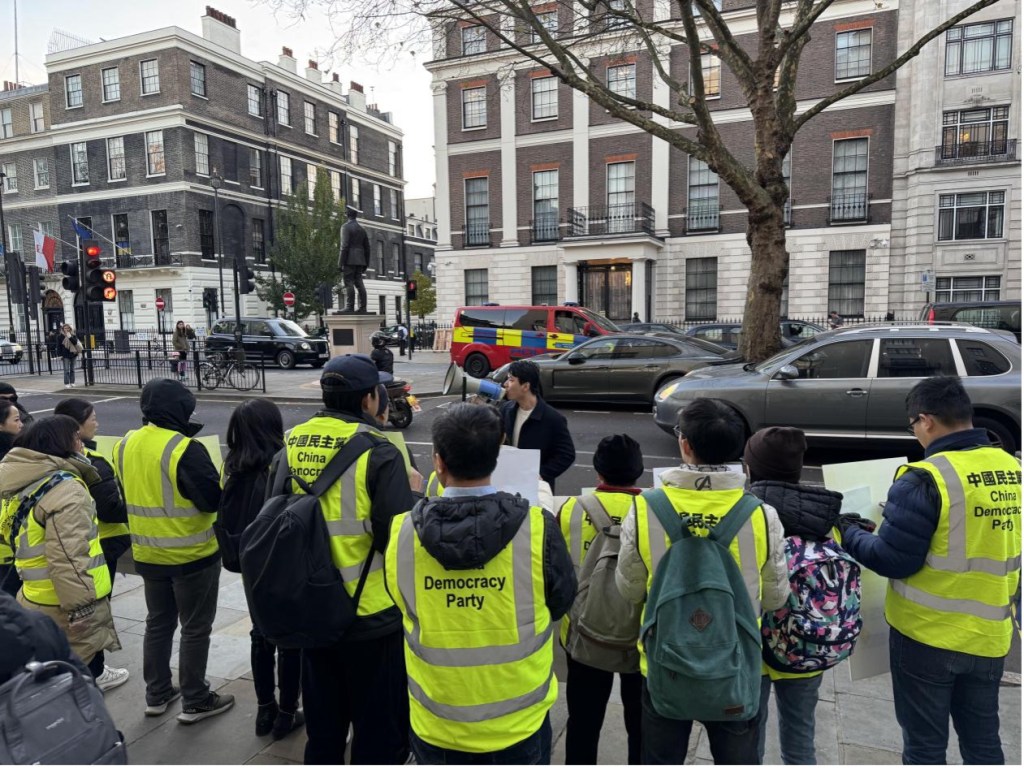
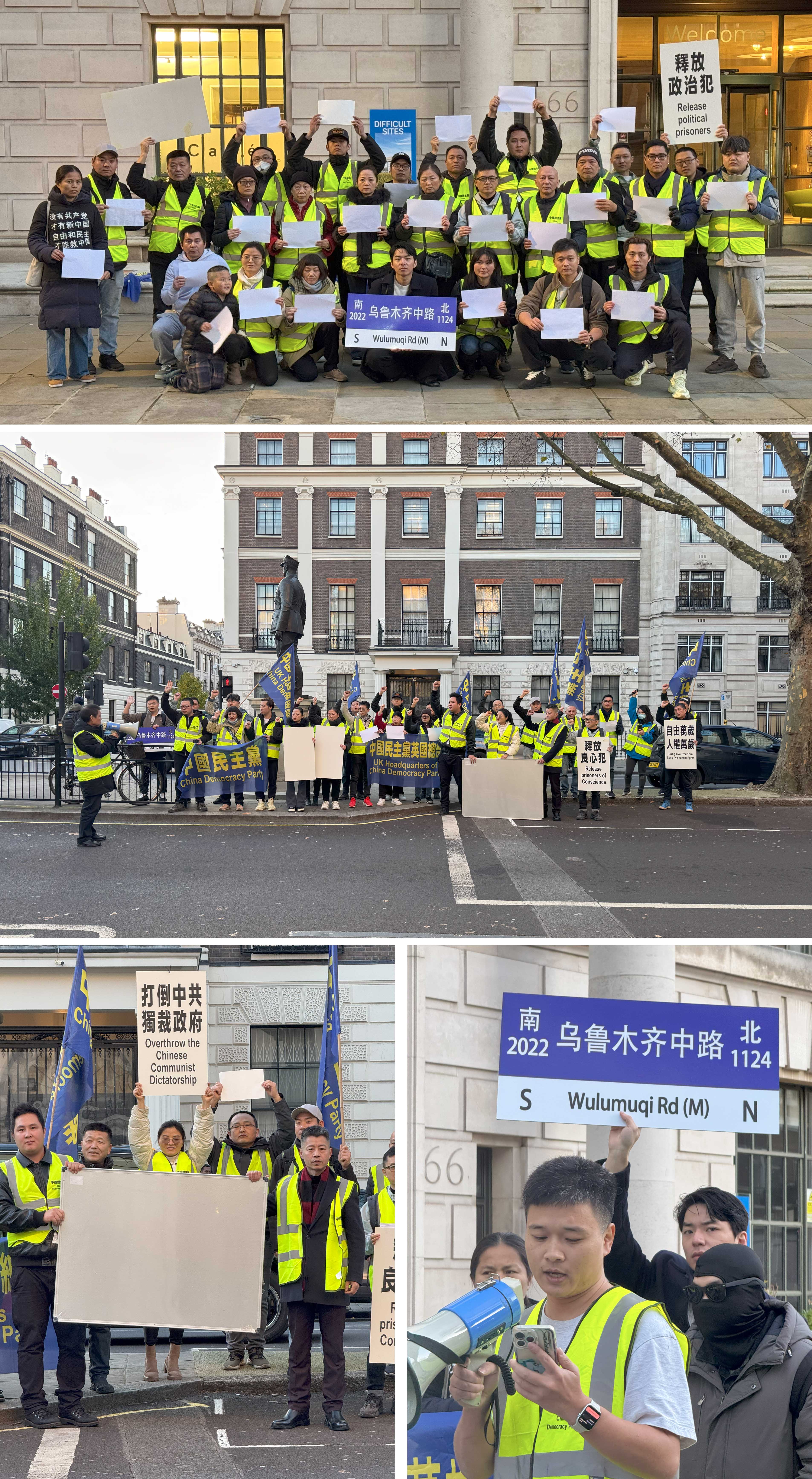
2024年11月26日下午,中国民主党英国总部联合无组织民主人士和香港民运组织成员,在中国驻伦敦大使馆前举行了纪念“白纸革命”两周年的和平抗议活动。此次活动在广告宣传期间受到死亡威胁,有人发邮件声称:“如果你们在中国大使馆前搞事,我们就搞你们,到时候不见血不罢休!”。大约有30多人参加了此次活动。英国警方对此作出反应,在现场增派了警力。

2022年11月24日,新疆乌鲁木齐大火后,中国民众发起的一系列抗议活动,目标旨在反对中共清零政策,要求言论自由。在这些运动中,民众手举白纸,抗议中共“删帖、封号”以及剥夺民众的言论自由。很多民众因为手举白纸抗议,而被警方逮捕。白纸运动的范围波及中国多个城市和大学。2022年11月26日晚,上海市民在上海乌鲁木齐中路抗议,喊出“中共下台,习近平下台”的诉求。2022年11月27日晚,大批北京市民自发前往四通桥抗议,声援勇士彭载舟,并高呼彭载舟的口号“不要核酸要吃饭 不要封控要自由 不要谎言要尊严;不要文革要改革 不要领袖要选票 不做奴才做公民”。抗议的余波也传到了海外,全球几十个城市的华人和大批留学生也纷纷自发举行抗议,以声援国内的白纸运动。

此次在英国伦敦的纪念活动现场,参与者手举白纸及标志性的“乌鲁木齐中路”路牌,于寒风中齐声高喊“不要谎言要尊严、不要领袖要选票、不要文革要改革、不做奴才做公民”等白纸口号,表达了参与者对民主与自由的执着追求。

为了回应死亡威胁,中国民主党英国总部黄华先生特地抱病赶来组织了火线入党活动,共有10名新党员在现场宣誓入党。黄华先生手持麦克风发言说:“白纸运动打破了中共独裁统治,不可反对的恐怖神话。如果当年没有那些勇敢站出来的年轻人,今天或许你们中的一些人已经不在了。我们今天站在这里,就是为了纪念他们的勇敢行动,给予他们支持!那个死亡威胁适得其反,反而造成更多的年轻人加入我们的行列!全体党员,无论你是新党员还是老党员,举起你的右手,跟着我宣誓!让我们用实际行动来回应那个死亡威胁!”

现场,有多位演讲者分享了对抗中共极权的感悟。

活动组织者俞滨先生在演讲中说:“回顾白纸革命的两年,我始终在思考,这场运动究竟留下了什么。是失败吗?或许是的。但失败并不意味着毫无意义。它至少让一些人重新思考,让另一些人决心行动,而这或许就是改变的起点。尽管我们遭遇了多重骚扰与死亡威胁邮件,但参与者用行动表明了捍卫民主自由的决心:我们永远不会遗忘白纸革命,每年都会纪念。只要中共一日不放开言论自由,不释放所有政治犯,不停止一党独裁,我们就要反抗到底,决不妥协。”

活动组织者程敏先生在演讲中指出:“我们要了解并正视个体对抗极权时的孤独与危险。觉醒带来的不仅是思想的开拓与自由,同时也是深刻的孤独和无助。”他提到,民主的道路如履薄冰,每个人都为此失去了很多,但希望从未熄灭,脚步从未停下。

此次活动的顺利举行不仅是对“白纸革命”精神的致敬,更是一次对自由与民主的庄严承诺。参与者相信,这份微弱但不熄的火焰,将传递至更多人手中,直至点燃整个黑暗的长夜。

参与者名单(按姓氏首字母排序):蔡梦杰、程敏、成亚利、成小丹、戴超、戴雪梅、顾
晓峰、郭会良、郭宇轩、何智威、黄华、兰子明、李亚伦、李景棠、李皓博、林明强、廖柳燕、卢灵飞、马建(非党员)、王冠儒、Thomas Hao,王建、王应河、韦伊铭、魏辰雨、徐伟华、俞滨、于伟梁、赵玉莲、朱嗣勇、以及三位不具名的其他党派民主人士。

中国民主党英国总部党员程敏供稿
2024年11月28日星期四

Fearless Death Threats – Second Anniversary of the White Paper Revolution in front of the Embassy in London

On the afternoon of 26th November 2024, the UK Headquarters of China Democracy Party, together with members of Unorganised Democracy and the Hong Kong pro-democracy movement, held a peaceful protest in front of the Chinese Embassy in London to commemorate the second anniversary of the ‘White Paper Revolution’. The event was advertised with death threats, with emails claiming: ‘If you do something in front of the Chinese Embassy, we’ll do something to you, and we won’t stop until there’s blood on our hands!’ . Around 30 people attended the event. The British police responded by deploying additional officers at the site.

On 24 November 2022, a series of protests initiated by the Chinese public in the aftermath of the Urumqi fires in Xinjiang were aimed at opposing the Chinese Communist Party’s policy of clearing the air and demanding freedom of speech. During these campaigns, people held up white paper to protest against the CCP’s ‘deletion of posts, blocking of numbers,’ and the denial of people’s freedom of expression. Many people were arrested by police for holding up white paper. The white paper movement spread to several cities and universities in China.2022 On the evening of 26 November 2022, Shanghai citizens protested on Urumqi Middle Road in Shanghai, shouting ‘Down with the CCP, down with Xi Jinping’.2022 On the evening of 27 November 2022, a large number of Beijing citizens went to Sitongqiao on their own accord to protest in solidarity with the warrior Peng Zaijiang, chanting the slogan ‘Peng Zaijiang’. They chanted Peng’s slogan: ‘Don’t want nuclear acid, want to eat, don’t want blockade, want freedom, don’t want lies, want dignity; don’t want the Cultural Revolution, want reform, don’t want leaders, want votes, don’t want to be a lackey, want to be a citizen’. The aftermath of the protest has also spread overseas, with Chinese and a large number of international students in dozens of cities around the world staging spontaneous protests in solidarity with the white paper movement in China.

At the commemorative event in London, UK, participants held up white paper and the iconic ‘Urumqi Middle Road’ road sign, and chanted white paper slogans such as ‘No lies, no leaders, no votes, no Cultural Revolution, no lackeys, no citizens’, expressing their support for democracy. These slogans expressed the participants’ persistent pursuit of democracy and freedom.

In response to the death threats, Mr. Huang Hua, from the UK Headquarters of China Democracy Party, rushed in sick to organise a firebrand membership event, where a total of 10 new members took the oath to join the party. Speaking with microphone in hand, Mr Huang Hua said, ‘The White Paper Campaign shattered the myth of the unopposed horror of the Chinese Communist Party’s dictatorial rule. Without those young people who bravely stood up back then, perhaps some of you would not be here today. We stand here today to honour their courageous actions and give them our support! That death threat backfired and instead caused more young people to join us! All members of the party, whether you’re new or old, raise your right hand and follow my pledge! Let’s respond to that death threat with real action!’

At the scene, a number of speakers shared their insights on fighting against the totalitarian power of the CCP.

In his speech, event organiser Mr Yu Bin said, ‘Looking back on the two years of the White Paper Revolution, I have always wondered what this movement has left behind. Was it a failure? Perhaps it was. But failure does not mean meaningless. It has at least made some people rethink and others resolve to act, and that may be the starting point for change. Despite the multiple harassment and death threat emails we encountered, the participants demonstrated their determination to defend democracy and freedom with their actions: we will never forget the White Paper Revolution and will commemorate it every year. As long as the CCP does not liberalise the freedom of speech, release all political prisoners and stop the one-party dictatorship, we will resist to the end and never compromise.’

In his speech, event organiser Mr Cheng Min said, ‘We need to understand and face up to the loneliness and danger of the individual in confronting totalitarianism. Awakening brings not only the opening up and freedom of thought, but also profound loneliness and helplessness.’ He mentioned that the road to democracy is like walking on thin ice, and everyone has lost a lot for it, but the hope is never extinguished and the footsteps never stop.

The success of this event is not only a tribute to the spirit of the ‘White Paper Revolution’, but also a solemn commitment to freedom and democracy. Participants believe that this weak but unquenchable flame will be passed on to more people, until it lights up the whole dark night.

List of participants (in alphabetical order): Cai Mengjie, Cheng Min, Cheng Yali, Cheng Xiaodan, Dai Chao, Dai Xuemei, Gu Xiaofeng, Guo Huiliang, Guo Huiliang, Guo Xiaodan, Xiaofeng Cai, Huiliang Guo, Yuxuan Guo, Zhiwei He, Hua Huang, Ziming Lan, Aaron Li, Jingtang Li, Haobo Li, Mingqiang Lin, Liu Liuyan Liao, Lingfei Lu, Jian Ma (non-member), Guanru Wang, Thomas Hao, Jian Wang, Yinghe Wang, Yiming Wei, Chenyu Wei, Weihua Xu, Bin Yu, Weiliang Yu, Yulian Zhao, Zhu Ziyong, and three anonymous other democrats.

Contributed by Cheng Min, a member of UK Headquarters of China Democracy Party

Thursday, 28 November 2024

右倾化与全球化:文明进步的对立与共生 Right-wing Shift and Globalization: The Conflict and Coexistence of Civilizational Progress

作者:民主党英国总部 俞滨

在全球化进程不断推进的背景下,世界变得愈加开放,且这一趋势难以逆转。真正的文明不仅仅局限于地域或文化背景,而是建立在对所有种族、信仰和国家的包容和理解上。

开放、自由的全球社会是未来人类文明发展的必然方向,因为只有实现资源、信息、文化和人才的自由流动,世界各国才能在共同繁荣的基础上实现可持续发展。

然而,当前世界范围内的政治右倾化趋势引发了我深深的忧虑。以德国、荷兰和美国为例,我们可以观察到,右翼势力在这些国家的崛起并非偶然,而是背后蕴含着复杂的社会经济因素。当前的许多政治领导人高喊类似“拯救国家”的口号,试图通过强调本国利益,激发民众对现状不满的情绪。

这种政治策略表面上似乎是在回应人民对生活改善的迫切需求,但实际上是将民粹主义和民族主义情绪最大化利用。这种民粹主义运动的核心,是通过渲染国家面临的“外部威胁”,来掩盖自身治理能力的不足,并通过排斥外来文化和移民,来寻求所谓的“国家重塑”。

进一步分析这种现象,可以发现这种右倾化的背后隐含着一种与纳粹主义相似的意识形态。纳粹主义在20世纪30年代的德国兴起,正是通过激发国民对外来者和少数族裔的仇视,煽动民族优越感来强化国内的政治控制。如今,现代右翼民粹主义借鉴了这一策略,通过煽动民族主义情绪和排外主义,试图打造一种“纯粹”的民族认同感。这种行为无异于通过制造分裂和对立,来实现短期的政治利益,而这种做法严重阻碍了全球化和多元文化的发展。

但为什么右翼政党能够迅速的吸引到大量支持者呢?原因在于右翼民粹主义者能够提供一种简单直接的叙事框架。将社会问题归咎于移民、全球化或外部威胁,提供了一种看似明确且简单的解决方案。这种叙事能够迅速获得共鸣,他们善于运用情感政治,通常通过激烈的言辞和强有力的形象,塑造出“强人”领导者的角色,以此安抚选民的不安全感。他们往往依赖于排外主义和民族主义,通过宣扬“本国优先”的政策,强调保护本土就业、限制移民,满足了这些群体对经济安全和文化认同的需求。这种通过强调“我们”与“他们”的二元对立,强化了选民的集体认同感和归属感。并且他们大多数善用社交平台,这种信息传播模式放大了右翼政客的声音,使他们能够更直接地与选民沟通,绕过传统媒体的筛选,形成一种“直接民主”的错觉。在这种机制下,右翼民粹主义者通过持续制造热点议题、煽动情绪化讨论,成功地吸引并保持了公众的关注。然而,正是这种迎合选民情绪的策略,使得右翼民粹主义可能导致社会更加分裂,削弱全球合作与多元文化的发展,从长远来看,对人类文明的进步构成了潜在威胁。

当前世界的右倾化趋势不仅是对全球化的反动,更是对人类文明进步的挑战。如果这种趋势继续发展下去,可能会导致国际关系的恶化,全球合作的倒退,以及各种族、文化间冲突的加剧。

我们必须倡导真正的文明理念,即超越国界、种族和信仰的包容与理解。只有在这一基础上,才能构建一个自由、开放且可持续的全球社会,实现全人类共同繁荣的目标。与此同时,各国政府和国际组织也需要加强对民粹主义的监测和干预,避免其对社会稳定和国际合作造成进一步的破坏。全球的未来在于合作与包容,而非孤立与对立,只有这样,才能推动世界朝向更加和谐与繁荣的方向发展。

Right-wing Shift and Globalization: The Conflict and Coexistence of Civilizational Progress

Author: Bin Yu

In the ongoing process of globalization, the world is becoming increasingly open, a trend that seems irreversible. True civilization is not confined to specific regions or cultural backgrounds; it is built on the foundation of inclusivity and understanding among all races, beliefs, and nations.

An open, free global society is the inevitable direction for the development of human civilization. Only by achieving the free flow of resources, information, culture, and talent can countries around the world realize sustainable development based on shared prosperity.

However, the current global trend of right-wing political shifts deeply concerns me. Taking Germany, the Netherlands, and the United States as examples, we can observe that the rise of right-wing forces in these countries is not a coincidence but is driven by complex socio-economic factors. Many current political leaders rally behind slogans like “save the nation,” aiming to stoke public dissatisfaction by emphasizing national interests.

At first glance, this political strategy seems to address the people’s urgent need for a better life, but in reality, it maximizes the use of populism and nationalism. At the core of these populist movements is the tactic of portraying external threats to mask their governance shortcomings. By rejecting foreign cultures and immigration, they seek to “reshape” the nation.

A deeper analysis reveals an ideology behind this right-wing shift that echoes elements of Nazism. The Nazi movement in 1930s Germany gained traction by stirring up hostility against foreigners and minority groups, promoting a sense of national superiority to strengthen political control. Modern right-wing populism borrows from this playbook, inciting nationalism and xenophobia to build a “pure” national identity. This approach aims to create divisions and opposition, securing short-term political gains but severely hindering the progress of globalization and multiculturalism.

Why, then, are right-wing parties able to attract a large number of supporters so quickly? The reason lies in the simple and direct narrative framework offered by right-wing populists. By blaming social problems on immigrants, globalization, or external threats, they provide seemingly clear and straightforward solutions. This narrative resonates quickly, as right-wing populists effectively use emotional politics. They often employ strong rhetoric and powerful imagery to construct the role of a “strong leader,” calming voters’ insecurities.

These leaders frequently rely on anti-immigrant and nationalist policies, promoting a “country-first” agenda that emphasizes protecting local jobs and restricting immigration, thus meeting voters’ demands for economic security and cultural identity. By highlighting a binary opposition between “us” and “them,” they reinforce voters’ sense of collective identity and belonging. Moreover, they adeptly use social media, amplifying their voices through this mode of communication. It allows them to bypass traditional media filters and engage with voters directly, creating an illusion of “direct democracy.” In this context, right-wing populists successfully maintain public attention by continuously generating hot topics and stirring emotional discussions. However, this strategy of pandering to voter sentiment could lead to greater social division, weakening global cooperation and cultural diversity. In the long term, this poses a potential threat to the progress of human civilization.

The current trend of right-wing shifts worldwide is not just a reaction against globalization but also a challenge to the advancement of human civilization. If this trend continues, it may lead to worsening international relations, a decline in global cooperation, and intensified conflicts among different races and cultures.

We must advocate for a true concept of civilization, one that embraces inclusivity and understanding beyond borders, races, and beliefs. Only on this basis can we build a free, open, and sustainable global society, achieving the goal of shared prosperity for all humanity. At the same time, governments and international organizations need to strengthen their monitoring and intervention against populism to prevent further disruption to social stability and international cooperation. The future of the world lies in collaboration and inclusivity, not isolation and confrontation. Only in this way can we push the world towards a more harmonious and prosperous direction.