
On Training the Cadres Needed by the Overseas China Democracy Movement
Five Essential Capabilities for Cadres in the New Era and Our Mission
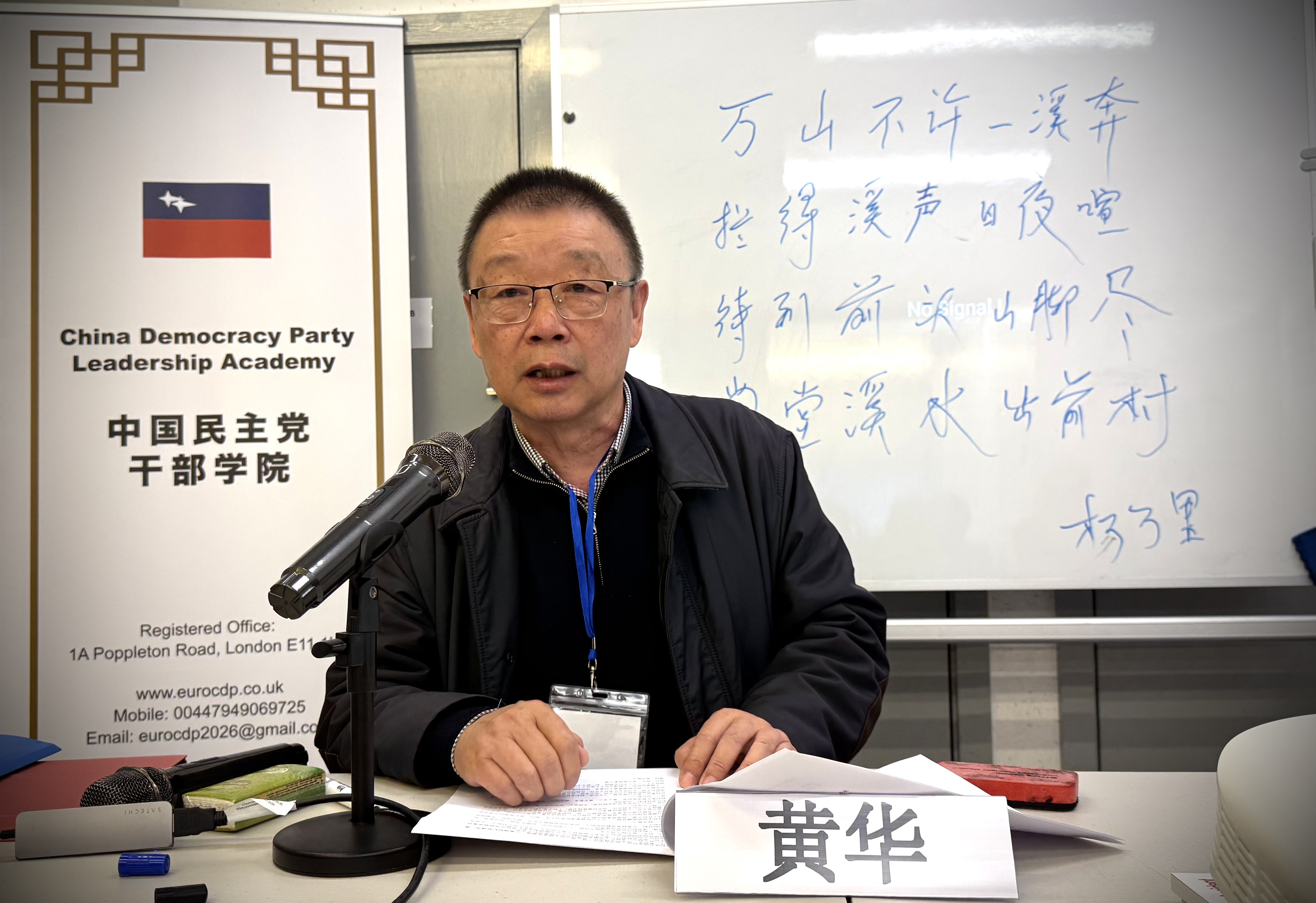
黄华
2026年11月2日
各位同仁、各位学员:
大家好!
今天,中国民主党干部学院举办第一期干部培训班,我感到十分高兴。五年前,也就是2021年11月24日,我和主席王冠儒先生正式成立中国民主党英国总部。那个时候,我曾经不止一次地对大家说:我有一个梦。我希望有一天,我们能够在英国海边租几个大篷车,举办自己的干部培训班。大家吃住在一起,白天上课、讨论,晚上到海边烧篝火、聊天,在共同生活中彼此了解、建立信任。
今年5月10日,在中国民主党北京党部主席王蕴溥先生和欧洲朋友的支持与帮助下,我们又成立了中国民主党欧洲总部。
今天,中国民主党干部学院成立了,第一期培训班也正式开始。
这个梦,我们走了五年。时间不算短,但我们一直在往前走。
干部,是一个政党的骨干,也是事业发展的中坚力量。培养什么样的干部,在很大程度上决定着一个政党的未来。
过去,中共提出过干部队伍“革命化、年轻化、知识化、专业化”的标准。但今天的中国,已经进入高度城市化、信息化、全球化的时代。互联网时代已经到来,人工智能时代也已经到来。
因此,中国未来的政治变化,不可能简单复制过去的模式。
中国民主党追求的是宪政、民主、法治和人民权利。我们的目标,不应该只是“掌握权力”,而应该是通过和平、理性、非暴力的方式推动政治进步,通过公开、公平的选举获得人民授权,并对选民负责。
中国的未来,应当由中国人民决定。
今天的中国民主党不是执政党。我们没有国家财政,没有行政资源,没有庞大的组织体系。成员分布在世界各地,社会环境不同,资源条件不同。因此,我们不能照搬任何现成模式。我们必须探索一条适合海外民主运动现实的干部培养道路。而干部培养首先要回答一个问题:我们到底需要什么样的人?
我认为,今天再以“革命化”作为干部培养的核心标准,已经过时。新时代的干部培养,应当逐步去意识形态化。
我们应该提出一个新的标准:责任化。
什么叫责任化?就是对组织负责,对社会负责,最终对人民负责。
我希望未来海外中国民主党干部能够做到:以德立身,以能任事;扎根本地,放眼祖国。品德应该放在第一位。
一个能力不足的人,也许只是少做一些事情;但一个没有诚信、没有责任感、没有纪律意识的人,却可能给整个组织带来更大的伤害。认同党的纲领,遵守党的纪律,承担党员责任,保守组织秘密,这是基本要求。
我要特别强调:
激烈的政治口号,不能代替一个党员应具备的基本资格。一个人喊多少口号,并不能说明他是否有责任意识、组织能力和合作精神。因此,未来干部学院应当逐步建立明确的干部和学员标准,包括品行、社会信誉、责任意识、合作精神、学习能力和长期服务组织的意愿。
对于海外干部培养,我想概括为四句话:
生存第一,发展第二;
基层起步,由下而上;
重在贡献,不图虚名;
重在实践,不尚空谈。
在这个基础上,我把新时代中国民主党海外干部需要具备的素质,概括为:
五种能力,一种品格,一种力量。
五种能力是:
自立能力、综合能力、协作能力、坚守能力、感召能力。
一种品格,是公共品格。
一种力量,是组织凝聚力。
如果用最简单的话来概括:
自立,使我们能够生存;
综合,使我们能够担当;
协作,使我们能够共事;
坚守,使我们能够走远;
感召,使我们能够团结更多的人;
公共品格,决定我们是否值得信任;
组织凝聚力,决定我们最终能够形成多大的力量。
第一,自立能力。
我们没有国家财政,也没有固定工资。每一位干部首先都是一个普通的社会成员,要工作,要养家,要承担家庭责任,也要适应所在国家的社会生活。
所以,自立能力,是海外干部最基础的能力。一个优秀的干部,首先应该能够依靠自己生活,承担家庭责任,遵守所在国法律,并在当地社会真正扎下根。
只有经济上的相对独立,才更有可能保持人格上的独立;只有人格上的独立,才更有可能保持政治判断上的独立。
所以:自立,是干部立身之本。
未来,干部学院可以逐步开设数字技能、人工智能应用、新媒体传播、项目管理、时间管理、语言和公共表达等课程。
我们的目标,不是培养依赖组织的人,而是培养能够独立生存、独立成长、长期服务社会的人。
第二,综合能力。
海外民主运动资源有限,一个人往往需要承担多项工作。所以,我们需要的不是只会一种工作的干部,而是具备综合能力的人。
我们需要这样的干部:既能思考,也能行动;既能写文章,也能组织会议;既能面对媒体,也能处理日常事务;既能独当一面,也能承担团队责任。
干部不是头衔。干部意味着责任。一个成熟的干部,可以站在台上讲话,也可以在台下搬椅子;可以主持会议,也可以做会议记录。干部不是“听”出来的,而是在实践中“做”出来的。
因此,培训应该更多采用实际任务:主持会议、组织活动、撰写新闻稿、接受采访、制作宣传材料、协调团队。
我们真正要培养的是:善于学习、善于思考、善于表达,更善于行动的人。
第三,协作能力。
任何事业,都不可能依靠一个人完成。我们来自不同国家,成长背景不同,职业经历不同,性格和思维方式也不同。民主本身,也不是要求所有人完全一致。所以,一个成熟的干部,必须学会在差异中合作,在共同目标下共事。
协作能力,就是能够尊重不同意见,按照制度办事,接受监督,也能够监督别人。
一个健康的组织,不能建立在个人崇拜之上,而应该建立在制度、规则和长期积累的信任之上。一个人可以走得快,但一群人才能走得远。
所以:协作,是干部成事之道。
第四,坚守能力。
民主运动是一项长期事业。它不会因为一次会议、一篇文章、一次活动,就发生根本改变。很多同志坚持多年,没有工资,没有职位,没有掌声,也未必能够马上看到结果。为什么还能坚持?因为心中有价值,有信念,有责任。但是,我所说的坚守,不是盲目坚持。
真正的坚守,是在困难面前不轻言放弃,在挫折面前保持理性,在失败以后仍然能够重新出发。一个成熟的干部,不仅要能够面对成功,也要能够承受失败;不仅能够接受掌声,也能够忍受孤独。
所以:坚守,是干部走远之力。
第五,感召能力。
一个涣散的政党,是没有战斗力的。团队精神从哪里来?很重要的一点,就是感召力。
一个干部,如果能够让别人愿意和他一起工作,愿意在困难的时候信任他,愿意在发生分歧以后继续合作,甚至能够让身边的人变得更好,那么他就具备了感召力。感召力很难通过课堂直接培养,但可以在实践中观察和训练。
比如小组合作、轮流担任负责人、公开演讲、冲突模拟、共同解决问题、同伴评价。
我认为,干部学院未来应该少考试,甚至不把考试作为主要方式,而以完成项目作为主要考核方式。
评价一个学员,不只看他记住了多少理论,更要看他承担了多少责任,完成了多少工作,推动了多少合作,解决了多少实际问题。
除了这五种能力,我还要强调一种品格:
公共品格。
公共品格包括诚实、守信、责任、宽容、自律、纪律意识、尊重事实、尊重规则,以及对公共利益的担当。
一个干部可以有个性,可以有不同意见,但不能没有底线。
一个组织能够长期存在,靠的不是一时激情,而是信任。
而信任来自长期行为:说话算数,出了问题敢于承担,权力能够被监督,规则能够被遵守,制度能够被执行。
当大多数干部都具备这样的公共品格时,一个组织才可能形成真正的凝聚力。
组织凝聚力,也不是靠口号形成的。它来自共同目标、公平制度、长期合作和彼此信任。
各位同仁、各位学员:
我们来自不同国家、不同行业。
有人是教师,有人是律师,有人是企业家、工程师、学者、媒体人,也有人只是普通劳动者。我们的职业不同,经历不同,年龄不同,学历不同。但是,我们可以拥有一个共同点:对公共事务的责任感。
中国古人说:天下兴亡,匹夫有责。今天,这句话仍然有意义。
无论我们生活在哪里,从事什么职业,只要关心国家前途和人民福祉,并愿意通过和平、理性、非暴力和建设性的方式推动社会进步,我们就可以承担属于自己的责任。
因此,中国民主党干部学院要培养的,不应该是空谈理论的人,不应该是充满仇恨和情绪的人,也不应该是脱离现实社会的人。
我们要培养的是:
有公共精神、
有专业能力、
有国际视野、
有责任担当、
有社会生存能力的新时代干部。
民主事业,需要理想,更需要能力;需要激情,更需要坚持;需要个人奋斗,更需要团队合作。从这个意义上说,干部培养,也是一种“军民两用”的能力建设。
如果有一天,中国需要我们,我们希望能够迅速集合起来,形成一支有信仰、有纪律、有能力、有组织经验的人才队伍,参与国家未来的民主建设。但如果我们这一代人等不到那一天,我们也应该有能力、有尊严地生活在海外,并且对接纳和保护我们的国家和社会作出贡献。
这同样是一种责任。
讲到这里,我想进一步谈一个制度问题。
因为干部问题,最终还是要回到制度问题。政党是由人组成的,而人无完人。
任何人都会犯错误,任何政党也都可能犯错误。
所以,一个成熟的政治制度,不能建立在“永远出现正确领导人”的假设之上。
一个真正可靠的制度,至少必须回答两个问题:
第一,如果领导人判断错了,怎么办?
第二,如果领导人离开了,怎么办?
强人政治也许能够迅速解决“谁说了算”的问题,但它也可能带来另外两个更大的问题:如果这个人判断错了,谁来纠正?如果这个人离开了,权力怎样交接?因此,判断一个政治制度是否稳定,不能只看领导人的权力有多大。更要看:政策纠错机制是否有效?最高权力交接是否制度化、可预测?
历史告诉我们,表面上的强大和稳定,并不意味着制度内部不存在风险。所以,我认为,观察今天中国未来的政治走向,也不能只看最高领导人拥有多少权力。同样重要的是:政策错误能否被及时纠正?权力能否和平、有序地交接?如果这两个机制不断削弱,就可能出现一个悖论:最高领导人的权力越来越强,但整个制度对个人的依赖也越来越强。这不是任何现代国家应当追求的长期状态。
因此,我也愿意公开向中国共产党提出一个问题:面对未来可能出现的制度风险、权力交接风险和社会矛盾,是否已经做好制度性的准备?
今天的中国,已经不是上世纪八十年代的中国。经济、社会、教育、科技以及人民的权利意识,都发生了巨大变化。因此,政治制度的设计,也不应该只从维护一个政党权力的角度出发。更应该从中华民族长期繁荣、社会稳定和子孙后代福祉的高度重新思考。真正负责任的政治力量,不应该只考虑怎样维持今天的权力。
更应该思考:怎样让政策错误能够被纠正;怎样让权力能够和平交接;怎样让社会冲突通过制度解决。这才是现代国家长治久安的真正基础。
我也呼吁中国共产党迈出实质性的一步:
释放因和平政治活动、组织活动和表达政治主张而受到处罚的中国民主党成员和其他政治异议人士。开放正常、和平、合法的政治参与空间。让不同政治意见能够通过制度、法律和公共讨论表达。
一个真正自信的国家,应当能够容纳不同声音。一个成熟的政治体系,也应当能够允许不同政治力量在宪法和法律框架下和平竞争。
各位同仁、各位学员:
中国民主党干部学院今天刚刚起步。
我们没有很多资金,没有庞大的校园,也没有成熟完备的制度。但是,这并不可怕。任何成熟的组织,都是从小事开始的。从培养一个干部开始。从完成一个项目开始。从建立一次真正的合作开始。从形成一条规则开始。从积累一份信任开始。组织,就是这样一步一步建立起来的。
我相信,只要我们坚持正确的方向,坚持学习,坚持实践,坚持自我完善,中国民主党就能够逐渐培养出一批有理想、有能力、有担当、有品格的新时代干部。
我也希望,中国民主党干部学院能够真正成为:
培养干部的平台,
发现人才的平台,
凝聚人才的平台,
训练能力的平台,
传承民主理念的平台。
最后,我再用几句话概括也是重复今天的核心:
以德立身,以能任事;扎根本地,放眼祖国。
自立,使我们能够生存;综合,使我们能够担当;协作,使我们能够共事;坚守,使我们能够走远;感召,使我们能够团结更多的人。公共品格,决定我们是否值得信任;组织凝聚力,决定我们最终能够形成多大的力量。
而这一切,最终都回到两个字:责任。
对组织负责,对社会负责,对国家负责,对人民负责。
让我们从今天开始,从自己开始,从一件一件具体的事情开始。一起学习,一起实践,一起建设,一起成长。为推动中国走向自由、民主、法治,为中华民族的长远发展,贡献我们的智慧和力量。
谢谢大家!
On Training the Cadres Needed by the Overseas China Democracy Movement
Five Essential Capabilities for Cadres in the New Era and Our Mission
Huang Hua
2 November 2026
Dear colleagues and fellow trainees,
Good morning, everyone!
I am delighted that the China Democracy Party Cadre Academy is holding its first cadre training programme today.
Five years ago, on 24 November 2021, Chairman Wang Guanru and I formally established the China Democracy Party UK Headquarters.
At that time, I told everyone on more than one occasion: I have a dream.
I hoped that one day we could rent a few caravans by the seaside in Britain and organise our own cadre training programme. We would live and eat together, attend classes and hold discussions during the day, and gather around a campfire by the sea in the evenings to talk. Through living together, we would come to understand one another and build mutual trust.
On 10 May this year, with the support and assistance of Mr Wang Yunpu, Chairman of the China Democracy Party Beijing Branch, and our friends in Europe, we established the China Democracy Party European Headquarters.
Today, the China Democracy Party Cadre Academy has been established, and its first training programme has officially begun.
It has taken us five years to realise this dream. That is not a short time, but we have continued moving forward.
Cadres are the backbone of a political party and the core force driving the development of its cause. The kind of cadres we train will, to a considerable extent, determine the future of our party.
In the past, the Chinese Communist Party proposed four standards for its cadre system: “revolutionary orientation, youthfulness, knowledge and professionalism”.
But China today has entered an era characterised by extensive urbanisation, information technology and globalisation. The internet age has arrived, and so has the age of artificial intelligence.
Therefore, China’s future political transformation cannot simply replicate the models of the past.
The China Democracy Party pursues constitutional government, democracy, the rule of law and the rights of the people.
Our objective should not merely be to “gain power”. Rather, we should promote political progress through peaceful, rational and non-violent means, obtain the people’s mandate through open and fair elections, and remain accountable to voters.
China’s future should be decided by the Chinese people.
Today, the China Democracy Party is not a governing party.
We have no state funding, no administrative resources and no vast organisational structure. Our members are scattered across the world, living in different social environments and facing different circumstances and resource constraints.
We therefore cannot simply copy any existing model.
We must explore a path for training cadres that reflects the realities of the overseas democracy movement.
And cadre training must first answer one fundamental question:
What kind of people do we actually need?
I believe that using “revolutionary orientation” as the central standard for cadre training is now outdated.
Cadre training in the new era should gradually move away from ideological criteria.
Instead, we should establish a new standard: responsibility.
What does responsibility mean?
It means being responsible to the organisation, responsible to society and, ultimately, responsible to the people.
I hope that future overseas China Democracy Party cadres will be able to:
Establish themselves through moral integrity and fulfil their duties through competence; put down roots in their local communities while keeping their homeland in view.
Moral character must come first.
A person who lacks ability may simply accomplish less. But someone who lacks honesty, responsibility and a sense of discipline may cause far greater harm to the entire organisation.
Supporting the Party’s programme, observing Party discipline, fulfilling the responsibilities of membership and safeguarding organisational confidentiality are basic requirements.
I want to emphasise one point in particular:
Radical political slogans cannot substitute for the fundamental qualifications required of a Party member.
The number of slogans someone shouts tells us nothing about whether that person has a sense of responsibility, organisational ability or a spirit of cooperation.
Therefore, the Cadre Academy should gradually establish clear standards for cadres and trainees, covering moral conduct, social reputation, personal responsibility, cooperation, learning ability and a willingness to serve the organisation over the long term.
For the training of overseas cadres, I would summarise our approach in four principles:
Survival first, development second;
Start at the grassroots and build from the bottom up;
Value contribution over empty titles;
Prioritise practice over empty rhetoric.
On this basis, I would summarise the qualities required of overseas China Democracy Party cadres in the new era as:
Five capabilities, one virtue and one source of strength.
The five capabilities are:
- Self-reliance
- All-round competence
- Collaboration
- Perseverance
- The ability to inspire others
The one virtue is civic virtue.
The one source of strength is organisational cohesion.
To put it as simply as possible:
Self-reliance enables us to survive.
All-round competence enables us to shoulder responsibilities.
Collaboration enables us to work together.
Perseverance enables us to go the distance.
The ability to inspire others enables us to unite more people.
Civic virtue determines whether we deserve the trust of others.
Organisational cohesion determines how much collective strength we can ultimately build.
First: Self-Reliance
We have no state funding and no fixed salaries.
Every cadre is, first and foremost, an ordinary member of society. We must work, support our families, fulfil our family responsibilities and adapt to life in the countries where we live.
Therefore, self-reliance is the most fundamental capability required of overseas cadres.
An outstanding cadre should first be able to support themselves, fulfil family responsibilities, obey the laws of their country of residence and establish genuine roots in the local community.
Only with a reasonable degree of economic independence can a person be more likely to maintain personal independence.
And only with personal independence can one be more likely to maintain independence of political judgement.
Therefore:
Self-reliance is the foundation upon which a cadre establishes themselves.
In the future, the Cadre Academy could gradually introduce courses in digital skills, artificial intelligence applications, new media communications, project management, time management, languages and public speaking.
Our goal is not to train people who depend on the organisation.
Instead, we aim to cultivate individuals who can survive independently, develop independently and serve society over the long term.
Second: All-Round Competence
The overseas democracy movement has limited resources, and one person often needs to undertake several different responsibilities.
Therefore, we do not need cadres who can perform only one type of work.
We need people with a broad range of capabilities.
We need cadres who can think as well as act; who can write articles as well as organise meetings; who can deal with the media as well as manage everyday administrative affairs; and who can work independently while also fulfilling their responsibilities within a team.
Being a cadre is not about holding a title.
Being a cadre means accepting responsibility.
A mature cadre can deliver a speech on stage and also move chairs behind the scenes.
They can chair a meeting and also take the minutes.
Cadres are not developed merely by listening to lectures. They are developed by doing things in practice.
Therefore, training should place greater emphasis on practical assignments, including chairing meetings, organising activities, drafting press releases, giving interviews, producing publicity materials and coordinating teams.
What we truly want to cultivate are people who are good at learning, thinking and expressing themselves, and who are even better at taking action.
Third: Collaboration
No cause can be accomplished by one person alone.
We come from different countries and have different backgrounds, professional experiences, personalities and ways of thinking.
Democracy itself does not require everyone to agree on everything.
Therefore, a mature cadre must learn to cooperate despite differences and work with others towards common goals.
The ability to collaborate means respecting different opinions, following established procedures, accepting supervision and being capable of supervising others.
A healthy organisation cannot be built upon the worship of individuals.
It should be built upon institutions, rules and trust accumulated over time.
One person may travel quickly, but a group of people can travel much further.
Therefore:
Collaboration is the means through which cadres achieve their objectives.
Fourth: Perseverance
The democracy movement is a long-term undertaking.
Fundamental change will not occur simply because of one meeting, one article or one event.
Many colleagues have persevered for years without salaries, positions or applause, and without necessarily seeing immediate results.
Why do they continue?
Because they hold values, convictions and responsibilities in their hearts.
But the perseverance I speak of is not blind persistence.
True perseverance means refusing to give up easily in the face of difficulties, remaining rational in the face of setbacks, and finding the strength to start again after failure.
A mature cadre must be capable not only of dealing with success, but also of enduring failure.
They must be able not only to accept applause, but also to tolerate loneliness.
Therefore:
Perseverance is the strength that enables cadres to go the distance.
Fifth: The Ability to Inspire Others
A fragmented political party cannot be an effective force.
Where does team spirit come from?
One important source is the ability to inspire others.
If a cadre can make others willing to work alongside them, willing to trust them in difficult circumstances, and willing to continue cooperating even after disagreements, and if they can even help those around them become better people, then that cadre possesses the ability to inspire.
This quality is difficult to cultivate directly through classroom teaching, but it can be observed and developed through practical experience.
Examples include group projects, taking turns as team leaders, public speaking, simulated conflict resolution, collaborative problem-solving and peer assessment.
I believe that the Cadre Academy should conduct fewer examinations in the future, perhaps even moving away from examinations as the main method of assessment.
Instead, project completion should become the principal means of evaluation.
When assessing a trainee, we should not look only at how much theory they have memorised.
More importantly, we should examine how much responsibility they have undertaken, how much work they have completed, how much cooperation they have encouraged and how many practical problems they have solved.
Beyond the Five Capabilities: Civic Virtue
In addition to these five capabilities, I would like to emphasise one essential virtue:
Civic virtue.
Civic virtue includes honesty, trustworthiness, responsibility, tolerance, self-discipline, a sense of discipline, respect for facts, respect for rules and a commitment to the public interest.
A cadre may have a distinctive personality and different opinions, but they cannot be without fundamental principles.
The long-term survival of an organisation depends not on temporary enthusiasm, but on trust.
And trust comes from consistent behaviour over time:
Keeping one’s word.
Having the courage to take responsibility when problems arise.
Ensuring that power is subject to scrutiny.
Respecting rules.
And implementing established procedures.
When most cadres possess these qualities of civic virtue, an organisation can begin to develop genuine cohesion.
Organisational cohesion cannot be created through slogans alone.
It comes from shared objectives, fair institutions, long-term cooperation and mutual trust.
Dear colleagues and fellow trainees,
We come from different countries and different professions.
Some of us are teachers, lawyers, entrepreneurs, engineers, academics or media professionals.
Others are ordinary workers.
Our professions, experiences, ages and educational backgrounds differ.
But we can all share one thing:
A sense of responsibility towards public affairs.
There is an ancient Chinese saying:
“The rise and fall of the nation is the responsibility of every ordinary person.”
This saying remains meaningful today.
Regardless of where we live or what profession we pursue, as long as we care about the future of our country and the wellbeing of its people, and are willing to promote social progress through peaceful, rational, non-violent and constructive means, we can all fulfil our responsibilities.
Therefore, the China Democracy Party Cadre Academy should not seek to train people who merely talk about theory.
It should not cultivate people consumed by hatred and emotion.
Nor should it produce people who are disconnected from the realities of society.
We should cultivate a new generation of cadres who possess:
- A strong sense of public responsibility
- Professional competence
- An international perspective
- The courage to take responsibility
- The ability to support themselves and function effectively in society
The cause of democracy requires ideals, but it also requires ability.
It requires passion, but even more importantly, perseverance.
It requires individual effort, but even more importantly, teamwork.
In this sense, cadre training is also a form of dual-use capacity building, with both civilian and political applications.
If one day China needs us, we hope to be able to assemble quickly and form a team of capable people with convictions, discipline, professional skills and organisational experience, ready to participate in the country’s future democratic development.
But if our generation does not live to see that day, we should still be able to live overseas with competence and dignity, while contributing to the countries and societies that have welcomed and protected us.
This, too, is a responsibility.
From Cadre Development to Institutional Development
At this point, I would like to discuss a further institutional question.
Because the question of cadres ultimately brings us back to the question of institutions.
Political parties are made up of human beings, and no human being is perfect.
Anyone can make mistakes, and any political party can make mistakes.
Therefore, a mature political system cannot be built upon the assumption that the correct leader will always emerge.
A genuinely reliable system must answer at least two questions:
First, what happens if a leader makes the wrong judgement?
Second, what happens when a leader leaves office?
Strongman politics may quickly resolve the question of who has the final say.
But it can also create two even greater problems:
If that person makes the wrong decision, who will correct it?
And if that person leaves office, how will power be transferred?
Therefore, when judging the stability of a political system, we should not look only at how much power its leader possesses.
More importantly, we should examine:
Are the mechanisms for correcting policy mistakes effective?
Is the transfer of supreme political power institutionalised and predictable?
History tells us that apparent strength and stability do not necessarily mean that a political system is free from internal risks.
Therefore, I believe that when considering China’s future political direction, we should not focus solely on how much power the country’s supreme leader holds.
Equally important questions are:
Can policy mistakes be corrected in a timely manner?
Can political power be transferred peacefully and in an orderly fashion?
If these two mechanisms continue to weaken, a paradox may emerge:
The power of the supreme leader becomes increasingly concentrated, while the entire political system becomes increasingly dependent upon that individual.
This is not a sustainable condition that any modern state should aspire to.
Therefore, I would also like to put a question openly to the Chinese Communist Party:
Has it made adequate institutional preparations to address the potential risks associated with the political system, leadership succession and social tensions in the future?
China today is no longer the China of the 1980s.
Its economy, society, education, technology and public awareness of rights have all undergone enormous changes.
Therefore, the design of political institutions should not be approached solely from the perspective of preserving the power of a single political party.
Instead, it should be reconsidered from the broader perspective of the long-term prosperity of the Chinese nation, social stability and the wellbeing of future generations.
A genuinely responsible political force should not concern itself only with how to preserve its current power.
It should also consider:
How can policy mistakes be corrected?
How can power be transferred peacefully?
How can social conflicts be resolved through institutions?
These are the true foundations of long-term stability and good governance in a modern state.
I therefore call upon the Chinese Communist Party to take a substantive step forward:
Release members of the China Democracy Party and other political dissidents who have been punished for peaceful political activities, organisational activities and the expression of political views.
Open up normal, peaceful and lawful channels for political participation.
Allow different political opinions to be expressed through institutions, the law and public discussion.
A truly confident country should be able to accommodate different voices.
A mature political system should also allow different political forces to compete peacefully within the framework of the constitution and the law.
Building the Future, One Step at a Time
Dear colleagues and fellow trainees,
The China Democracy Party Cadre Academy is only just beginning its journey.
We do not have substantial funding, a large campus or a fully developed institutional structure.
But this should not frighten us.
Every mature organisation begins with small steps.
It begins by training one cadre.
By completing one project.
By establishing one genuine partnership.
By introducing one rule.
By building one foundation of trust.
This is how an organisation is built, step by step.
I believe that as long as we remain committed to the right direction, continue learning, continue practising and continue improving ourselves, the China Democracy Party will gradually develop a new generation of cadres who possess ideals, abilities, responsibility and moral integrity.
I also hope that the China Democracy Party Cadre Academy will truly become:
A platform for training cadres.
A platform for discovering talent.
A platform for bringing talented people together.
A platform for developing practical capabilities.
And a platform for passing on democratic ideals.
Finally, I would like to summarise and repeat the central message of today’s speech:
Establish ourselves through moral integrity and fulfil our duties through competence; put down roots in our local communities while keeping our homeland in view.
Self-reliance enables us to survive.
All-round competence enables us to shoulder responsibilities.
Collaboration enables us to work together.
Perseverance enables us to go the distance.
The ability to inspire others enables us to unite more people.
Civic virtue determines whether we deserve the trust of others.
Organisational cohesion determines how much collective strength we can ultimately build.
And all of this ultimately comes down to one word:
Responsibility.
Responsibility to the organisation.
Responsibility to society.
Responsibility to the country.
Responsibility to the people.
Let us begin today.
Let us begin with ourselves.
Let us begin with one practical task at a time.
Let us learn together, practise together, build together and grow together.
Let us contribute our wisdom and strength towards advancing China along the path of freedom, democracy and the rule of law, and towards the long-term development of the Chinese nation.
Thank you, everyone!
